
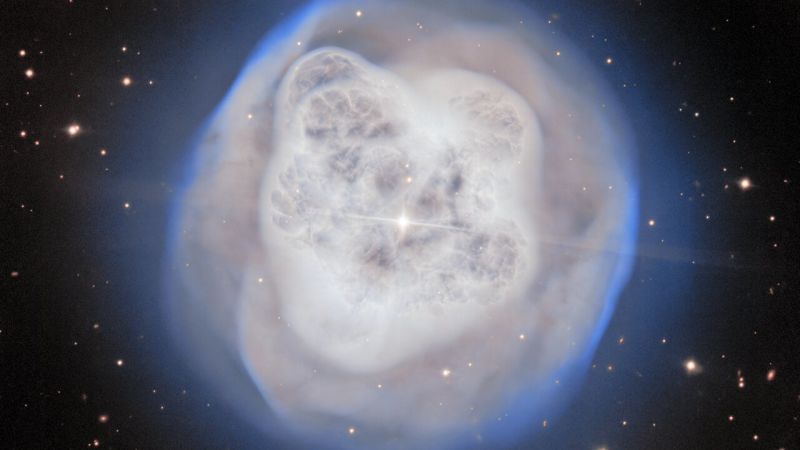
Stunning New Image of the Crystal Ball Nebula Reveals a Star’s Final Moments
Qwenews.com – A groundbreaking new image of the Crystal Ball Nebula has captured the breathtaking final stages of a star’s life, offering a rare glimpse into the cosmic drama of stellar death. This mesmerizing view, taken by the Gemini Multi-Object Spectrograph, showcases the intricate dance of a binary star system as it undergoes dramatic transformation. The instrument, mounted on the Gemini North telescope, provides an unprecedented level of detail, with its location atop Maunakea in Hawaii allowing for clear observations of the nebula’s complex structure.
The Science Behind the Spectacular
According to Travis Rector, an astronomer from the NOIRLab team, the nebula was not the primary scientific target but its striking appearance made it a compelling subject. “The nebula wasn’t our primary science goal, but its captivating appearance made it a compelling subject,” Rector explained. NOIRLab, part of the National Science Foundation’s National Optical-Infrared Astronomy Research Laboratory, used advanced imaging techniques to reveal the vibrant interplay between stars and their ejected material. The image serves as a testament to the beauty and complexity of astrophysical processes, even when they are not the main focus of a study.
“It’s a way to share with people just how amazing our universe is,” Rector added. “The nebula was not a science target, it was one that was chosen just because it looks really cool.”
Unveiling the Nebula’s Cosmic Story
Located approximately 1,500 light-years from Earth in the Taurus constellation, the Crystal Ball Nebula’s vivid colors are a result of spectrograph filters that isolate specific wavelengths of light. Red hues represent hot hydrogen, while blue tones highlight ionized oxygen—a common gas in such celestial formations. The light we see today has traveled 1,500 years to reach us, capturing a moment from the distant past. This perspective underscores the vast timescales involved in stellar evolution, as the nebula’s formation is a process that unfolds over millennia.
Though the nebula’s name evokes a crystalline structure, it is not a planet but a remnant of a star’s life cycle. The process begins when a star nears the end of its life and sheds its outer layers, creating a luminous shell of gas and dust around its core. This core, a dense white dwarf, continues to shape the nebula as it interacts with the surrounding material. The intricate patterns observed in the image are a result of this dynamic relationship, with the binary star system playing a crucial role in the nebula’s formation and evolution.
William Herschel, the German-British astronomer who coined the term “planetary nebula,” first documented this object in 1790. His observations, though limited by the technology of his time, laid the foundation for modern understanding of such phenomena. Despite its name, the Crystal Ball Nebula is a testament to the fleeting beauty of stellar life, as these structures typically persist for only around 10,000 years. The new image, therefore, not only highlights the star’s death but also preserves a snapshot of its brief, luminous existence.
The nebula’s unusual shape is influenced by the orbital dynamics of its binary stars, which complete an orbit around each other every nine years. This slow rotational pace contributes to the cloud-like patterns seen in the image, as the stars’ gravitational interactions stir the expanding gas shell. Rector likened the process to the spinning of cotton candy, creating a fluffy, intricate structure. Such phenomena are rare in the cosmos, making the Crystal Ball Nebula a valuable subject for study.
“These objects are really spectacularly beautiful,” Rector remarked. “They often have these very complex yet symmetric structures.”
While the image captures a single moment, it also invites deeper exploration into the broader context of stellar evolution. Jan Cami, a professor at Western University in London, Ontario, emphasized the importance of studying these objects across different wavelengths. “If you look at the same object with the James Webb Space Telescope, it feels like a different entity altogether,” he said. This multi-wavelength approach allows scientists to uncover hidden details and gain a more comprehensive understanding of the nebula’s composition and behavior.
The new image of the Crystal Ball Nebula, therefore, represents more than just a visual achievement—it is a scientific milestone that bridges historical observations with modern technology. As telescopes continue to evolve, researchers can now detect subtle changes in the central star’s temperature and observe how it influences the surrounding environment. These celestial displays, though brief in their lifespan, offer profound insights into the life cycles of stars and the forces that shape the universe. The Crystal Ball Nebula stands as a reminder of the universe’s capacity to inspire awe while advancing our knowledge of cosmic processes.