
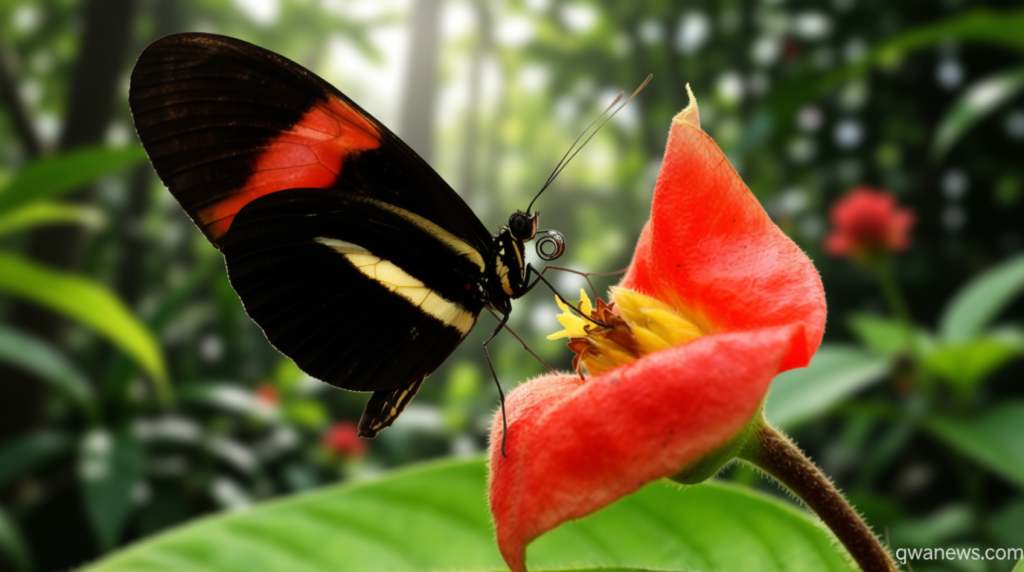
Unusual Strategy Lets Tropical Butterflies Live 25 Times Longer
Qwenews.com – Researchers have long questioned why most butterflies live only a few weeks before dying, but a groundbreaking study reveals a unique survival strategy in certain tropical species. These butterflies, specifically some members of the Heliconius genus, can extend their adult lives to nearly 25 times that of their shorter-lived relatives. The discovery, published in Nature Communications, challenges existing assumptions about aging in insects and offers new insights into longevity across species. By examining ecological and genetic factors, scientists uncovered how this adaptation allows certain butterflies to thrive for over a year, while others survive just 14 days.
Evolutionary Clues in Diet and Survival
The study suggests that a dietary shift may be the key to this remarkable longevity. Unlike the majority of butterfly species that depend solely on nectar from flowers, some Heliconius butterflies incorporate pollen into their adult diets. This change in feeding behavior provides them with additional nutrients, including lipids and amino acids, which are critical for metabolic efficiency. Dr. Jessica Foley, lead author of the research and postdoctoral scholar at Tufts University, explains that this dietary difference could be the driving force behind their extended lifespans.
“Understanding how lifespan differences arise in nature is essential for unraveling the biology of aging,” Foley said. “While some insects live for mere days, others, like these Heliconius, can persist for years. This variation invites us to explore the evolutionary strategies that enable such disparities.”
The research team analyzed data from butterfly farms, field observations, and lab experiments across 28 Heliconius species. Their findings showed that only six species lack pollen consumption, with lifespans ranging from 14 to 98 days. The remaining 22 species, which include pollen-feeding varieties, exhibit lifespans up to 348 days. Even when pollen was excluded from their diets, the long-lived species still outlasted their non-pollen-feeding counterparts, indicating that their longevity is not solely dependent on nutritional intake.
The Pullinator Tool: A New Method for Aging Research
To better understand the aging process, the researchers developed an innovative tool called “The Pullinator.” This device measures grip strength by attaching a perch with textured surfaces to a light source, allowing scientists to assess how physical abilities decline over time. By using this method, the team could observe the subtle changes in muscle function and metabolic rate that occur as these butterflies age, providing concrete data on their prolonged vitality. The tool is designed to be non-invasive and adaptable, making it a valuable resource for studying aging in other insect species.
The study’s findings highlight the potential of Heliconius butterflies as a model for understanding human aging. While nutrition plays a role in their longevity, the research suggests there are deeper biological mechanisms at work. These could include genetic adaptations, hormonal regulation, or even cellular processes that slow the aging rate. Dr. Foley notes that the discovery opens doors to exploring how similar strategies might be applied to human health, particularly in the context of aging-related diseases and interventions.
Further analysis of the data revealed intriguing patterns in lifespan variation among Heliconius species. For instance, certain species that consume pollen from specific plants showed greater longevity, indicating that diet quality might influence lifespan beyond mere caloric intake. The researchers also observed that the longest-lived butterflies exhibited slower rates of wing wear and more efficient energy utilization, traits that could be linked to their extended survival. These findings underscore the complexity of aging and the importance of environmental and physiological factors in determining lifespan.
Implications for Human Aging Research
The study’s implications extend beyond the insect world, offering potential insights into human aging. By comparing the biological mechanisms of Heliconius butterflies with those of humans, scientists may identify universal principles of longevity. For example, the role of protein-rich diets in delaying aging, which is already a topic of interest in human health, could be further explored through these butterflies. Additionally, the use of “The Pullinator” tool demonstrates how simple yet effective methods can measure aging in organisms, potentially leading to more precise studies in other species.
Dr. Foley emphasizes that the discovery of this unusual strategy in Heliconius butterflies could inspire new approaches to aging research. “This strategy is not just about eating pollen,” she explains. “It’s about a suite of adaptations that work together to slow the aging process. By studying these mechanisms, we may uncover ways to enhance longevity in humans through lifestyle or genetic modifications.” The research also highlights the importance of biodiversity in understanding aging, as each species offers unique perspectives on how life is prolonged in different environments.