
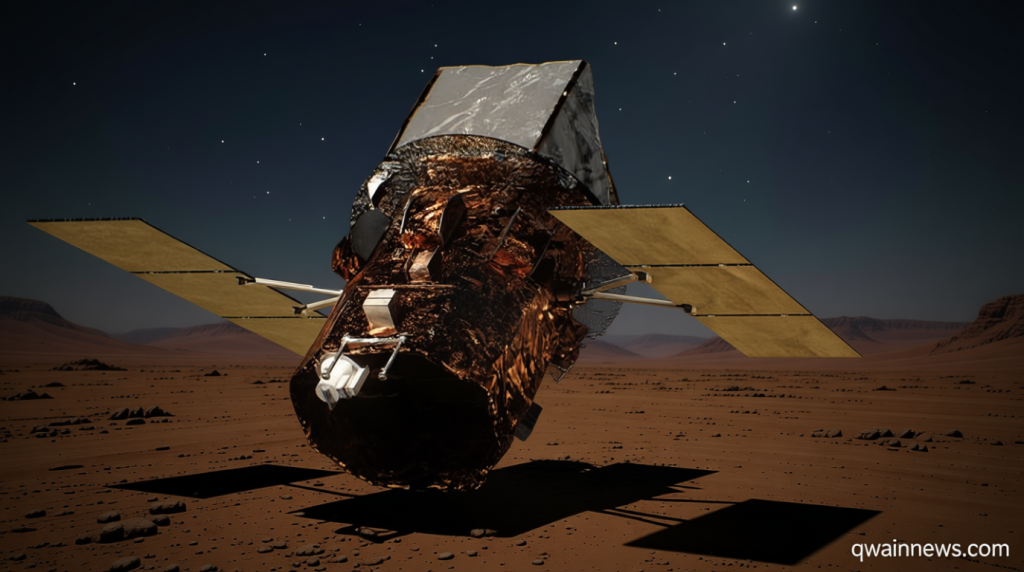
A 3,200-Pound Space Observatory’s Rescue Mission Begins
Qwenews.com – As a 3,200-pound space observatory faces the imminent threat of reentry, a groundbreaking rescue mission has been launched to preserve its scientific legacy. The Neil Gehrels Swift Observatory, which has operated in Earth’s orbit for over two decades, is now at risk of losing its mission due to escalating atmospheric drag and solar activity. NASA, in collaboration with a commercial aerospace firm, has initiated a daring effort to elevate the satellite’s trajectory and prolong its operational life. This mission represents a pivotal moment in space exploration, showcasing the growing role of private companies in sustaining orbital assets.
Swift’s Critical Decline
Over the past several years, orbital decay has threatened to bring the Swift satellite to a lower altitude, jeopardizing its ability to study cosmic events. Scientists have observed that the observatory, once capable of detecting gamma-ray bursts and mapping supernovae, could soon descend below 185 miles (300 kilometers) this month. This altitude is crucial, as it marks the threshold where atmospheric forces become too strong to maintain stable orbits. With the 11-year solar cycle reaching its peak, increased solar radiation is further accelerating the satellite’s descent, making intervention urgent.
The Swift satellite, weighing 3,200 pounds, has been instrumental in advancing our understanding of the universe. Its unique design allows it to rapidly detect and analyze high-energy phenomena, providing critical data to researchers worldwide. However, as its orbit deteriorates, the satellite’s instruments may become too damaged to function effectively. Without action, the observatory could reenter Earth’s atmosphere within weeks, leading to its loss and a significant gap in cosmic observation capabilities.
The Rescue Mission Unfolds
To counter this threat, NASA has partnered with Katalyst Space Technologies, a Phoenix-based company specializing in satellite maintenance. The rescue mission involves the deployment of the LINK satellite, a smaller but advanced spacecraft designed to reposition Swift. Launched by a Northrop Grumman Pegasus XL rocket, LINK was carried aloft from a modified L-1011 aircraft named Stargazer over the Kwajalein Atoll. Despite weather disruptions and a software glitch that delayed a prior launch, the mission successfully launched at 4:36 a.m. ET, marking a crucial step in the effort to save the observatory.
“This mission isn’t just about saving a single satellite; it’s about proving that we can extend the lifespan of orbital assets through innovative technology,” said Ghonhee Lee, CEO of Katalyst Space Technologies. “Swift’s 22-year journey has provided invaluable insights, and we’re determined to ensure its contributions continue for years to come.”
The LINK satellite, measuring just 5 feet (1.5 meters) in height and weighing 880 pounds (399 kilograms), is equipped with solar panels spanning 20 feet (6 meters) to harness energy for extended operations. Its three robotic arms are engineered to precisely grasp the Swift observatory, allowing for controlled repositioning. The mission’s success could set a precedent for future deep-space maintenance, enabling satellites to remain operational longer and reducing the need for costly replacements.
The collaboration between NASA and Katalyst Space Technologies highlights the growing synergy between government agencies and private industry in space exploration. This partnership leverages cutting-edge engineering and rapid deployment capabilities to address a challenge that has loomed over the Swift mission for years. By extending the satellite’s orbital life, the project not only safeguards a vital scientific tool but also demonstrates the feasibility of in-orbit interventions for other spacecraft. Such advancements could revolutionize how we manage space assets, ensuring they continue to serve humanity’s quest for knowledge beyond Earth’s atmosphere.