
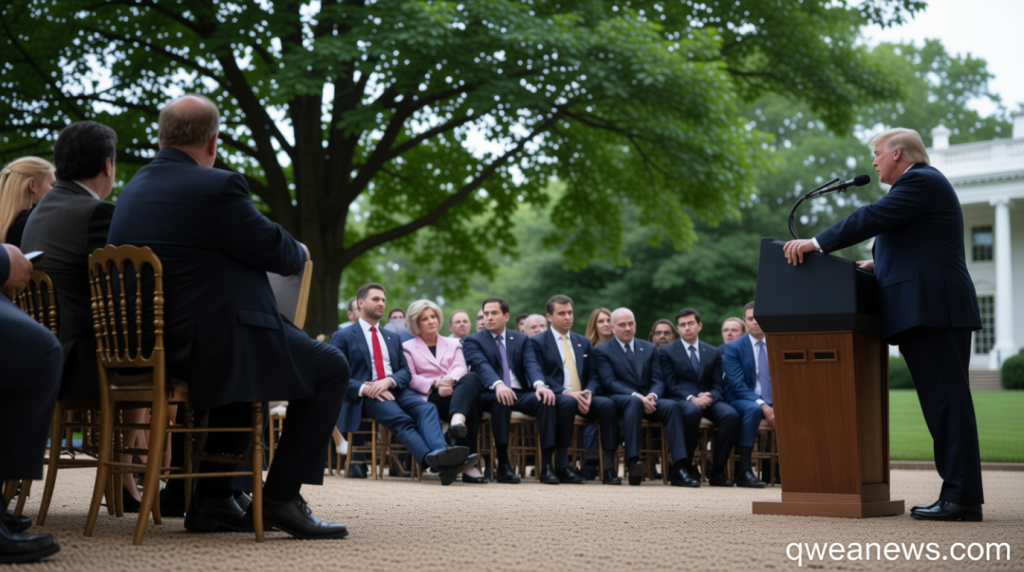
Here’s How the TV Networks Handled Trump’s Prime-Time Address
Qwenews.com – Here’s how the TV networks – On Thursday, July 16, 2026, President Donald Trump delivered a prime-time address that sparked varied responses across major broadcast networks. While CBS and Fox chose to air the event live, NBC and ABC delayed coverage, creating a stark contrast in how the networks prioritized their programming. This divergence raised questions about the media’s role in shaping public perception, with some outlets emphasizing real-time engagement and others focusing on thorough analysis to contextualize Trump’s statements.
Strategic Decisions Behind Live and Delayed Coverage
The White House had requested live broadcasts of the speech, but NBC and ABC opted to delay airing it, citing the importance of fact-checking and narrative preparation. This decision placed Trump at odds with the networks, as he criticized their approach during the address, claiming it reflected bias. “Their failure to air this speech live should mean a revocation of their licenses,” he declared, underscoring his frustration with what he perceived as media skepticism.
“Their failure to air this speech live should mean a revocation of their licenses.” — President Donald Trump
CBS and Fox, by contrast, incorporated the speech into their prime-time schedules. CBS adopted a unique strategy, embedding a “truth sandwich” format to provide balanced context. The network introduced pre-speech fact checks and followed up with post-event analysis, aiming to mitigate the risk of spreading unverified claims. Fox, known for its alignment with Trump, aired the address during Sean Hannity’s program, though some internal voices cautioned against the potential political and financial consequences.
Media Perspectives on Trump’s Narrative
Newsrooms across the networks grappled with how to present Trump’s address. NBC’s Hallie Jackson highlighted that much of the content was “largely not new,” suggesting a focus on contextualizing rather than amplifying. ABC followed a similar approach, allowing time for post-event review before broadcasting. These decisions reflected a broader strategy to ensure accuracy, particularly in light of Trump’s history of making electoral claims.
“…a little bit like trying to argue with, like, a raving crazy person standing next to you on the subway claiming they’re Jesus Christ.” — Chris Hayes
CNN and MS NOW took distinct paths, with CNN choosing to monitor the speech before presenting curated clips alongside rigorous fact-checking. MS NOW briefly aired the address before transitioning to analysis, framing Trump’s remarks as a challenge to journalistic credibility. The differing approaches underscored the tension between immediate coverage and measured scrutiny, highlighting how each network’s editorial stance influenced its presentation.
Implications for Media Trust and Political Discourse
The split in coverage revealed deeper divides in media perception of Trump’s messaging. Partisan networks like Fox treated the address as a pivotal moment, reinforcing their alignment with the president. Meanwhile, more centrist outlets such as CBS and ABC emphasized transparency, aiming to separate fact from political spin. This strategy was critical in an era where public trust in media is increasingly scrutinized, particularly following controversies related to election integrity.
“Fox News has not seen that documentation yet and is not in a position to assess the accuracy of the president’s statements tonight.” — Bret Baier
Experts noted that the networks’ choices reflected a balancing act between political loyalty and journalistic responsibility. While Trump criticized delayed coverage as biased, the networks argued that real-time broadcasts could amplify misinformation. This debate intensified as the speech became a focal point for discussions about media neutrality, accountability, and the evolving role of television in shaping political narratives.
Long-Term Impact and Viewer Reactions
The address’s handling by the networks had lasting implications for how audiences consumed political content. CBS’s hybrid approach of live and post-event analysis was praised for its transparency, while Fox’s coverage reinforced its reputation as a pro-Trump outlet. NBC and ABC’s delayed broadcasts allowed for more in-depth segments, but critics argued that they risked reducing the speech’s immediate impact.
Viewers reacted differently depending on their media consumption habits. Those tuning into live coverage often described a sense of urgency, while delayed viewers appreciated the opportunity to assess the speech’s claims. Social media amplified these reactions, with supporters and skeptics alike using the networks’ decisions to argue their positions. The event highlighted the importance of timing in political communication, as well as the networks’ influence over how messages are received and interpreted.