
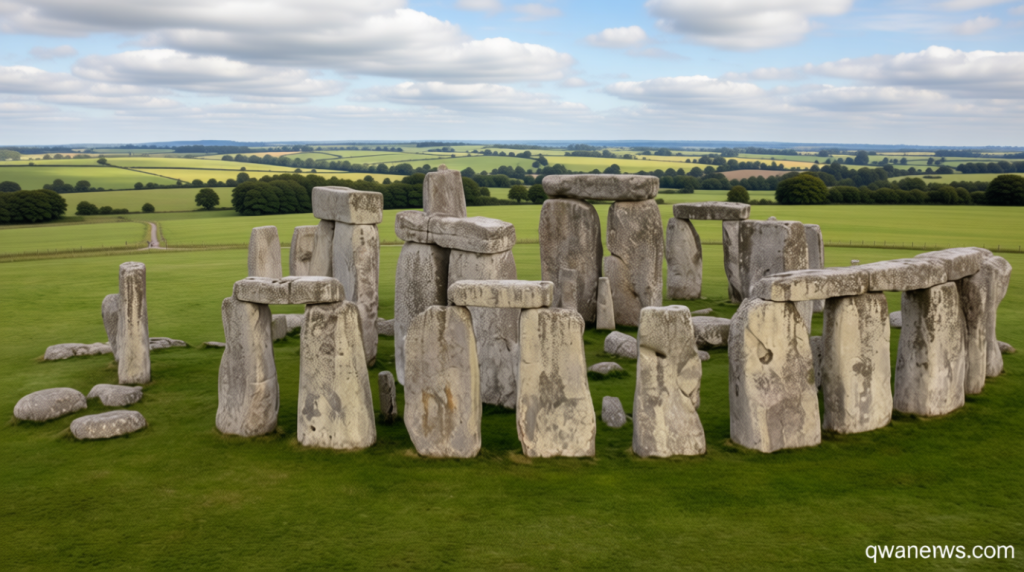
New Discovery May Have Been Stonehenge Prototype
Qwenews.com – Recent archaeological findings have unveiled a structure that could serve as a precursor to Stonehenge, offering profound insights into the prehistoric practices of early British settlers. Unearthed in the southwest of England, this 5,000-year-old site features two wooden poles positioned precisely 120 meters apart, creating a natural alignment with the sun’s path during solstices. The discovery, made by a team from Wessex Archaeology, suggests that ancient communities may have used such arrangements to mark celestial events, potentially laying the groundwork for the iconic stone monument we recognize today. This revelation, shared in a statement released on Thursday, highlights the significance of early astronomical knowledge in shaping monumental architecture.
Ancient Astronomical Practices and Their Legacy
Phil Harding, a leading archaeologist involved in the project, emphasized that the wooden poles were not merely random placements but intentional markers tied to the sun’s movement. His team used radiocarbon dating to confirm the poles were embedded in pits approximately 5,000 years ago, during the Neolithic period. This timeframe aligns with the initial construction of Stonehenge’s earthworks, which predates the monument’s famous stone structures by nearly five centuries. The alignment of these poles with the solstices underscores the importance of the sun in prehistoric societies, as Harding noted, “The sun was incredibly important to these prehistoric communities, and they could plot and record its midsummer rising to a high degree of accuracy.” The site’s proximity to Stonehenge—just 5 kilometers away—further strengthens its connection to the larger monument.
The research team also uncovered a wealth of artifacts at the site, including pottery, animal bone, charcoal, and worked flints. These items suggest that the area was not only a place for astronomical observation but also a hub for communal gatherings. The presence of such materials indicates that people likely used the site for both practical and ceremonial purposes, possibly celebrating solstice events. Among the most intriguing finds was an “extremely rare disc-shaped knife,” which may symbolize the sun disc—a concept central to Neolithic cosmology. This artifact, alongside others, hints at a deeper cultural and symbolic significance tied to the site’s purpose.
Reconstructing the Ancient Sky and Landscape
Fabio Silva, a skyscape archaeologist contributing to the project, used detailed reconstructions of the ancient sky and landscape to verify the solstice alignment. By simulating the celestial conditions of the Neolithic era, the team confirmed that the wooden poles would have marked the sun’s position during key seasonal events. Silva’s work reveals that Stonehenge’s design was not an isolated innovation but part of a broader tradition of landscape-based rituals. “This discovery helps us understand Stonehenge not as a singular creation, but as part of a much longer conversation between people, the land, and the sky,” he stated. Such findings challenge previous assumptions about the timeline and evolution of monumental construction in the region.
The site’s role within the larger Stonehenge landscape is also being reevaluated. Susan Greaney, an archaeology lecturer at the University of Exeter, noted that the Bulford area was a significant middle Neolithic settlement, with evidence of both habitation and monument-building. This duality suggests that the land surrounding Stonehenge was a dynamic space where people lived, worked, and created. The alignment of the wooden poles with the River Avon’s eastern banks further highlights the strategic importance of the location, as it may have been chosen for its visibility and symbolic resonance. Greaney added, “The possible alignment is part of a significant middle Neolithic settlement at Bulford,” emphasizing its place in the region’s prehistoric history.
Experts are now considering how this discovery might reshape our understanding of Stonehenge’s origins. The wooden poles, though simpler in construction, demonstrate a sophisticated grasp of celestial mechanics that rivals later monuments. Researchers speculate that such structures were the foundation upon which Stonehenge’s more elaborate design was built, serving as a template for alignment and ritual. The new discovery also raises questions about the role of the sun in Neolithic spirituality, with some scholars suggesting that early communities may have used these markers to honor deities or seasonal cycles. As the analysis of the site continues, the implications for our knowledge of ancient engineering and cultural practices are expected to grow.
The findings have sparked renewed interest in the interconnectedness of Neolithic monuments across England. While Stonehenge remains the most well-known of these structures, the Bulford site suggests that similar designs may have been widespread, with each monument reflecting a shared understanding of the natural world. This discovery aligns with the focus keyword “New discovery may have been,” as it represents a pivotal moment in the study of Neolithic astronomy and its influence on monumental architecture. Further research is needed to fully decode the site’s purpose, but its significance as a possible prototype for Stonehenge is already evident.