
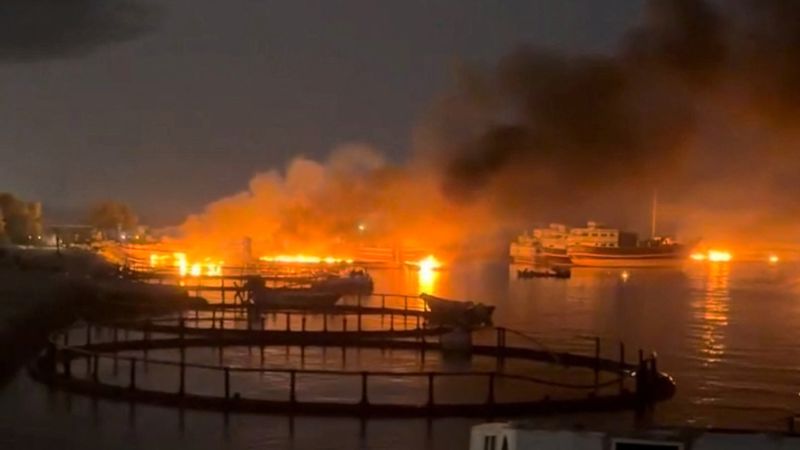
The US is striking Iran again; Ceasefire Struggles to Hold
Qwenews.com – The US is striking Iran again, reigniting tensions in the Middle East amid ongoing hostilities. Despite a fragile ceasefire that seemed to hold for months, the renewed airstrikes and missile attacks between the two nations have highlighted the challenges in maintaining peace. The conflict, which has seen intermittent strikes since late February, has once more escalated, with both sides accusing each other of breaching the terms of their recent Memorandum of Understanding (MoU). Analysts and diplomats are now questioning whether the US can deliver a decisive blow to Iran’s influence or if the war will continue in a cycle of retaliation.
Escalation After the Ceasefire Breakdown
The latest round of attacks began after a series of coordinated strikes by Iran on commercial vessels near the Strait of Hormuz, a critical shipping route for global oil supplies. The US responded by targeting Iranian military infrastructure, including key facilities in the region. This pattern of escalation, reminiscent of earlier conflict phases, has raised concerns about the effectiveness of the MoU as a tool for de-escalation. While the ceasefire aimed to reduce the risk of large-scale military confrontations, it appears to have failed in addressing the deeper strategic and ideological divides between the two nations.
“The ceasefire had little chance of survival because the Iranian government that signed it has no authority over the Islamic Revolutionary Guard Corps (IRGC),” said Carl Schuster, former director of the US Pacific Command’s Joint Intelligence Center.
Iran’s IRGC, a powerful and independent military force, has been at the center of the country’s aggressive posture. This faction, which operates with relative autonomy, has shown a willingness to escalate tensions, even as the broader government seeks to negotiate. The US, in its strikes, has focused on weakening the IRGC’s ability to project power, but the faction’s resilience has allowed Iran to continue its attacks on US interests in the Gulf region. As the conflict persists, the question remains: how much can the US strikes on Iran change the dynamics of this protracted standoff?
Implications for Global Trade and Regional Stability
The recent attacks near the Strait of Hormuz have drawn immediate attention to the economic stakes involved. By targeting shipping lanes, Iran has sought to assert control over a vital artery of international commerce, potentially disrupting oil flows and affecting global markets. The US, in its countermeasures, has aimed to safeguard these routes, but the continued strikes have raised fears of broader regional instability. With both sides unwilling to cede ground, the conflict risks becoming a prolonged struggle for dominance in the Persian Gulf.
Analysts note that the current level of violence, though less intense than earlier phases, still poses a significant threat to maritime security. The US’s re-imposed sanctions on Iranian oil, which were set to be lifted as part of the ceasefire, have further complicated negotiations. These sanctions, combined with the military strikes, have intensified economic pressure on Iran, pushing its leadership to make difficult choices about the country’s strategic direction. As the US is striking Iran, the geopolitical consequences of the conflict are expanding, affecting not just the Middle East but also global energy markets and international alliances.
The cycle of retaliation shows no signs of slowing, with each side’s actions seemingly designed to provoke the other. The US’s strikes on Iranian targets have been met with Iranian attacks on US military installations in Kuwait and Bahrain, demonstrating a mutual commitment to escalating the conflict. This dynamic has kept the region in a state of heightened tension, with diplomats working to find a resolution before the situation spirals further. For now, the US is striking Iran with a renewed sense of urgency, but the path to lasting peace remains unclear.
“The US is striking Iran with precision, but without a clear strategy, the outcome remains uncertain,” remarked retired US Air Force Col. Cedric Leighton, a CNN military analyst. “The attacks are a show of force, but they may not be enough to dismantle Iran’s resolve.”
As the conflict continues, the role of the IRGC in Iran’s military operations becomes increasingly significant. This faction’s ability to mobilize quickly and independently has allowed it to maintain a steady presence in the region, even amid the ceasefire agreement. The US’s focus on targeting the IRGC’s capabilities suggests a broader strategy to weaken Iran’s military dominance. However, without a comprehensive approach that addresses Iran’s political and ideological motivations, the US may struggle to achieve a decisive outcome. The challenge now is whether the US can deliver a knockout blow—or if the war will continue as a series of measured strikes and counterstrikes.