
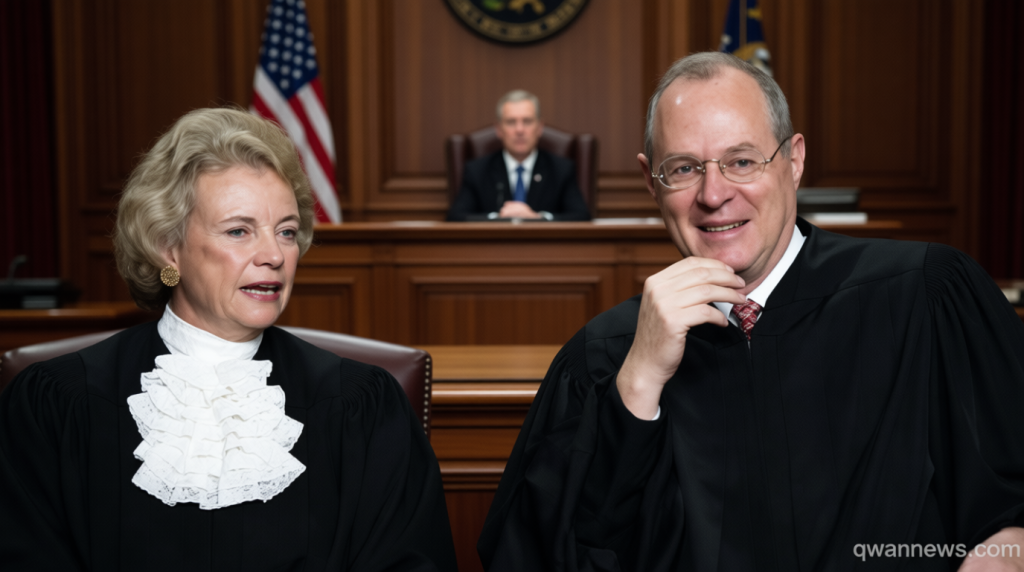
Analysis: The Supreme Court’s Loss of Center and Its Impact
Qwenews.com – Over the past five decades, the Supreme Court operated with a stabilizing influence from conservative moderates who served as intermediaries between opposing legal ideologies. Justices like Sandra Day O’Connor and Anthony Kennedy were instrumental in shaping decisions that balanced ideological divides, often prioritizing practical outcomes over rigid doctrinal adherence. O’Connor, known for her political acumen honed during a career as a state legislator, cultivated a sense of unity among justices through informal gatherings, including post-argument lunches and social events with foreign legal figures.
A Fractured Judicial Landscape
Today, the Court is marked by deep ideological fragmentation, with rulings frequently split along a 6-3 partisan divide. Even within the conservative majority, justices disagree on the extent to which they should overturn established legal norms. This absence of a centrist consensus has led to increasingly polarized opinions, with recent decisions revealing a growing disconnect between the Court’s rulings and the broader American public.
“Both Justices Kennedy and O’Connor cared about what the country as a whole thought about the court,” said Leah Litman, a law professor at the University of Michigan and former clerk to Justice Kennedy. “They provided a middle to the court because they cared about the middle, median views in the country and didn’t want the Supreme Court to stray too far from that. And rightfully so – it doesn’t work to have an apex, unelected court that’s catering to a smaller and smaller minority section of the country.”
Historical Precedents and Contrasts
Former justices like Lewis Powell, appointed by Republican presidents, exemplified a pragmatic approach that sought to reconcile competing interests. Powell’s 1992 vote to uphold Roe v. Wade reflected this balance, as he acknowledged the societal impact of reversing the landmark decision. “Some of us as individuals find abortion offensive to our most basic principles of morality,” he noted, “but that cannot control our decision. Our obligation is to define the liberty of all, not to mandate our own moral code.”
In contrast, the recent Louisiana and Alabama voting-rights rulings have demonstrated a shift toward more ideologically driven outcomes. These decisions not only dismantled key legal precedents but also altered the landscape of electoral practices, disproportionately favoring Republican strategies in the midst of the 2025-26 midterm cycle. The Court’s current trajectory suggests a departure from the collaborative ethos of its predecessors.
Recent Cases and Judicial Trends
With just ten days remaining in the current term, the justices face 17 unresolved cases, several of which challenge the boundaries of presidential authority. Issues such as birthright citizenship and the power to remove independent agency heads, like those at the Federal Trade Commission and Federal Reserve, highlight ongoing debates about executive influence. Chief Justice John Roberts, who has historically expanded presidential authority, now aligns more closely with Trump’s agenda, further polarizing the Court’s approach.
Brad Snyder, a law professor at Georgetown University, noted that Roberts’ past decisions demonstrated a form of institutional pragmatism. However, recent rulings, such as the April 2024 decision curtailing voting rights and the 2024 opinion granting Trump broad immunity, have shifted the Court’s focus toward ideological alignment over balanced judgment.