
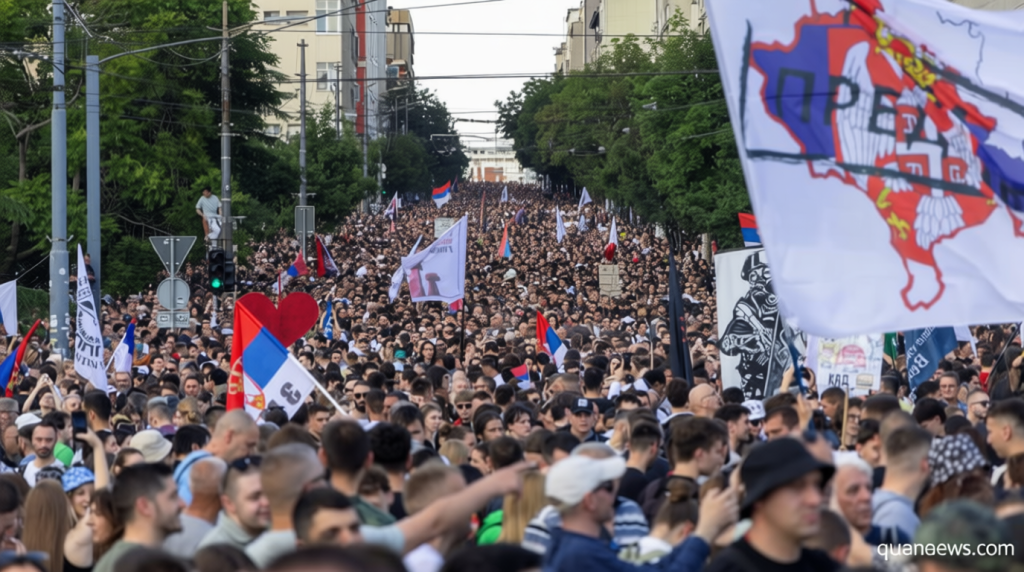
President Vucic Announces Resignation Amid Student Protests
Qwenews.com – On Saturday, Serbian President Aleksandar Vucic declared his intention to step down within weeks, prompting the nation to prepare for early presidential and parliamentary elections. This decision follows 18 months of sustained anti-government demonstrations, primarily driven by student activists. The protests were ignited by the tragic collapse of an awning at a railway station in Novi Sad, northern Serbia, in November 2024, which resulted in 16 fatalities.
Protesters, opposition groups, and human rights organizations have accused the government of systemic mismanagement and corruption, linking the incident to broader issues in infrastructure projects. Vucic, who has held leadership roles for 12 years, addressed his supporters at a pro-government rally in Belgrade, stating, “I will be president for only a couple more weeks, and then I will resign.”
Political Strategy and Transition Plans
Vucic’s current presidential term was set to conclude in mid-2027, but the recent announcement signals an accelerated shift in power. He aims to bolster his Serbian Progressive Party (SNS) in upcoming elections by rebranding their campaign list as “United Serbia.” While he did not confirm the exact timeline for his resignation or the dissolution of parliament, analysts suggest his move is designed to maintain influence.
“This is not at all the end of Vucic,” remarked Radivoje Grujic, a Warsaw-based political analyst. “He already has a plan, one that definitely does not mean he’s going into political retirement — quite the opposite.”
Despite the resignation, Vucic’s political trajectory may continue. If his party secures victory in the parliamentary vote, he could transition to the role of prime minister, ensuring his dominance persists regardless of title. The protests, the largest rallies since Slobodan Milosevic’s downfall in 2000, have intensified pressure on his administration.
Protest Momentum and Electoral Challenges
Days prior, students in Novi Sad gathered to honor the victims of the railway disaster and called for snap elections. Another rally is planned for Sunday in Kraljevo, south-central Serbia, highlighting the movement’s growing reach. Opposition leaders and student activists have united in demanding accountability, with Savo Manojlovic, head of the Move-Change movement, asserting, “By resigning and with early presidential and parliamentary elections, Vucic is trying to preempt his inevitable fall, because of protests and because of the student movement, which has more support than he does.”
Vucic’s presidency, though largely ceremonial, has been a central pillar of Serbia’s political landscape. He has hinted at returning to party politics or becoming prime minister again, with allies recently endorsing this path. In a February interview with Reuters, he admitted uncertainty about his post-term plans but noted his openness to further involvement in governance.
Reforms and Criticisms
During his Belgrade rally, Vucic pledged to address corruption, raise pensions, and enhance health services for the underprivileged. However, opposition figures contested these promises, accusing him of perpetuating corruption, fostering ties with organized crime, and suppressing media freedom. The president also claimed protesters were collaborating with foreign powers, a claim denied by the demonstrators.
As Serbia seeks EU membership, it faces challenges in improving its legal framework, ensuring electoral fairness, and reducing corruption. Vucic’s commitment to these reforms remains under scrutiny, with critics arguing his actions have not sufficiently aligned the nation with European standards. His resignation announcement underscores the growing tension between his administration and the public’s demands for change.