
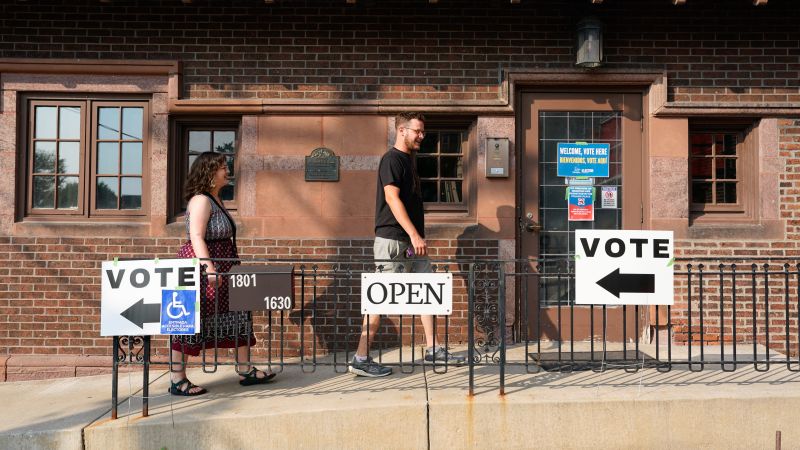
Wisconsin Primaries: Establishment Strikes Back
Qwenews.com – Establishment strikes back in Wisconsin as voters rejected a progressive surge in Tuesday’s Democratic primary, while Minnesota progressives celebrated a dual victory that highlighted the ongoing tension within the party between its left and center wings.
In a race that many viewed as a referendum on the party’s ideological trajectory, Milwaukee County Executive David Crowley secured a narrow victory over democratic socialist Francesca Hong in the Democratic gubernatorial primary. The outcome signals that the establishment has successfully rallied behind a moderate alternative after a period of uncertainty.
Wisconsin: Establishment Consolidates Behind Crowley
Hong, a 37-year-old state legislator and former restaurant proprietor, faced mounting concerns about her electability in a crucial presidential battleground. Her performance in television appearances drew particular attention, most notably during a CNN interview where she provided an extended, somewhat unfocused response to questions regarding a 2020 social media post in which she suggested canceling Thanksgiving.
Outgoing two-term governor Tony Evers played a significant role in the final days of campaigning, actively encouraging Democrats to support Crowley. Many party members worried that Hong could prove vulnerable in a general election matchup against Republican Representative Tom Tiffany.
The contest arrived just one week after Abdul El-Sayed claimed the Democratic Senate nomination in Michigan by a razor-thin margin. August has emerged as a critical testing ground for the party’s left flank, offering an opportunity to prove that progressive candidates can succeed beyond heavily Democratic urban centers and into competitive swing states.
Why the Progressive Wave Stalled
Several factors may explain why progressive candidates faced headwinds in both Wisconsin and Michigan. Some voters appear hesitant to back candidates who might encounter difficulties in a general election contest. Democratic leadership expressed considerable concern about nominating both El-Sayed and Hong, and certain constituents may have viewed those selections as overly risky.
Polling dynamics also complicate primary predictions. Unlike general elections, primary voter pools are less consistent. Critics suggest that surveys may disproportionately capture educated, urban respondents who lean leftward while missing rural, working-class voters. Additionally, both Wisconsin and Michigan experienced a scarcity of high-quality polling data.
In Wisconsin’s case, late consolidation against Hong appears to have been decisive. A Marquette Law School survey conducted in late July indicated Hong leading at 46 percent, with former Lieutenant Governor Mandela Barnes at 21 percent and Crowley at 11 percent. Once Barnes withdrew from the race the following day, Crowley emerged as the clear alternative, drawing voters who wanted to prevent Hong’s nomination.
Minnesota: A Progressive Double Win
Just across the border, progressives achieved a significant victory in Minnesota’s Democratic Senate primary. Lieutenant Governor Peggy Flanagan defeated moderate Representative Angie Craig in a contest to replace the retiring Senator Tina Smith.
Flanagan’s campaign focused heavily on Craig’s political record, particularly her financial backing from the American Israel Public Affairs Committee and her support for the Laken Riley Act. That legislation requires detaining undocumented immigrants accused of specific offenses, a position Craig now acknowledges she regrets.
Immigration enforcement had become a particularly sensitive topic in Minnesota following January, when federal agents fatally shot two American citizens during demonstrations against mass deportation initiatives. Despite this charged atmosphere, Flanagan avoided the electability concerns that plagued Hong in Wisconsin.
Her campaign received endorsements from prominent progressive voices, including Vermont Senator Bernie Sanders and Massachusetts Senator Elizabeth Warren, both of whom remained neutral in Wisconsin’s governor’s race. Flanagan is positioned as the strong favorite heading into November, when she will face Michele Tafoya, a former NFL broadcaster making her first bid for elected office.
Progressives also captured the Democratic nomination for the House seat in Minnesota’s 2nd District, which Craig is vacating. Matt Little, a former state senator, won a competitive field in the Twin Cities’ southern suburban areas.
The race was seen as a gauge of the party’s ideological direction: testing whether the progressive insurgency that has played out in deep-blue districts this spring and summer would extend into another presidential battleground.
What This Means for 2026
The establishment strikes back in Wisconsin demonstrates that moderate candidates can still prevail when party leaders unite behind them. While progressives won in Minnesota, the Wisconsin result suggests that electability concerns remain paramount in battleground states.
For more coverage of primary results and political analysis, visit CNN Politics for ongoing updates.
Frequently Asked Questions
Who won the Wisconsin Democratic gubernatorial primary? Milwaukee County Executive David Crowley defeated democratic socialist Francesca Hong in a narrow victory, marking the establishment’s return to power in Wisconsin.
Why did Francesca Hong lose despite leading in polls? Late consolidation against Hong after Mandela Barnes withdrew from the race proved decisive. Voters concerned about electability in a general election against Republican Tom Tiffany rallied behind Crowley.
Did progressives win or lose in Tuesday’s primaries? Progressives won in Minnesota with Peggy Flanagan’s Senate victory, but lost in Wisconsin where the establishment struck back. This split outcome reflects the party’s ongoing ideological balance.
What are the key dates for the 2026 general election? The general election will be held in November 2026, with candidates from both parties preparing for what could be a pivotal contest in several battleground states.