
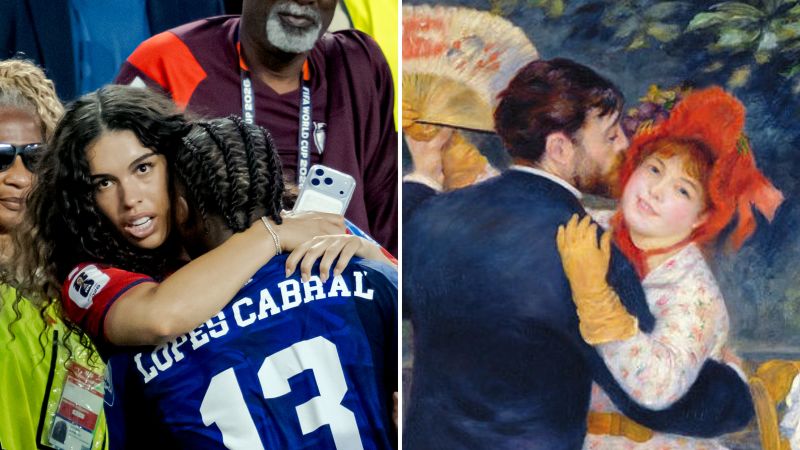
Finding the art in the beautiful game
Qwenews.com – Finding the art in the beautiful game has become a powerful lens through which to view the World Cup, a global spectacle that marries athleticism with cultural storytelling. In a memorable match between Cape Verde and Argentina, fullback Sidny Lopes Cabral’s late goal in the 102nd minute not only shifted the momentum of the game but also captured the raw, emotional essence of soccer. As he sprinted into the stands to embrace his girlfriend, Jayley da Cruz, the moment was immortalized in a viral image that transcended sport. This poignant scene sparked inspiration for LJ Rader, whose social media platform “Art But Make It Sports” reimagines soccer moments through the lens of classical art, creating a unique dialogue between athletic action and artistic expression.
The Intersection of Sport and Art
LJ Rader, the creative director of “Art But Make It Sports,” has gained a dedicated following by pairing iconic sports imagery with historical art. His work often juxtaposes modern soccer scenes with pieces from the past, such as a 1999 photo of US Women’s National Team star Brandi Chastain’s shirtless celebration against a 12th-century sculpture of a kneeling female deity. These combinations highlight how sports can evoke the same universal emotions as art, bridging generations and cultures. During the FIFA World Cup, Rader has been particularly active, curating thousands of visuals that align with the tournament’s vibrant moments and the rich heritage of art history.
The World Cup’s dynamic atmosphere provides Rader with a constant stream of material, as fans and players alike become central figures in its narrative. Social media platforms have amplified this, with users frequently sharing their interpretations of the matches. Some connections are immediate—like when a photo of English midfielder Jude Bellingham’s header reminded Rader of a Sibylle Bergemann image of a statue of Friedrich Engels being lifted in East Berlin. This instant inspiration underscores the power of visual storytelling, where a single moment can resonate with a broader historical context, inviting viewers to see the game in a new light.
Challenges and Creativity in Pairing
Rader’s process blends intuition with meticulous analysis, as he seeks to match the intensity of a soccer moment with the right artistic counterpart. While some pairings are seamless, others require deeper contemplation. For instance, during a Spain–Portugal match in Dallas, he aimed to capture the playful interaction between Rodri and Bernardo Silva, but only found a rear-view angle, missing the expressive facial details he believed were essential. This challenge reflects the balance he maintains between spontaneity and precision, ensuring that each image resonates with the emotional weight of the scene it represents.
Despite the logistical hurdles, Rader’s work has garnered global attention, with followers from diverse backgrounds engaging in discussions about the connections he makes. When asked about the unique qualities of soccer in his creative process, he noted, “Football is hard because you can’t see faces, but there are more people and movement, which balances things out.” This contrast between the static and dynamic elements of the game adds depth to his interpretations, allowing him to explore themes of unity, individuality, and human connection through each pairing.
As the World Cup progresses, Rader’s project becomes a mirror of the tournament itself, reflecting its highs and lows, its triumphs and heartbreaks. The viral image of Sidny Lopes Cabral and Jayley da Cruz’s embrace has become a symbol of this artful approach, proving that even the most fleeting moments can be transformed into enduring cultural artifacts. By embracing the beauty in the chaos of the beautiful game, Rader invites audiences to find meaning beyond the scoreboard, fostering a deeper appreciation for the sport’s emotional and artistic dimensions.