
Trump’s Persistent Reference to ‘Communism’
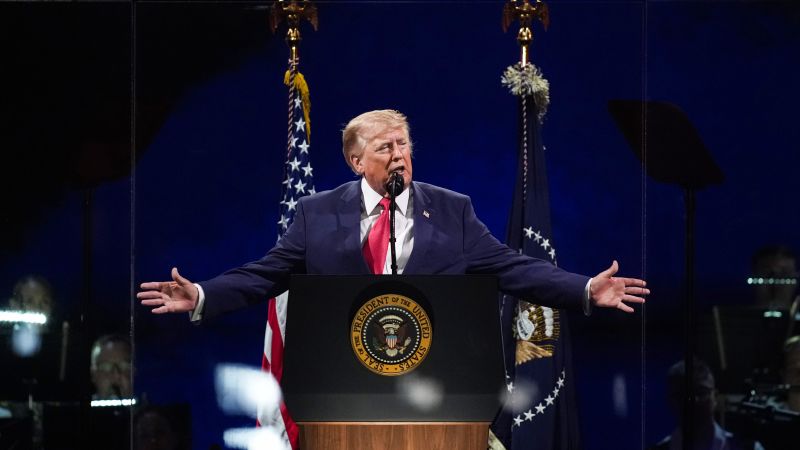
Qwenews.com – During a recent gathering to mark the 250th anniversary of the United States, President Donald Trump delivered a speech that harkened back to earlier political climates. At the July 3 event held at Mount Rushmore, he asserted, “Communism is a mortal threat to American liberty,” positioning it as the most significant danger to the nation, surpassing events like World War I, World War II, Pearl Harbor, or 9/11. This instance was part of a broader pattern, with the word appearing 14 times in a single 30-minute address. The following day, at the Fourth of July festivities on the National Mall, Trump reiterated his concerns, assuring supporters that “America will never be a communist country.”
A Rhetorical Tool in the Midterm Campaign
Labeling opponents as “communists” has emerged as a central tactic for Trump and his Republican allies during the midterm elections. As democratic socialist candidates gained traction in Democratic primaries, energizing leftist groups while unsettling moderate leaders, the administration has revived the practice of red-baiting. “These are communists,” stated White House press secretary Karoline Leavitt during a Fox News appearance. Meanwhile, House Speaker Mike Johnson told Fox News, “This is communism, and it has led to the murder of innocent people, tens of millions of them in the 20th century alone.”
The Evolution of ‘Communism’ as a Term
According to CNN’s “Word of the Week” series, the term “communism” originated in English around 1840, predating the publication of Karl Marx and Friedrich Engels’ “Communist Manifesto” by eight years. Initially, it described an ideology aiming for a stateless, classless society with shared ownership of property and production. However, by the early 20th century, it had taken on a negative connotation in American politics, linked to immigrant labor movements and fears of revolutionary upheaval following the 1917 Russian Revolution.
During the first Red Scare, authorities targeted suspected radicals, anarchists, and foreigners through events like the Palmer raids. Over time, communism became synonymous with authoritarian regimes, such as those of Stalin, Mao, and Castro, and with Cold War anxieties like nuclear threats. Trump’s use of the term, however, extends beyond specific ideologies, as noted by Austin Sarat, a professor at Amherst College. He explains that the label serves as a shorthand for “un-American” values, suggesting that opposing political views jeopardize the American way of life.
A Historical Political Strategy
Accusing adversaries of communist influence is a time-tested strategy in U.S. politics. In the 1940s and ’50s, Senator Joseph McCarthy gained notoriety by claiming that communist spies had infiltrated American institutions, undermining public trust and prompting widespread interrogations. His campaign was supported by Roy Cohn, who later mentored young Donald Trump. Similarly, the “pink” smear was instrumental in Richard Nixon’s 1950 Senate victory. This pattern continues today, as the “communist” label remains a tool to discredit progressive movements, even when they align more with democratic socialism than full communism.
“You can be loyal to Karl Marx or you can be loyal to America. You can be a communist or you can be a patriot. You cannot be both.”
As the political landscape shifts, the term “communism” retains its power to evoke fear and rally support, echoing its role in past ideological battles while adapting to contemporary challenges.