
Trump’s Political Gambit at the World Cup Faces Unfavorable Winds
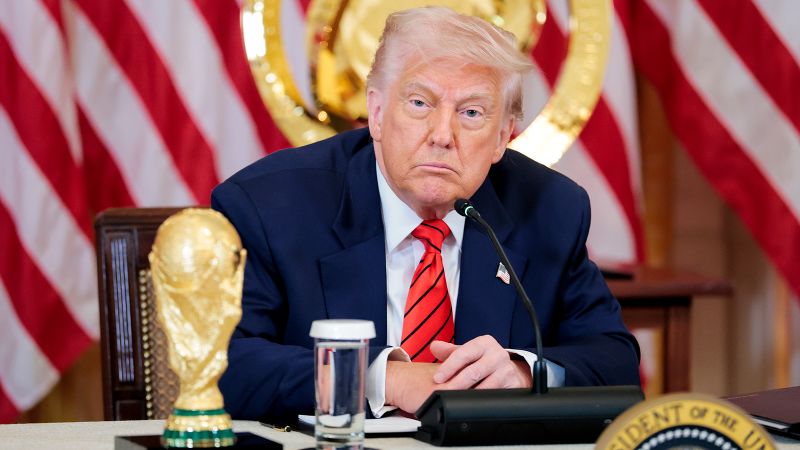
Qwenews.com – In 2018, Donald Trump anticipated missing the opportunity to showcase himself on the world’s most prestigious sports stage, expressing disappointment that “I won’t be here” for the World Cup finals co-hosted by the U.S. in 2026 due to presidential term limits. However, his remarkable political resurgence—making him only the second leader to secure two non-consecutive terms—granted him additional influence and a chance to engage with the global soccer spectacle. Trump has long demonstrated a knack for positioning himself as a global figure, leveraging events to amplify his presence. This year, he proudly displayed a gleaming World Cup replica in his Oval Office, hosted Gianni Infantino within his MAGA network, and celebrated with Chelsea after presenting them with a trophy in a U.S.-based FIFA club competition.
Political Tensions Overshadow the Soccer Celebration
The 2026 World Cup finals, set to begin on Thursday, now risk amplifying the political rifts that define Trump’s second term. While the president may aim to reassert his international appeal, critics abroad are likely to view his involvement as emblematic of the turmoil and discord in his administration. His political fortunes have recently dimmed, both domestically and internationally, due to rising unpopularity and setbacks overseas. Infantino’s recent decision to award Trump the FIFA Peace Prize—following the president’s exclusion from the Nobel version—now appears awkward in light of U.S. military actions against Iran, a World Cup qualifying nation.
“I would certainly like to be there, but I wouldn’t pay it either, to be honest with you,” Trump told the New York Post about $1,000 tickets for the first Team USA game.
Trump’s stringent immigration policies, which left some foreign fans feeling excluded from the U.S. experience, have cast a shadow over the tournament’s build-up. A Somali referee faced entry denial during a time when the administration accused Minnesota Somalis of fraud, despite the community’s denial. The Senegalese team reported rigorous security checks upon arriving for their pre-World Cup camp, though the federation called it routine. Iran also canceled its ticket allocation for three group games in the U.S., citing fears of ICE sweeps targeting undocumented migrants at matches involving South American teams with large followings.
Commercialization and Affordability Concerns
Rising ticket prices have further complicated the event’s appeal, with costs exceeding $1,000 for some games. Critics argue this reflects FIFA’s growing focus on profit over the sport’s traditionally working-class fan base, symbolizing broader affordability crises in Western societies and economic disparities between the Global South and North. Trump’s own hesitation at these prices highlights the disconnect between his rhetoric and the financial realities faced by many supporters.
A History of Political Interference in Sports
Political tensions have historically marred major sporting events. The U.S. spearheaded a boycott of the Moscow Olympics in 1980 over the Soviet invasion of Afghanistan, while the 2022 World Cup in Qatar was shadowed by allegations of human rights abuses, including migrant worker fatalities. The 2026 tournament, co-hosted with Canada and Mexico amid Western Hemisphere tensions, adds a new layer of division. Trump’s tendency to generate polarizing reactions has drawn scrutiny to Infantino’s close ties to the U.S. president, who recently hosted the FIFA leader at his Gaza peace summit in Egypt.
Infantino’s frequent presence in Washington and Mar-a-Lago underscores this alignment. His support for Trump’s vision of global dominance, as expressed in the president’s Instagram declaration—“Together, we will make not only America great again, but also the entire world”—has left questions about FIFA’s role in fostering unity versus perpetuating geopolitical friction.