
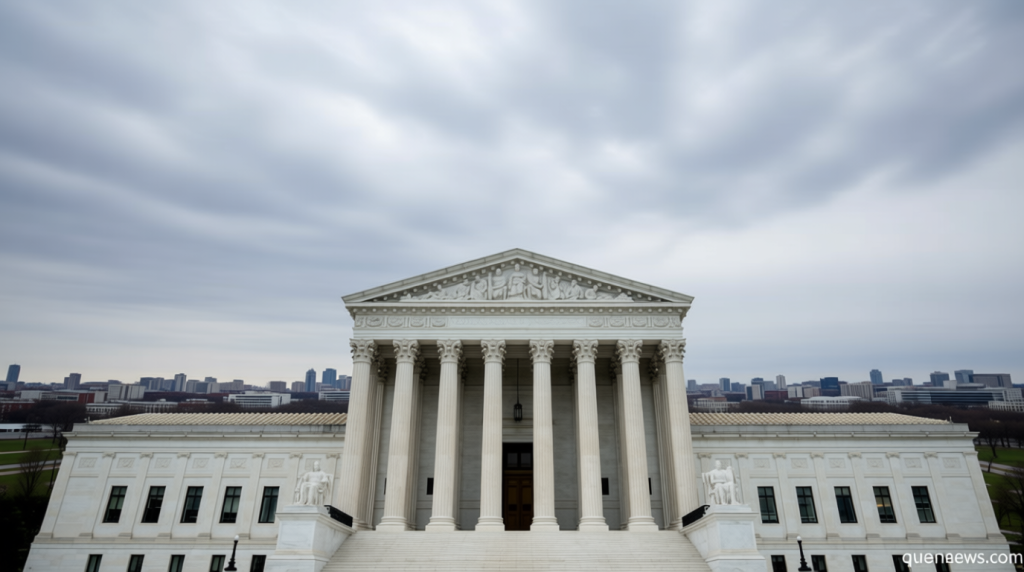
Supreme Court to Review AR-15 Ban in Key Second Amendment Case
Qwenews.com – The Supreme Court has agreed to review a significant Second Amendment case that challenges state and local restrictions on AR-15-style semi-automatic rifles. This landmark decision brings renewed attention to the legal boundaries of firearm ownership, as the court prepares to determine whether such bans align with the constitutional right to bear arms. The case, which has drawn national interest, centers on the question of whether modern weapons like the AR-15 should be classified as “assault weapons” under existing regulations.
Illinois Residents Push for Legal Change
At the heart of the case are two Illinois residents who argue that Cook County’s ordinance unfairly targets AR-15 rifles and other semi-automatic firearms. The regulation, which prohibits the sale or possession of specific models, including the AR-15, has sparked a legal battle over the balance between public safety and individual gun rights. Plaintiffs claim that these weapons are vital for self-defense and recreational shooting, emphasizing their role in both personal and historical contexts. The legal brief highlights the AR-15’s significance as a symbol of American resilience, drawing parallels to its use in the Revolutionary War and westward expansion.
“The rifle has long been a cornerstone of American freedom, representing the means by which citizens have protected themselves and their communities,” the plaintiffs’ filing stated. This argument underscores the broader debate over whether such restrictions are overly broad or constitutionally justified.
Similar Laws in Ten States
States across the U.S. have implemented similar bans on semi-automatic rifles, with ten jurisdictions currently enforcing restrictions on “assault weapons” and “large capacity magazines.” These laws have been challenged in courts, with advocates arguing that they disproportionately affect law-abiding citizens. In Connecticut, for instance, residents are seeking to overturn state regulations that classify the AR-15 as an assault weapon. The Supreme Court’s ruling could set a precedent that influences the validity of these laws nationwide, potentially reshaping the landscape of gun ownership in the coming years.
Historical Precedent and Judicial Evolution
The case follows the Supreme Court’s 2022 decision in New York State Rifle & Pistol Association v. Bruen, which emphasized that modern gun laws must reflect the nation’s historical tradition of firearm regulation. In that ruling, the court struck down New York’s strict carry permit requirements, asserting that the Second Amendment protects a broad range of weapons. This precedent is now being tested as the court evaluates whether AR-15 rifles meet the same historical and traditional standards. Legal analysts suggest that the outcome may hinge on how the justices interpret the weapon’s role in American history and its relevance to contemporary uses.
“The Bruen decision established a new framework for evaluating firearm regulations, requiring courts to assess whether restrictions are consistent with historical traditions of arms use,” explained one legal expert. “This case will determine how that framework applies to modern semi-automatic rifles.”
Arguments and Stakeholders
Gun rights organizations, such as the Second Amendment Foundation and the Firearms Policy Coalition, are supporting the challenge, citing the AR-15’s widespread adoption by civilians for both defense and sport. They argue that the weapon’s design is not inherently dangerous and that its regulation infringes on constitutional freedoms. On the other hand, local officials and gun control advocates, including Everytown for Gun Safety, defend the bans by pointing to high-profile mass shootings linked to semi-automatic firearms. These arguments have intensified as the Supreme Court prepares to weigh in on the issue.
Implications for Gun Laws
The Supreme Court’s decision on this case could have far-reaching implications for state and local gun legislation. If the court sides with the plaintiffs, it may signal a shift toward broader recognition of individual firearm rights, potentially invalidating similar restrictions in other states. Conversely, a ruling that upholds the bans could reinforce the government’s authority to regulate weapons deemed threatening to public safety. As the court deliberates, legal experts anticipate a closely watched decision that will redefine the scope of the Second Amendment in the modern era. The outcome is expected to influence future debates on gun control, with potential impacts on both legislation and public perception of firearms.