
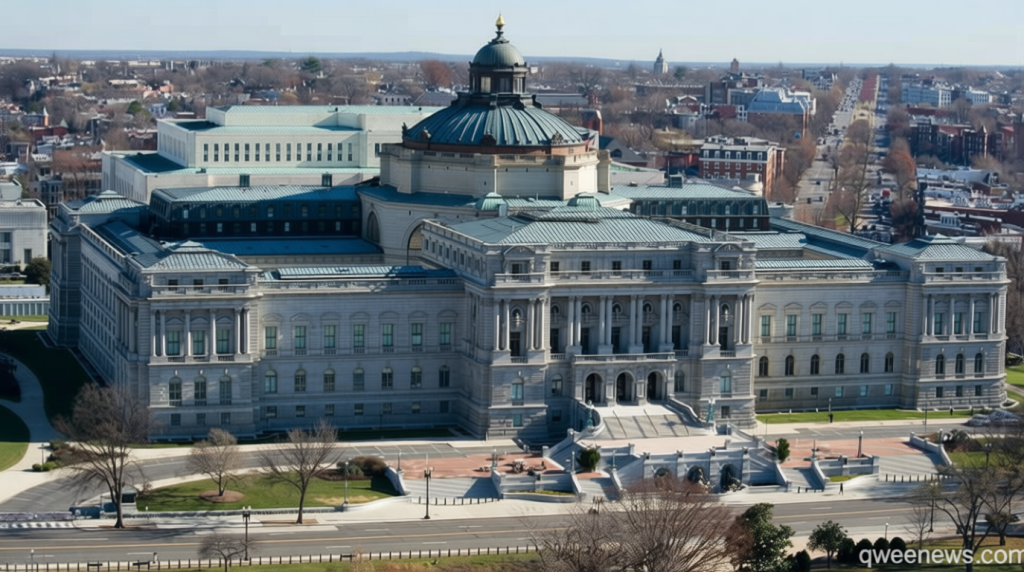
Supreme Court Blocks Trump’s Attempt to Fire Library of Congress Official
Qwenews.com – The U.S. Supreme Court has temporarily halted President Donald Trump’s effort to remove Shira Perlmutter, a senior Library of Congress official, from her role as head of the Copyright Office. This decision allows Perlmutter to continue her work at the institution while lower courts review the legality of Trump’s claim. The ruling underscores the ongoing debate over presidential authority to dismiss federal employees, particularly those in positions linked to legislative functions.
Legal Dispute and Background
Trump’s attempt to fire Perlmutter came amid a broader campaign to consolidate control over key government agencies. In May 2024, he had already removed Carla Hayden as Librarian of Congress and appointed Todd Blanche, his former attorney, as acting librarian. Simultaneously, he sought to end Perlmutter’s tenure at the Copyright Office, a division under the Library of Congress. The dispute reached the Supreme Court after Trump loyalists arrived at the Library of Congress with a letter asserting the president’s right to direct the institution, prompting officials to challenge the move in court.
“The executive’s alleged interference with the work of a legislative branch official, as she performs duties to advise Congress, strikes us as a violation of the separation of powers,” stated Judge Florence Pan, a Biden appointee, in the DC Circuit’s ruling. This decision highlighted the unique legal status of Perlmutter’s position, which the court argued could not be easily dismissed under traditional presidential removal powers.
Separation of Powers and Legal Precedents
Perlmutter’s legal team emphasized that her role as register of copyrights is defined by statute as a legislative officer, not an executive one. This classification grants her greater independence, as only the Senate-confirmed Librarian of Congress can remove her. The argument aligns with historical precedents, including cases where the executive branch’s power to fire officials was challenged for overstepping constitutional boundaries.
In contrast, the Trump administration maintained that the Copyright Office’s functions, such as negotiating international copyright agreements and issuing legal opinions, fall within the scope of executive authority. Solicitor General D. John Sauer argued in an emergency filing that treating the Librarian of Congress and Register of Copyrights as legislative officers would disrupt established frameworks of power. The Supreme Court’s pause in Perlmutter’s case reflects the complexity of balancing these competing claims.
Implications for Government Structure
The ruling has sparked discussions about the balance of power between the executive and legislative branches. By allowing Perlmutter to stay in her position, the Supreme Court has affirmed that the Library of Congress official Trump sought to remove operates under a distinct legal framework. This decision could set a precedent for future disputes involving independent federal agencies, particularly those with roles in policy advising and legislative support.
Legal experts note that while the president retains broad removal powers, the specific circumstances of Perlmutter’s case may require a more nuanced approach. The dispute highlights how executive actions can intersect with institutional autonomy, raising questions about the extent of presidential influence over agencies like the Library of Congress. For now, the Library of Congress official Trump remains in her role, pending further judicial review.
Broader Context and Political Significance
Perlmutter’s case is part of a larger pattern of Trump’s efforts to reshape federal appointments and agency leadership. Her position as a key figure in copyright law has drawn attention due to her role in shaping policies that impact creators and businesses. The Supreme Court’s intervention underscores the importance of institutional checks, ensuring that the Library of Congress official Trump’s actions are subject to legal scrutiny rather than unilateral executive decisions.
As the legal battle continues, the focus will likely shift to whether the Library of Congress official Trump’s position qualifies as a “principal officer” under the Constitution’s separation of powers doctrine. This determination will influence how future administrations handle similar cases, reinforcing the significance of Perlmutter’s case in the broader landscape of executive-legislative relations. For now, the Library of Congress official Trump’s tenure is safeguarded, pending a final resolution of the dispute.