
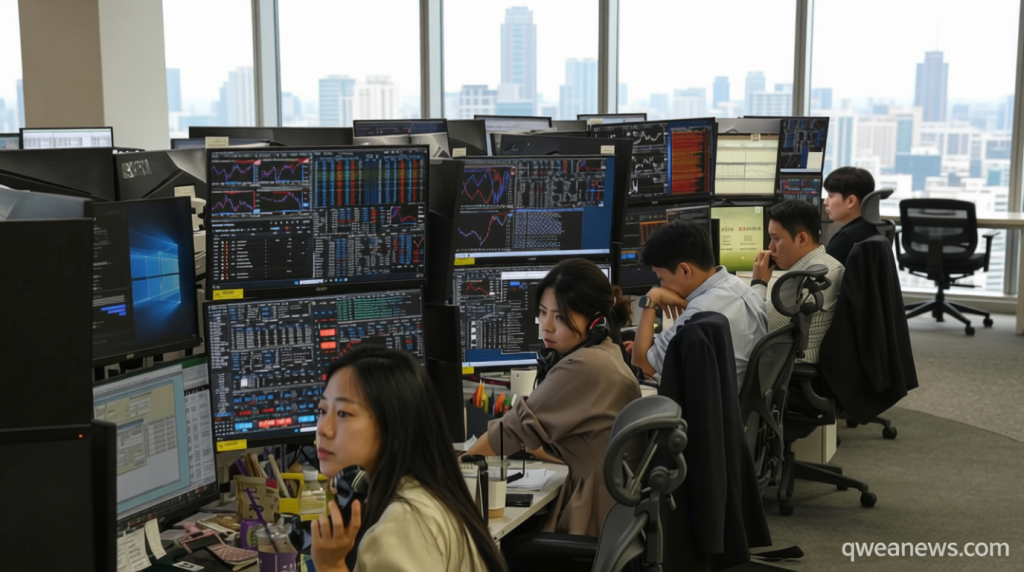
AI-driven selling sparks market turmoil. South Korean index drops 10%
Qwenews.com – Global stock markets faced renewed volatility this week, with AI-related fears driving sharp declines across major indices. The Nasdaq Composite fell 2.21% on Tuesday, while the S&P 500 dropped 1.44%, as investors offloaded shares in semiconductor firms and tech-driven companies. The Dow Jones Industrial Average, less reliant on technology stocks, saw a smaller decline of around 0.1%. Both the S&P and Nasdaq recorded their worst trading sessions in nearly two weeks, following steep losses in Asian markets.
South Korean Market Plunges 10%
South Korea’s Kospi index experienced a dramatic 10% collapse on Tuesday, triggering a 20-minute circuit breaker halt. SK Hynix and Samsung, two of the world’s largest memory chipmakers, plummeted over 12%, dragging the broader market down with them. Together, these firms account for roughly half of the Kospi’s total market value, amplifying the impact of their declines.
“These big moves are part of a growing trend of rising volatility in tech stocks generally,” noted James Reilly, a senior markets economist at Capital Economics. “This volatility is, in our view, evidence of excessive froth and calls into the question the sustainability of this rally.”
Asian markets had already begun to reflect this anxiety. The Nikkei 225 in Japan fell 3.6%, while Softbank lost 15% amid regional fears. Most other indices in the region declined by more than 1%, signaling a broader regional sell-off.
US Tech Stocks Face Sharp Corrections
US markets started the week with losses, as the Nasdaq dropped 1.3% on Monday and extended declines on Tuesday. The initial tech sell-off in the US spilled over into Asian trading hours, intensifying as the day progressed. Traders’ concerns, however, were not tied to a single catalyst.
Some investors may have been locking in profits after tech stocks surged earlier this year. While Google’s 5% Monday drop was attributed to a high-profile AI executive joining Anthropic, SpaceX’s 16% plunge was linked to post-IPO volatility. By Tuesday, Google rebounded slightly, losing less than 1%, and SpaceX gained about 1% after fluctuating in volatile trading.
Analysts Point to Fed Rate Hikes as a Factor
Other market participants speculated that the Federal Reserve’s potential rate increases later this year could be a driving force. New Fed Chair Kevin Warsh’s June 2 press conference, where he emphasized the central bank’s commitment to curbing inflation, was interpreted as a signal for future hikes. This prompted a sell-off in markets, though the sentiment had already been building in Asia.
Despite the turmoil, tech stocks have remained resilient overall. The Nasdaq is down about 5.5% from its June 2 peak, yet it’s still up 10% year-to-date. The market’s focus has shifted from geopolitical events, such as the Iran ceasefire announced by President Trump in April, back to the core issues of AI growth and rising interest rates.
Global Market Reactions
The ripple effects of the sell-off extended beyond South Korea. Japan’s Nikkei 225 fell 3.6%, and tech giant Softbank dropped 15% in a day of heightened uncertainty. Most Asian indices declined by more than 1%, underscoring the interconnectedness of global financial markets. Meanwhile, the US tech sector remained under pressure, with Nvidia and Oracle also posting significant losses.
“AI and valuations for tech-related companies are returning to the spotlight, as equity markets shift their focus from the Middle East war towards the sustainability of tech-related spending amid rising global interest rates,” stated Mason Mendez, a global real asset economist.
As the situation unfolds, traders brace for further volatility. With AI valuations at record highs and growth trajectories uncertain, even minor shifts can trigger massive exits. The challenge for markets remains: how much can they withstand before the momentum falters?