
A Mysterious Cold Blob in the Atlantic Ocean Sparks Climate Concerns
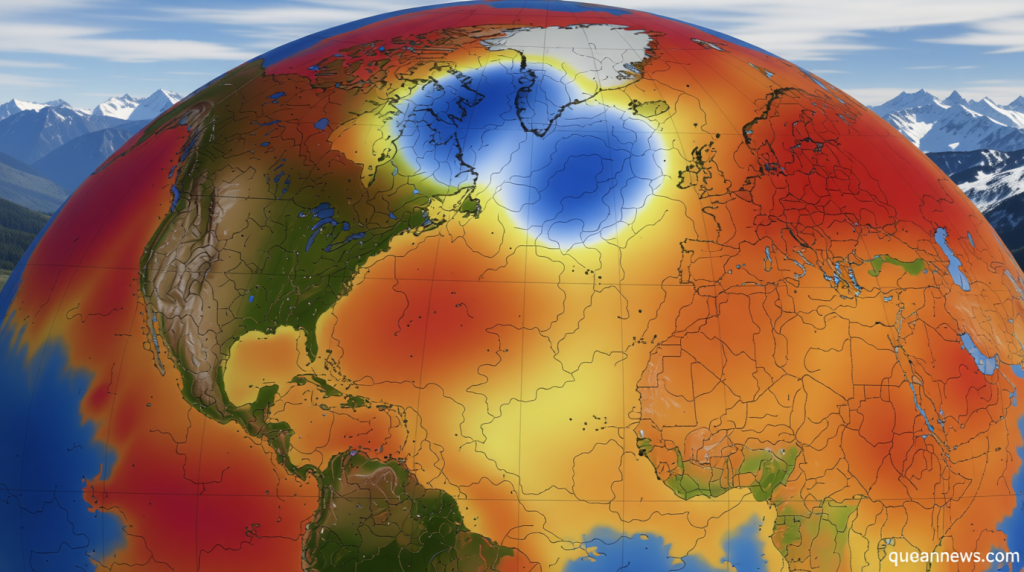
Qwenews.com – The emergence of a mysterious cold blob in the North Atlantic has captivated scientists for years, offering a stark contrast to the overall warming trend of the planet. This phenomenon, located near Greenland and Iceland, has been cooling by nearly 1 degree Celsius since 1900, raising critical questions about its origins and implications. A new study has deepened the intrigue, suggesting that this anomaly might be more than just a weather event—it could signal a significant shift in the ocean’s circulation patterns, potentially heralding a climate tipping point.
The Role of the Atlantic Meridional Overturning Circulation (AMOC)
Researchers have long speculated that the cold blob is linked to the Atlantic Meridional Overturning Circulation, a vast system of currents that transports warm water from the tropics northward and returns cooler, denser water southward. This system functions like a planetary conveyor belt, maintaining global heat distribution and influencing weather systems. However, recent findings indicate that the cold blob’s cooling trend may be a direct result of the AMOC’s weakening, a phenomenon that has been documented through satellite and instrument data.
“The cold blob’s formation is a clear indicator of the AMOC’s declining strength,” stated Stefan Rahmstorf, a physics and ocean professor at Potsdam University, who collaborated on the study. “This is not just a regional anomaly—it’s a sign of broader changes in the ocean’s role as a climate regulator.”
The study’s methodology combined long-term oceanographic data with advanced climate models to analyze the cold blob’s persistence and its connection to AMOC dynamics. While previous theories focused on atmospheric factors such as wind shifts or cloud patterns, this research emphasizes the deep-sea cooling as a more definitive marker of the current system’s instability. The results suggest that the cold blob is a tangible manifestation of the AMOC’s weakening, which could have far-reaching consequences.
Global Implications of a Weakening AMOC
Experts warn that if the AMOC continues to weaken, it could trigger a cascade of climate impacts. These include accelerated sea-level rise along the U.S. East Coast, as the reduced heat transport may slow the Gulf Stream’s ability to counteract melting ice sheets. Europe could also face more frequent and severe cold spells, while Africa might experience prolonged droughts due to disrupted monsoon systems. The cold blob, therefore, is not an isolated event but a critical early warning signal for global climate change.
“Independent evidence shows the AMOC is at its weakest in a millennium,” Rahmstorf added. “This means the cold blob’s presence is both a symptom and a symptom of the ocean’s response to human-induced warming.”
Despite the study’s robust findings, some scientists caution that the data is still evolving. “Current datasets are reliable approximations, not perfect,” noted David Thornally, a UCL professor not involved in the research. “We need to ensure that the cold blob’s cooling isn’t mistaken for a temporary fluctuation rather than a long-term trend.” Jonathan Baker of the UK Met Office echoed this sentiment, highlighting that while the study strengthens the link between the cold blob and AMOC changes, uncertainties remain in fully understanding the system’s behavior.
René van Westen, a researcher at Utrecht University, pointed out that earlier studies had already suggested atmospheric factors could create a cold blob. However, the new analysis, which aligns across multiple independent datasets, provides stronger evidence that the AMOC’s decline is a key driver of the anomaly. This underscores the importance of the cold blob as a focal point for further investigation into the ocean’s role in climate dynamics.
As the debate continues, the cold blob serves as a crucial piece of the puzzle in deciphering the complex interactions between ocean currents and global climate. Its cooling trend is now being closely monitored alongside other indicators, such as sea ice expansion and heat distribution patterns. With the AMOC’s stability under threat, the cold blob may become a defining feature of the next century’s climate landscape, urging scientists and policymakers to take action before the situation worsens. The cold blob’s presence reminds us that the ocean, often seen as a stabilizer, is now showing signs of being pushed to its limits.