
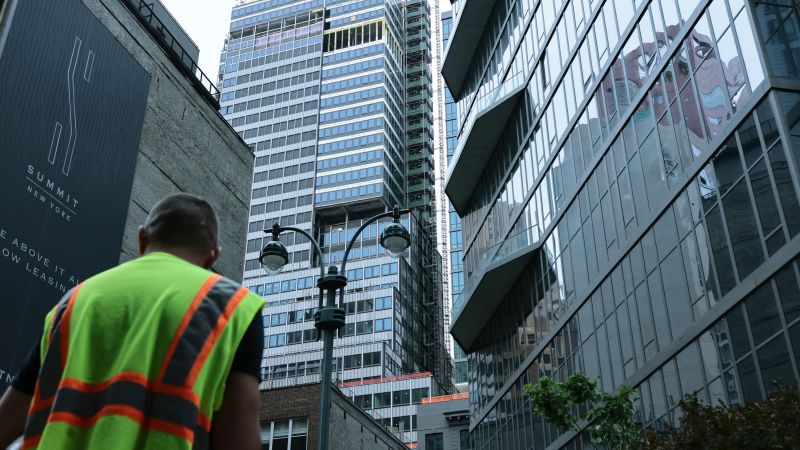
Crews Work to Stabilize NYC High-Rise: What Comes Next?
Qwenews.com – Crews work to keep NYC high-rises stable after a structural incident forced over 100 workers from a Midtown Manhattan office building to evacuate Tuesday. The sudden collapse of columns in a nearby high-rise raised alarms, prompting city officials to declare a “localized collapse zone.” Jason Polanco, one of the displaced employees, described the chaotic scene as he left his belongings behind, later returning to retrieve laptops and documents. This event highlights the ongoing challenges of maintaining safety in urban high-rises, especially during construction or renovation phases.
Evacuation and Immediate Response
The evacuation process initially took hours, with teams working tirelessly to secure the building and ensure the safety of both workers and hotel guests. Suitcases and backpacks were carried to safety as the public watched the unfolding crisis, with questions mounting about the building’s structural reliability. The timeline for reentry remains uncertain, with officials estimating a recovery period of several days to a couple of weeks. Polanco emphasized the uncertainty, noting that even after stabilization, the building’s full restoration depends on expert assessments.
“The columns and beams that were impacted will be fully replaced once the Department of Buildings clears crews to do so,” said Nathan Berman, founder and managing principal of MetroLoft, the building’s developer.
Despite the evacuation, the East 42nd Street high-rise has remained stationary since the incident. Four adjacent structures are still under inspection, though no further collapses have been reported. City officials have established a “collapse zone” to monitor potential risks, while police patrol barricades to prevent unauthorized access. The public’s fascination with the Pfizer headquarters building’s structural challenges has turned the event into a focal point of urban safety concerns.
Stabilization Process Details
Construction crews have been working through the night to reinforce vulnerable areas, installing steel supports to stabilize the building’s compromised structure. According to the Department of Buildings, emergency jacks and temporary shoring systems are critical in maintaining the building’s integrity. These jacks, which support vertical elements like ceilings and slabs, are typically used during construction but now play a vital role in ensuring safety for occupants and the surrounding area.
“Shoring and columns transfer the weight in the compromised areas to the foundation,” explained Chris Cerino, former president of the Structural Engineers Association of New York. “They will likely be installing shoring posts for the entire height of the building at and below the failure zone.”
Authorities estimate that stabilization efforts may require extending support systems 20 floors down to the foundation, with over 100 additional jacks delivered to the site for installation. The work is inherently risky, as structural engineer Matthew Roblez noted, with crews needing to coordinate closely with experts to determine optimal placement of supports. This meticulous process underscores the importance of rapid response in preventing larger disasters.
Root Cause of Structural Damage
Investigations suggest the problem stemmed from columns that could not withstand the added weight of recent renovations. Berman revealed that MetroLoft expanded approximately 18,000 square feet across 15 upper floors, causing two columns to bend and leading to noticeable floor sagging—some as much as four inches. He explained that the columns were either inadequately reinforced or overlooked during the reinforcement process. The exact cause will be clarified “in due time,” but the incident has sparked renewed scrutiny of safety protocols in aging urban high-rises.
While the immediate danger has been mitigated, the event underscores the complexities of structural maintenance in high-density areas. Nearby businesses, including a bagel shop and a nail salon, remained closed as stabilization work progressed, affecting local foot traffic and operations. The incident has also prompted discussions about the need for stricter oversight during building modifications, particularly in older structures.
Long-Term Implications for NYC High-Rises
The incident has broader implications for New York City’s high-rise infrastructure, raising questions about the balance between urban development and safety. With aging buildings facing increasing pressure from renovations, tenants, and commercial activities, the risk of structural failures is a growing concern. City officials are now reviewing protocols to prevent similar incidents, emphasizing the importance of regular inspections and contingency planning.
“This event is a reminder that even the most modern buildings require constant vigilance,” said a spokesperson for the Department of Buildings. “We are working with experts to ensure that all high-rises meet the highest safety standards.”
Experts warn that structural issues in high-rises can often be overlooked until they escalate, making early detection critical. The East 42nd Street building’s situation serves as a case study for the challenges of maintaining stability in vertical structures. As crews continue their work, the building’s future remains uncertain, with potential delays in operations and ongoing assessments to determine its full recovery.
Residents and businesses in the area are preparing for the long-term effects of the incident. While the immediate risks have been addressed, the event has heightened awareness of structural vulnerabilities in the city’s skyline. With crews working around the clock, the hope is that the high-rise will soon be deemed safe for reoccupation. However, the path to full restoration will require time, resources, and a commitment to learning from the incident to prevent future occurrences.