
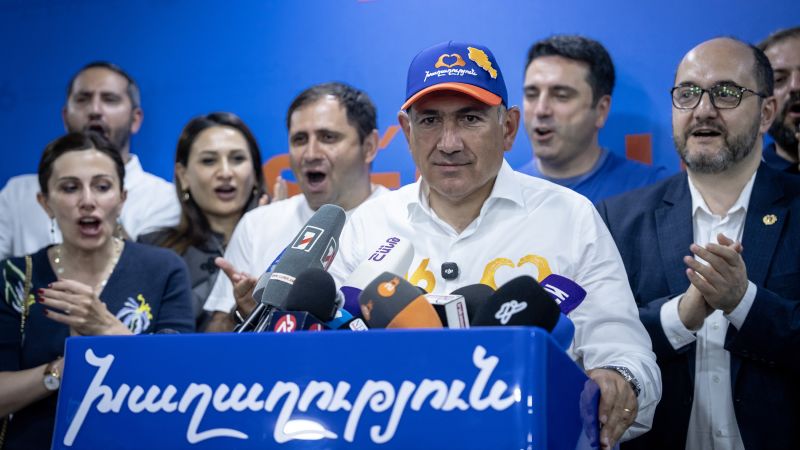
Armenia’s Prime Minister Claims Election Win, Poised to Accelerate Pivot from Russia
Qwenews.com – Armenia’s Prime Minister Nikol Pashinyan has asserted that his victory in the recent parliamentary election signals a decisive shift toward distancing from Russian influence. With the final results confirming his ruling Civil Contract party secured 49.81% of the vote, as reported by Reuters, Pashinyan now faces the challenge of translating this political momentum into tangible progress on his agenda to accelerate a pivot away from Russia. Analysts note that while the narrow lead may not secure an outright majority, it represents a strong endorsement of his vision for a more balanced foreign policy, reducing reliance on Moscow and enhancing ties with the European Union and Turkey.
The Geopolitical Test
This election has been seen as a pivotal moment for Armenia’s geopolitical trajectory, with public opinion heavily influenced by the ongoing conflict with Azerbaijan and the aftermath of the 2023 military defeat in Nagorno-Karabakh. Pashinyan’s campaign focused on renegotiating the country’s relationship with Russia, emphasizing the need for economic diversification and security partnerships beyond the Kremlin’s sphere. His strategy has drawn attention from international allies, including former U.S. President Donald Trump, who publicly supported his bid for reform through a social media endorsement, highlighting the significance of Armenia’s shift in regional alignments.
“Nikol’s help will bring the United States, Armenia, the South Caucasus, and Central Asia to greater heights than ever before. Make (Armenia) Great Again,” Trump stated in a post that underscored the growing interest in Armenia’s potential reorientation toward the West.
Strategic Shifts and Economic Reforms
Amidst the election results, Pashinyan has intensified his efforts to reshape Armenia’s economic and political landscape, positioning the nation as a strategic bridge between Europe and the broader Eurasian region. His administration has prioritized integrating with EU markets, streamlining trade agreements, and reducing dependence on Russian energy imports, which had long dominated Armenia’s economy. While progress is gradual, the election outcome has emboldened his government to push for legislative reforms that could further align the country with Western institutions, including the European Investment Bank and the World Bank.
The decision to accelerate a pivot away from Russia has not been without hurdles. Domestically, Pashinyan faces resistance from factions within his own party and opposition groups that remain loyal to traditional ties with Moscow. Additionally, the Russian government has responded to the election results with a mix of diplomatic pressure and economic sanctions, targeting Armenian goods such as fresh produce, flowers, and spirits to curb its growing independence. This move reflects Moscow’s anxiety over Armenia’s potential shift in allegiance, particularly as the country seeks to strengthen its position in the ongoing peace talks with Azerbaijan.
Russian Concerns and Regional Tensions
Russia’s reaction to the election outcome has been swift and calculated, with President Vladimir Putin emphasizing the importance of maintaining influence over Armenia in a pre-election address. He linked the nation’s pivot to the West to the EU’s role in shaping Ukraine’s 2014 crisis, suggesting that a similar pattern could emerge in the South Caucasus. Despite these concerns, Armenia’s renewed engagement with European partners has gained traction, with the European Commission recently pledging support to ease trade barriers and promote investment in the country’s infrastructure and energy sectors.
The military defeat in Nagorno-Karabakh in 2023 served as a catalyst for Pashinyan’s strategic realignment, prompting a reassessment of Armenia’s security arrangements with Russia. This led to the suspension of Armenian participation in the Russian-led Collective Security Treaty Organization, a symbolic break that signals a deeper commitment to aligning with Western defense alliances. However, the transition remains complex, as Armenia must navigate its historical reliance on Russian military support while building trust with NATO and EU nations to ensure long-term stability.
The Road Ahead: Challenges and Opportunities
While Pashinyan’s victory offers hope for a more independent foreign policy, the path to solidifying Armenia’s pivot away from Russia is fraught with challenges. The government must address internal divisions, secure funding for reforms, and manage the delicate balance between its European aspirations and its relationships with Turkey, Iran, and Azerbaijan. The election result also highlights the public’s growing disillusionment with Russia, particularly among younger voters who see the West as a more attractive partner for economic growth and democratic values.
International observers remain cautious, noting that the success of Armenia’s pivot will depend on consistent policy implementation and the ability to withstand Russian pressure. The European Commission’s recent statement on Russia’s economic sanctions underscores the EU’s recognition of Armenia’s strategic importance, but tangible outcomes will require sustained political will and cooperation. As Pashinyan moves forward, his administration’s ability to deliver on its promises of reform will determine whether Armenia’s shift toward the West becomes a lasting transformation or a temporary realignment.