
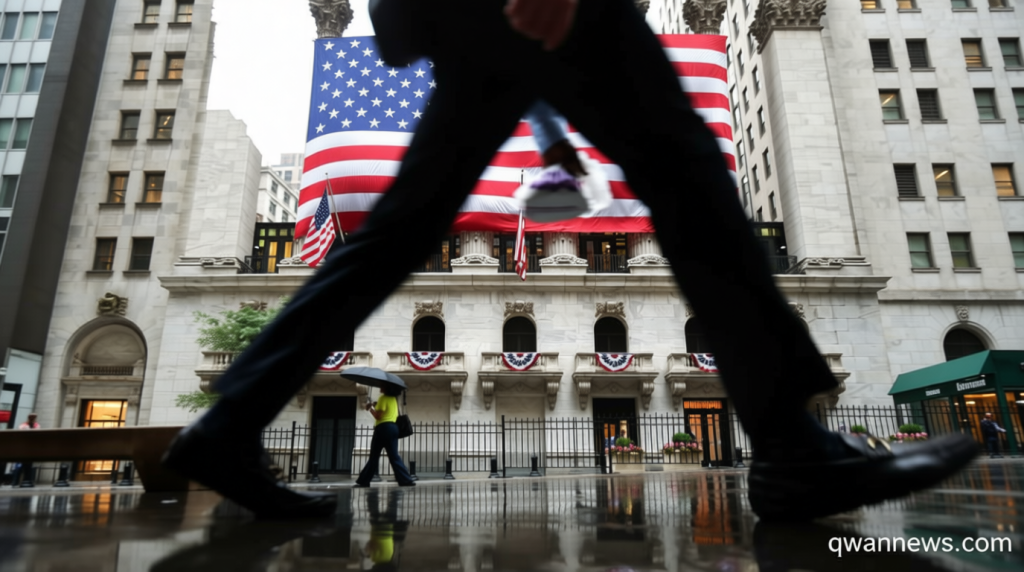
Americans Question Capitalism as Faith in Free Markets Declines
Qwenews.com – Americans are increasingly expressing doubt about capitalism, according to new polling data that reveals a significant shift in economic sentiment across the political spectrum. While President Donald Trump has positioned himself to label Democratic opponents as socialists and communists throughout the 2026 midterm campaign, a more significant transformation is unfolding across the political landscape. Rather than socialism’s ascent, the defining narrative involves Americans increasingly questioning capitalism and economic equity. Recent polling confirms this shift extends well beyond traditional Democratic strongholds, reaching into Republican territories as well.
A Fox News survey mirrors Gallup findings from the previous year, revealing that while socialism receives marginally better reception, capitalism’s standing has deteriorated considerably. The question of whether democratic socialist candidates represent genuine threats appears less alarming than MAGA-aligned figures in the eyes of many voters. This changing dynamic suggests that Americans are evaluating economic policies based on outcomes rather than ideological labels alone.
Shifting Perceptions Among All Parties
Capitalism’s favorability rating has plummeted from a thirty-point positive margin in 2019—when 57 percent of registered voters viewed it favorably against 27 percent unfavorable—to merely four points positive currently, with 50 percent favorable and 46 percent unfavorable. Meanwhile, 65 percent of voters now believe the economic system favors the wealthy, climbing from 56 percent during Trump’s initial term. These numbers indicate that Americans are growing increasingly concerned about economic inequality regardless of their political affiliation.
Perhaps most notably, Republicans have experienced substantial changes in their economic outlook. Capitalism’s favorability among Republicans dropped from 72 percent in 2019 to 61 percent today. Strongly positive views among Republicans fell from 54 percent to 41 percent. Additionally, the proportion of Republicans believing the system favors the wealthy rose from 30 percent in 2018 to 42 percent currently. This erosion of confidence among traditionally pro-business voters signals a broader realignment in how Americans perceive economic fairness.
Consider this: fewer than half of Republicans—the party traditionally championing free markets—maintain strongly favorable views of capitalism. Furthermore, 42 percent of Republicans embrace sentiments reminiscent of Bernie Sanders regarding an economy tilted toward the privileged. Americans who once viewed capitalism as inherently beneficial are now scrutinizing its ability to deliver prosperity to ordinary citizens.
Democratic Socialists Find Unexpected Appeal
Such data illuminates why candidates advocating economic restructuring—regardless of whether they embrace socialism or alternative labels—gain traction among American voters. This trend helps explain how democratic socialists, despite socialism remaining generally unpopular, have emerged as some of the most popular politicians nationally. Americans appear willing to support policies that address their concerns, even when those policies carry ideological labels they might otherwise reject.
Vermont’s independent senator Sanders holds perhaps the strongest image ratings among prominent politicians over the past ten years. Meanwhile, New York Representative Alexandria Ocasio-Cortez performs reasonably well despite years of Republican opposition characterizing her as a political boogeywoman. According to the Fox poll, AOC ranks similarly to Vice President JD Vance, though neither enjoys widespread popularity. These figures demonstrate that Americans are responding to substance over style in political leadership.
Conservative commentator Meghan McCain suggested this week that Republicans face a “huge f***ing problem” should Democrats select someone capable of addressing economic concerns like New York Mayor Zohran Mamdani, a democratic socialist. “The tone of what he is saying is brilliant,” McCain stated on X, continuing: “Despite my abject fear and repulsion of socialism, it is really impactful. If democrats are smart they will nominate someone with his tenor and tone on economics and national policy.”
McCain’s assessment carries considerable weight. Her comments demonstrate that branding opponents as socialists or communists may not function as the decisive weapon Trump envisions. As economic disillusionment spreads across party lines, candidates articulating systemic change find receptive audiences regardless of ideological labels. Americans are ultimately prioritizing solutions to their economic struggles over traditional partisan boundaries.
The implications of this shift extend beyond the current election cycle. If Americans continue to express skepticism toward capitalism while remaining open to socialist-inspired policies, political parties must adapt their messaging accordingly. The traditional conservative strategy of attacking opponents as socialists may lose effectiveness as more Americans recognize the appeal of economic reform. Ultimately, the polling data suggests that Americans are ready for a new conversation about how the economy should work for everyone, not just the wealthy elite.