
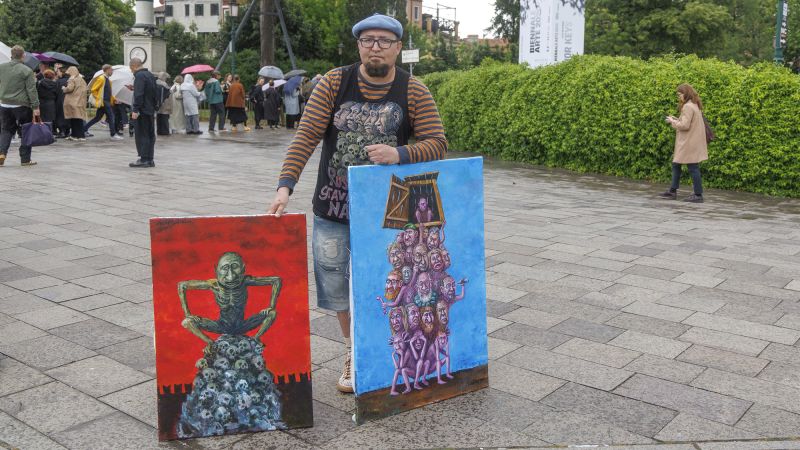
Exiled Russian Artist Known for Anti-Putin Cartoons Shot Dead in Poland
Qwenews.com – The tragic death of exiled Russian artist Semyon Skrepetsky, widely recognized for his incisive anti-Putin cartoons, has sparked international outrage and renewed discussions about freedom of expression in the region. The incident occurred on June 16, 2026, in Biała Podlaska, a small town near the Belarusian border, where the artist was fatally shot by an unidentified assailant. Prosecutors from the Lublin district confirmed the incident, highlighting its significance as a symbolic attack on dissent in Russia’s exiled community.
A Voice of Dissent Through Art
Skrepetsky, whose real name was Robert Kuzovkov, had built a reputation as a provocative political cartoonist in Russia before fleeing the country in 2021. His work often targeted President Vladimir Putin, using exaggerated caricatures to critique his leadership and policies. One of his most iconic series depicted Putin with a bovine nose, a recurring motif that mocked his perceived authoritarianism. These cartoons not only circulated widely within Russia but also found an audience in the diaspora, where they became a powerful tool for political commentary.
His art frequently intertwined humor with social critique, offering sharp insights into Russia’s political landscape. For instance, he once illustrated Putin in a surreal scene of hugging pigs, a metaphor for his controversial decisions during the war in Ukraine. Another notable piece showcased the Russian leader alongside global figures like U.S. President Donald Trump and Chinese President Xi Jinping, juxtaposing their policies and personalities in a satirical manner. These visuals, though lighthearted in style, carried deep political implications, resonating with those who opposed Putin’s regime.
The Shooting and Investigation
According to Marcin Kozak, a spokesperson for the Polish prosecutors’ office, the attack unfolded when Skrepetsky was approached by an assailant who fired two shots at point-blank range. The victim, who was known for his bold critiques, fell to the ground and later died at the scene. The shooter then fired three more rounds before vanishing into the crowd. The incident has been described as a calculated act of violence, with investigators suspecting a link to Russian political forces operating outside the country.
Following the attack, a manhunt led to the arrest of two Belarusian nationals in the vicinity of the Belarusian Consulate in Biała Podlaska. Both suspects, aged 37 and 33, are currently under interrogation for their potential roles in the killing. The location of the crime, close to the Belarusian border, has raised questions about the cross-border coordination of the attack. Polish authorities are working closely with Belarusian counterparts to determine the motive and connection to the broader geopolitical tensions in the region.
“The murder of Skrepetsky underscores the risks faced by those who challenge the Kremlin’s narrative, even from abroad,” said a European Union official in a statement. “His anti-Putin cartoons were not just artistic expressions—they were a rallying cry for those seeking change.”
Skrepetsky’s death has drawn comparisons to other high-profile cases of political violence against Russian dissidents. His exile began in 2021 after he publicly burned his Russian passport in protest of the invasion of Ukraine, an act that cemented his status as a symbol of resistance. However, his views evolved over time, as he grew increasingly critical of Ukrainian leadership and certain factions within the Russian opposition. Despite this shift, his anti-Putin stance remained central to his work, earning him both admiration and enmity among political circles.