
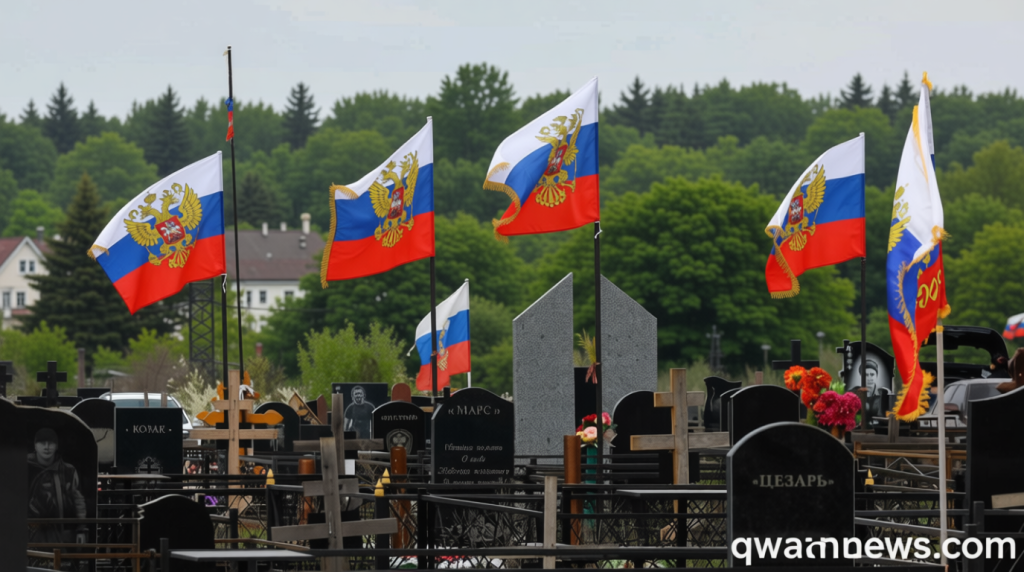
2 Million Casualties in Russia’s Ukraine War: Bloodier Than Stalingrad
Qwenews.com – The war in Ukraine has escalated to unprecedented levels, with Russia’s invasion resulting in over 2 million combined casualties, surpassing the deadly toll of Stalingrad in terms of human cost. This grim figure, revealed in a recent analysis by the Center for Strategic and International Studies (CSIS), includes both military and civilian losses. The data suggests that Russia has suffered approximately 1.4 million casualties—encompassing killed, wounded, and missing personnel—since the conflict began, while Ukraine’s casualty count ranges between 525,000 and 625,000, with 125,000 to 150,000 deaths. The staggering numbers highlight a war that is bloodier than Stalingrad, the most infamous battle of World War II, and are reshaping the dynamics of the conflict.
The Human Toll of Russia’s Invasion
The 2 million casualty total reflects the immense strain on Russia’s military and population. According to the CSIS report, the casualty distribution is uneven, with less developed regions and ethnic minorities bearing the brunt of the losses. In areas like Donetsk and Luhansk, entire villages have been devastated, leaving male populations nearly wiped out in some cases. These localized impacts are not only tragic but also reveal the logistical challenges of maintaining a prolonged war effort in a country with vast, sparsely populated territories.
Russian forces have reported significant attrition, with the rate of casualties outpacing recruitment. This has forced the military to rely on conscription and reserve units, often from regions with lower economic stability or political loyalty to the war effort. The cumulative effect is a mounting pressure on Russia’s domestic resources and morale, as families face the loss of loved ones and the war becomes increasingly unsustainable.
“These casualty rates are staggering,” said Seth G. Jones and Riley McCabe, the researchers behind the CSIS analysis. “Russian fatalities in Ukraine have exceeded four times all U.S. casualties across every war since World War II, and nearly nine times the combined toll of the Soviet and Russian military efforts in global conflicts. The war is not just a military operation—it is a deeply personal and societal crisis.”
Strategic Implications of the Casualty Surge
As the war enters its second year, the casualty ratio has shifted dramatically, with Russia facing losses at an eight-to-one rate compared to Ukraine. This imbalance underscores the challenges of Russia’s attrition-focused strategy, which has been plagued by tactical missteps and a reliance on outdated tactics in modern warfare. Ukraine’s growing use of drone technology and layered defense systems has created a “kill zone” along the frontlines, making it increasingly difficult for Russian troops to advance without heavy casualties.
The CSIS findings align with Western estimates, which have consistently highlighted Russia’s struggle to maintain its offensive momentum. Analysts note that the war has become a test of Russia’s resilience, with its ability to replenish forces declining as the conflict drags on. This has forced the Russian military to adopt a more defensive posture, particularly in the east, where the fighting has intensified. The casualty numbers also raise questions about the long-term viability of the invasion and its impact on Russia’s global standing.
Meanwhile, Ukraine’s ability to sustain its defense has been bolstered by international support and its own strategic adaptations. The country’s drone capabilities, combined with its use of Western-supplied weapons, have transformed the battlefield into a more equal contest. However, the human cost remains high, with civilians suffering disproportionately from the destruction of infrastructure and the displacement of millions. The war’s toll is not just measured in military losses but in the broader trauma to Russian society.
Historically, Stalingrad is remembered as a turning point in World War II, where the Soviet Union’s resilience against the Nazis led to a critical shift in the war’s momentum. The current casualty figures in Ukraine suggest a similar turning point for Russia, albeit in a different context. The conflict has not only tested the military but also exposed vulnerabilities in Russia’s leadership, economic stability, and public support. As the war continues, the question remains: can Russia endure the relentless pace of attrition without significant domestic backlash?
The CSIS report adds context to these numbers, emphasizing that the war’s cost for Russia is now greater than for Ukraine. This is due to the combination of higher casualties, the need for sustained supply chains, and the psychological impact on Russian troops. The researchers also highlight that the conflict’s human cost is likely to rise further, especially as the war enters a new phase of trench warfare and urban combat. The data serves as a stark reminder of the long-term consequences of Russia’s invasion and the evolving nature of modern warfare.