
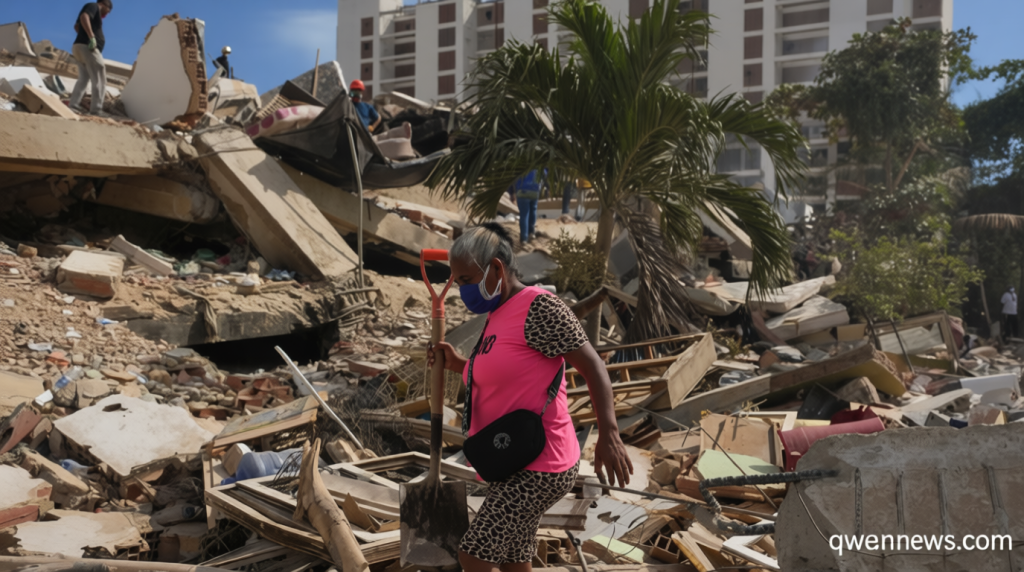
Venezuelans Search Rubble Manually Amid Government Equipment Delays
Qwenews.com – Venezuelans scour collapsed buildings by hand as the government’s machinery remains idle, highlighting the nation’s struggle to respond effectively to the devastation caused by two recent earthquakes. In the coastal city of La Guaira, families have taken to using shovels, pickaxes, and bare hands to extract survivors and recover bodies from the rubble. Despite the urgent need for efficient tools, government excavators and other heavy machinery sit unused due to fuel shortages and logistical failures. Over a week into the crisis, the painstaking efforts of citizens underscore the critical gap between crisis and preparedness.
Infrastructure Crisis and Government Accountability
The earthquakes, which struck with magnitudes of 7.2 and 7.1 on the Richter scale, have exposed the fragility of Venezuela’s infrastructure and the inadequacy of its emergency response. While the government has been praised for organizing volunteer efforts, many argue that its failure to deploy heavy equipment has compounded the suffering. Analysts point to long-standing issues with resource allocation and maintenance, which have left even basic machinery inoperable. “The government’s machinery was meant to be a lifeline, but it’s just sitting idle,” said political commentator Sofia Núñez, emphasizing the disconnect between planning and execution.
“We’re not just dealing with the physical destruction of buildings; we’re witnessing a breakdown in the state’s ability to protect its citizens,” Núñez added. “This is a direct consequence of neglect and mismanagement.”
Residents in La Guaira, where the earthquakes caused widespread damage, are now relying on makeshift methods to navigate the wreckage. Engineering student Hassel Mendoza, who traveled from Tampa to assist in the search, described the challenges: “Without the proper tools, we’re fighting a losing battle. The steel beams are like walls, and we’re cutting through them one by one.” Her experience reflects the broader frustration among Venezuelans, who are questioning the government’s readiness for such disasters.
Delayed Aid and Unmet Needs
As the search for survivors continues, the lack of specialized equipment has left rescue operations in a state of limbo. Civil defense teams from Aragua state reported no access to modern tools such as seismic sensors, hydraulic lifts, or advanced drilling machines. Instead, volunteers are using basic hand tools to dismantle nine-story apartment buildings, a process that is both slow and dangerous. “We’re not just saving lives—we’re risking our own,” said community leader Laura Vargas, who coordinated a local search team. “The government promised aid, but we’re still waiting for it.”
“The absence of machinery isn’t just a technical issue; it’s a symbol of the government’s priorities,” Vargas explained. “They’re focused on maintaining control, not on delivering life-saving resources.”
While the government has distributed water donations and some food supplies, the scale of the crisis has far outpaced these efforts. The official death toll has risen to 1,943, with estimates suggesting that thousands more may be missing. The United Nations has mobilized 10,000 body bags to aid in the recovery process, but the delays in accessing equipment have slowed progress. This has led to growing concerns about the efficiency of the government’s disaster management framework.
Community Resilience and International Concern
Despite the overwhelming challenges, the resilience of Venezuelans has become a defining feature of the response. Neighbors are working together to clear debris, share resources, and support one another in the face of uncertainty. This grassroots effort has been a lifeline in the absence of official assistance. “We’re not waiting for the government to act—we’re doing it ourselves,” said José Ramírez, a local resident. “It’s a survival strategy, but it’s not sustainable.”
“The government’s inaction has forced the people to take charge,” Ramírez said. “This is a moment of solidarity, but it’s also a wake-up call for the state’s preparedness.”
International observers have raised concerns about the government’s handling of the crisis. The U.S. Geological Survey has estimated that over 10,000 people may be trapped or missing, with the potential for the death toll to rise further. Meanwhile, the government continues to defend its efforts, citing organized volunteer networks and the role of community structures. Interior Minister Diosdado Cabello urged citizens to remain patient, stating, “Our communes are the backbone of this rescue operation, and they are working tirelessly.”
Hope and the Road Ahead
Amid the chaos, hope persists as search teams continue their efforts. Families are gathering in makeshift camps, sharing stories of those still missing and praying for their safe return. The tragedy has also sparked discussions about the long-term implications for Venezuela’s infrastructure and emergency systems. “This isn’t just a one-time event—it’s a test of how well the country can recover,” said disaster relief expert Dr. Elena Torres. “The question is whether the government will learn from this or repeat the same mistakes.”
“We need a comprehensive plan to rebuild and prepare for the next disaster,” Torres added. “The people are resilient, but the state must rise to meet their needs.”
With the search continuing in La Guaira and surrounding areas, the focus remains on the human toll of the crisis. As Venezuelans scour collapsed buildings by hand, the hope is that their perseverance will eventually lead to more efficient recovery. The situation serves as a stark reminder of the importance of robust emergency systems and the consequences of their absence. For now, the citizens are the ones holding the line, even as the government machinery remains on the sidelines.