
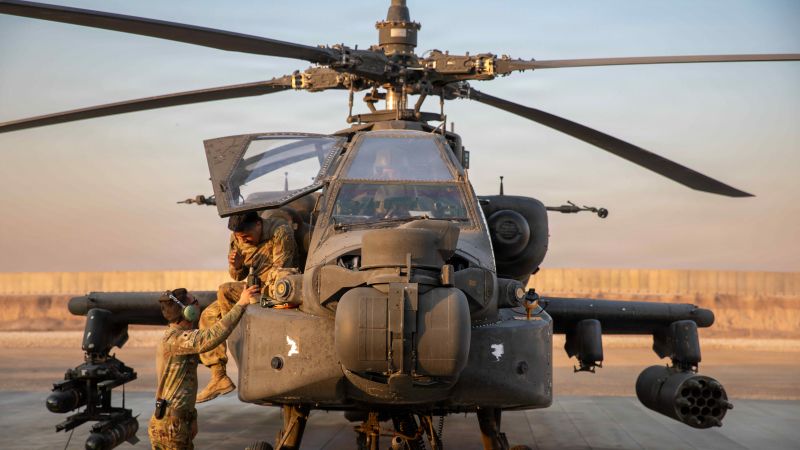
Trump Says Pilots Are Fine After Apache Helicopter Crash Near Strait of Hormuz
Qwenews.com – U.S. President Donald Trump reassured the public that “the pilots are fine” following reports of an Apache helicopter crash near the strategic Strait of Hormuz. The incident, which occurred on June 9, 2026, involved a U.S. military aircraft that went down in the waters surrounding the narrow strait, a critical maritime passage between the Arabian Peninsula and the Indian Ocean. Trump made the statement during a press briefing in New York City after the NBA Finals game, highlighting the safety of the crew and downplaying initial concerns about the crash’s severity.
“The pilots are fine, nobody injured,” Trump declared, addressing reporters with his trademark confidence.
While he offered no specifics on the cause of the crash, the president emphasized that an official report would be released the following day. The incident has sparked renewed scrutiny of U.S. military operations in the region, particularly as tensions between regional powers continue to escalate.
Strategic Importance of the Strait of Hormuz
The Strait of Hormuz, a 30-mile-wide waterway, serves as a vital artery for global oil trade, with approximately 20% of the world’s seaborne oil passing through it daily. Its strategic significance has made it a frequent target for military action, including attacks by Iran and its allies. The Apache helicopter’s crash near this location raises questions about the risks associated with U.S. military presence in the area, especially during heightened conflict periods. Analysts suggest the incident could be linked to ongoing operations targeting Iranian naval assets or monitoring activity in the Persian Gulf.
Trump’s assurance that the pilots are fine comes amid a series of recent military confrontations. In the past month, the U.S. has faced multiple incidents, including the destruction of drones and aircraft by Iranian forces, as well as unexplained losses in aerial combat. The Apache crash adds to these concerns, prompting discussions about the safety protocols and coordination of U.S. military missions in the volatile region.
Apache Helicopter Operations and Regional Context
Apache helicopters are renowned for their versatility in combat scenarios, capable of conducting precision strikes, providing close air support, and executing reconnaissance missions. The U.S. military has relied heavily on these gunships to monitor and engage threats in the Gulf, particularly in response to Iranian aggression. However, this crash marks the first known loss of an Apache since the conflict with Iran intensified in February 2026, according to U.S. Central Command (CENTCOM) records.
CENTCOM has not yet confirmed the exact cause of the incident, but officials noted that the helicopter’s location and mission align with recent efforts to disrupt Iranian supply lines. The crash has also reignited debates about the balance between military readiness and the safety of personnel. Trump’s repeated emphasis that the pilots are fine underscores the administration’s focus on maintaining operational morale and public confidence, even in the face of setbacks.
Meanwhile, the broader geopolitical landscape remains tense. Iran and Israel have been engaged in direct military exchanges, with Iran launching missile attacks and Israel conducting airstrikes in response. The Apache incident occurs amid these developments, raising questions about the potential for further escalation. Experts warn that the region’s instability could lead to more incidents involving U.S. and allied forces.
Historical Precedents and Military Response
Similar incidents have occurred in the region, including the destruction of a U.S. drone by Iranian forces in March 2026 and the crash of a KC-135 Stratotanker in Iraq earlier that year. These events have prompted calls for enhanced coordination and improved communication between U.S. military units and local allies. Trump’s statement that the pilots are fine may also reflect an effort to downplay the incident’s impact on overall military strategy.
Despite the crash, officials have not indicated a significant pause in operations. The U.S. continues to deploy Apache helicopters to patrol the Gulf, where they play a key role in intercepting Iranian vessels and supporting coalition efforts. The military has also been working to recover and analyze wreckage from the incident, with the goal of identifying any lessons learned to prevent future losses. This approach aligns with Trump’s broader narrative of resilience in the face of adversity.