
This Year Could Mark a Space Race Tipping Point
Qwenews.com – This year could mark a space-race tipping point as global superpowers intensify their lunar ambitions. While countless observers gaze upward to witness the solar eclipse, a far more significant contest unfolds beyond our atmosphere. Billionaire visionaries Musk and Bezos are vying for dominance in America’s renewed journey to the moon. CNN FlashDoc’s latest documentary, “Eclipsing Power: Musk, Bezos and The New Space Race,” captures this moment. What once simmered quietly amid global politics has now erupted into a fierce struggle for celestial supremacy. China’s swift technological progress stands alongside America’s growing declarations of intent to secure cosmic territory.
China’s Rapid Ascension
Over the last half-decade, Beijing has achieved remarkable milestones. The Tiangong orbital laboratory now orbits Earth, offering a modern alternative to the aging International Space Station led by Washington. Additionally, Chinese spacecraft accomplished an unprecedented feat by collecting the first soil samples from the moon’s far side—a task no other country has replicated. Yet perhaps most consequential is Beijing’s ambition to establish a permanent lunar settlement before 2040. This goal has galvanized American legislators, prompting NASA to commit resources toward building its own moon base.
Complicating matters is China’s traditionally opaque approach to aerospace development. Determining precisely which nation leads remains challenging without complete transparency. Nevertheless, several indicators suggest this year represents a critical juncture. The moon’s southern polar region has emerged as the central battleground for both superpowers.
The Water Ice Prize
Scientists consider the south pole essential because they believe it harbors substantial deposits of water ice. This precious resource holds tremendous value for future space exploration. It can be transformed into rocket propellant, oxygen for breathing, and potable water—all necessities for maintaining human presence beyond Earth. Both Washington and Beijing intend to dispatch robotic probes to this region during 2026, clearing the path for eventual human missions.
America depends heavily on commercial enterprises to create affordable robotic landers. The upcoming Griffin mission, developed by Pittsburgh-based Astrobotic Technology, will attempt delivery to the lunar south pole toward the end of 2026. This NASA-supported endeavor aims to surpass two previous American landers that stumbled during their attempts to navigate the challenging southern terrain.
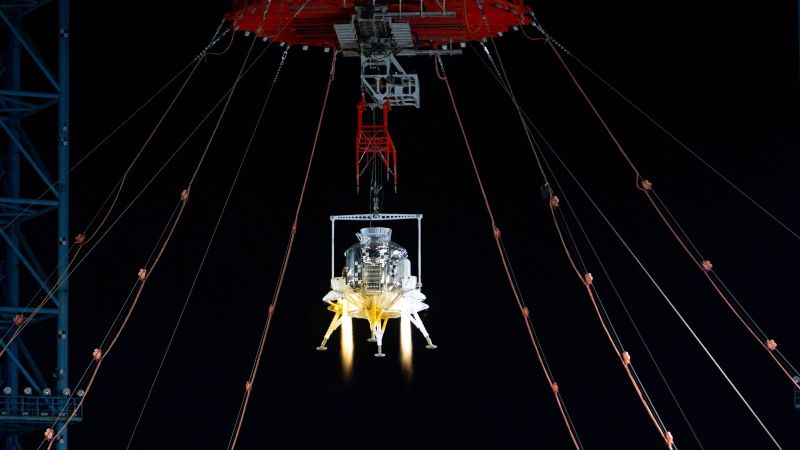
Meanwhile, China prepares to launch its sophisticated Chang’e-7 mission imminently. This ambitious project employs four distinct robotic systems—an orbiter, lander, rover, and mobile “hopper”—operating together to collect unprecedented scientific data. Notably, the mission includes instruments capable of drilling into and analyzing water ice directly. American robotic missions targeting similar objectives won’t arrive until at least next year.
“If lunar water ice is successfully located, it could significantly reduce the cost and time required to transport water from Earth, facilitating the establishment of a human base for long-term activities on the moon and enabling further exploration of Mars or deep space,” Tang Yuhua, the deputy chief designer of the Chang’e-7 mission, said in a 2025 interview with state media.
Higher Stakes for Humanity
This surge of south-pole-focused activity occurs against a backdrop of limited international regulations governing space activities. The situation recalls Cold War dynamics, when NASA’s lunar achievements demonstrated Western capitalist technological superiority over Eastern communist systems. However, contemporary ambitions extend far beyond mere visits to the moon.
Clayton Swope, deputy director of the Aerospace Security Project at the Center for Strategic and International Studies, emphasizes that the current objectives involve creating permanent settlements where humans can thrive. The nonprofit organization maintains bipartisan representation.
“The long-term vision will take generations to execute on,” Swope said. “But in my mind, it’s a scenario where there are people being born, people dying, their families, children growing up in a place that is not Earth — so that looks a lot like a city, more than it looks like an expedition to the south pole.”
Swope expresses hope that any future extraterrestrial colonies would operate under frameworks reflecting Western democratic values. Whether China shares this perspective remains uncertain. Beijing’s space program receives direct guidance from leadership, with President Xi Jinping championing the construction of a cooperative lunar station as a cornerstone of national ambition.
Frequently Asked Questions
When will China launch its Chang’e-7 mission?
China is preparing to launch its Chang’e-7 mission imminently in 2026, with the mission employing four distinct robotic systems to explore the lunar south pole.
What is the significance of water ice on the moon?
Lunar water ice can be transformed into rocket propellant, oxygen for breathing, and potable water—all necessities for maintaining human presence beyond Earth and reducing transportation costs from Earth.
How does this space race differ from the Cold War era?
While the Cold War focused on demonstrating technological superiority, contemporary ambitions extend to creating permanent human settlements on the moon and enabling further exploration of Mars and deep space.
What role do commercial companies play in America’s lunar program?
America depends heavily on commercial enterprises like Astrobotic Technology to create affordable robotic landers, with the upcoming Griffin mission representing this public-private partnership approach.