
Saudi Arabia Turns to Muslim Allies in Defense Pact
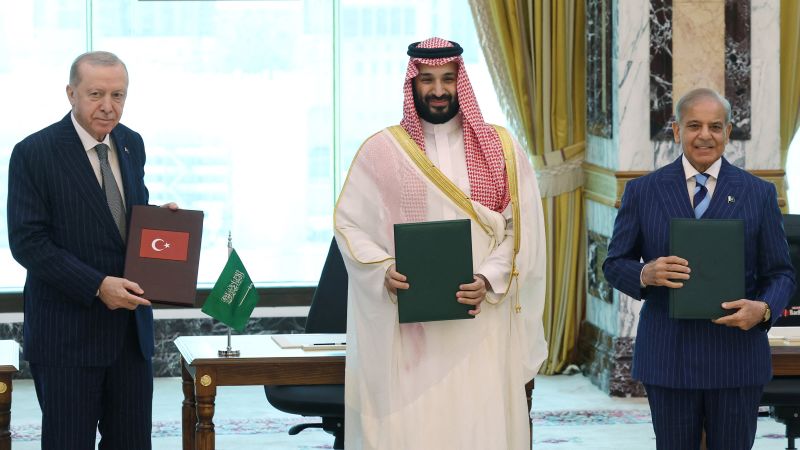
Qwenews.com – Saudi Arabia turns to Muslim military heavyweights as regional tensions with Iran intensify. On Friday in Mecca, the kingdom formalized a landmark defense agreement with Pakistan and Turkey, creating a NATO-style mutual protection framework. Under this arrangement, any attack on one member nation triggers collective response from all three signatories.
Strengthening Regional Security
The agreement aims to build collective deterrence capabilities while enhancing comprehensive defense cooperation among the three nations. For Saudi Arabia, this pact provides additional security beyond its longstanding relationship with Washington, particularly as confidence in American commitment to Gulf allies faces renewed scrutiny.
Turkish forces represent NATO’s second-largest military contingent, while Pakistan remains the only Muslim nation with nuclear weapons. Together, these partners create a unified Sunni-led military presence addressing Iranian pressure. Turkish officials emphasized the arrangement targets no specific adversary, and Saudi Arabia’s foreign ministry clarified the pact does not constitute a sectarian military bloc.
Open to Future Expansion
Turkish officials indicated that additional regional nations may eventually join the arrangement, potentially following NATO’s expansion model. The published statement omitted detailed specifications regarding each country’s individual obligations and left ambiguous the extent of military intervention commitments.
The timing proves significant as Israel extends military operations throughout the Middle East while Saudi Arabia’s relationship with the United Arab Emirates shows signs of strain. Both Pakistan and Turkey share borders with Iran and possess compelling motivations to prevent regional escalation. Pakistan must balance its considerable Shiite demographic and delicate diplomatic ties with Tehran, while Turkey and Iran maintain shared concerns regarding Kurdish separatist movements.
Addressing Iranian Threats
During ongoing conflict, Tehran repeatedly targeted Saudi facilities encompassing civilian infrastructure, energy installations, and American interests. While direct Iranian strikes on Saudi territory diminished following an April 8 ceasefire agreement, Iran-aligned groups operating in Yemen and Iraq maintained pressure on the kingdom.
Riyadh has emerged as one of the war’s most vocal critics, actively working to moderate US President Donald Trump’s approach toward the Islamic Republic. A Saudi representative informed CNN on Thursday that the kingdom prepares for a substantial coordinated offensive by Iran-backed militias in Iraq and Yemen, backed by the Islamic Revolutionary Guard Corps.
“The Saudis should understand that a paper agreement with Turkey and Pakistan will not bring them security, just as decades of one-sided dependence on the Americans failed to do so.”
The Mecca treaty functions as a clear message to Iran: a significant additional assault on Saudi Arabia could activate the pact, pulling Pakistan and Turkey into hostilities and substantially broadening the conflict. Iranian reactions revealed considerable displeasure with the arrangement. Ebrahim Rezaei, a member of parliament’s National Security and Foreign Policy Committee, expressed skepticism on social media platform X.
Frequently Asked Questions
What countries are part of the new defense pact? The agreement includes Saudi Arabia, Pakistan, and Turkey, forming a mutual defense arrangement similar to NATO’s collective security model.
How does the pact work in practice? Under the framework, any assault directed at one member nation will be considered an attack upon all three signatories, triggering collective military response.
Is this a sectarian alliance? No. Both Turkish and Saudi officials emphasized that the arrangement targets no specific adversary and does not constitute a sectarian military bloc or formal axis.
Could other countries join the pact? Turkish officials indicated that additional regional nations may eventually join the arrangement, potentially mirroring NATO’s expansion model.
What is the connection to ongoing Iran tensions? The pact strengthens Saudi Arabia’s position as Tehran repeatedly targeted Saudi facilities and maintains pressure through Iran-aligned groups in Yemen and Iraq.
CNN’s Issy Ronald, Aida Karimi, Gul Tuysuz and Sophia Saifi contributed reporting.