
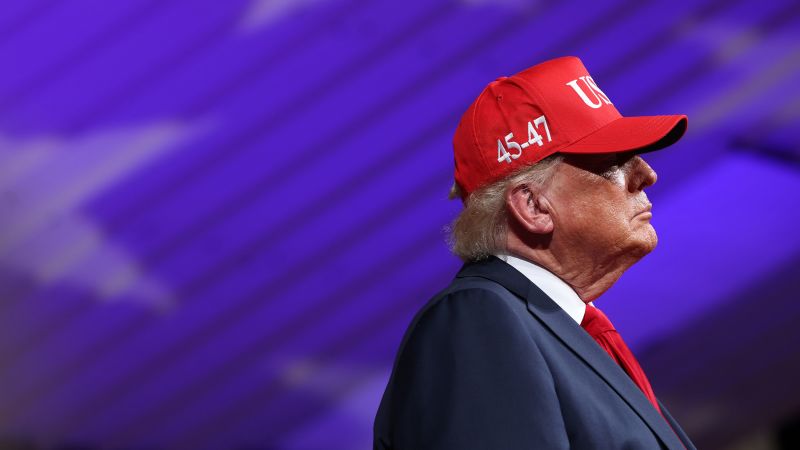
Trump’s AI Push Is Tied to a Much Larger Economic Bet
Qwenews.com – President Donald Trump’s forceful support for rapid artificial intelligence expansion is putting him in an unusual position: increasingly distant from some of the technology industry’s most prominent executives while also out of step with many voters uneasy about the infrastructure behind the AI boom.
That stance carries political risk less than two months before the midterm elections. Communities across the country have resisted plans for nearby data centers, while many Americans remain skeptical about how AI will affect jobs, privacy and everyday life. Yet the administration’s emphasis on moving quickly may reflect a more immediate concern than public opinion: the possibility that the US economy has become too reliant on AI investment to tolerate a serious pullback.
Spending on advanced computing, data centers and related technology is now a major force in economic growth. ING estimates that technology investment centered on AI and data centers represents roughly one-third of year-over-year US economic growth in 2026. AI-related investment is also responsible for half of all profit growth in the S&P 500, Goldman Sachs’ chief equity strategist recently told CNBC.
Those estimates involve judgment calls, and economists caution that no single calculation can fully capture AI’s contribution. Still, the broader picture is difficult to ignore. Without the surge in spending on chips, servers, power-hungry facilities and software, the economy would likely be far weaker and could potentially be in recession.
Why an AI slowdown could spread beyond Silicon Valley
Supporters of AI see the technology as a transformational economic force, comparable in its eventual productivity impact to the internet’s expansion around the beginning of the century. The expected gains are not limited to technology companies: advocates anticipate that broad adoption could change how businesses organize work, create products and serve customers.
But the near-term economic story is more fragile. A reduction in AI investment could challenge lofty share prices, particularly among companies closely tied to the buildout. Lower stock values could reduce household wealth, weaken consumer confidence and make companies more cautious about their own investment plans.
“If the music stops, and if it stops in a big, big way, it’s likely that we’re going to end up in stagnation or outright contraction over a period of at least a year,” Olu Sonola, US head of economic research at Fitch Ratings, told CNN.
Consumer spending is a central part of that concern. Investors whose portfolios have gained from AI-related stocks may feel wealthier and spend more freely, reinforcing an economy that depends heavily on household demand. In that sense, the AI boom is doing more than enriching technology investors; it is helping support activity across a consumer-driven economy.
If the flow of money into the sector slows sharply, the consequences could reach well beyond Wall Street and the companies building AI systems. A decline in stock wealth can affect decisions about travel, housing, large purchases and discretionary spending, while weaker business valuations can limit hiring and capital spending.
A recession scenario illustrates the stakes
Fitch recently examined a hypothetical AI-linked downturn in which US equities fell about 35% over six months. That drop is close to the median decline experienced during past financial busts. In the scenario, the United States entered recession and gross domestic product contracted by 1.5% the following year.
The ratings agency did not present that outcome as its forecast. It said a steep drop in US equity prices is not its base case, and there is no specific signal that AI investment is about to collapse. Still, the scenario highlights how concentrated economic momentum has become around a relatively connected group of businesses and investors.
“We have this ecosystem that’s spun up around AI,” said John Sedunov, a finance professor at Villanova University. “There are a bunch of companies that are very reliant on each other. And when you break a link in a chain like that, then there’s bound to be fallout.”
That interconnectedness includes companies financing construction, supplying hardware, developing models, operating data centers and buying the services those systems provide. A disruption in one part of the chain could affect demand elsewhere, especially if investors react by cutting back funding or reassessing future revenue expectations.
Other economic pressures raise the risk
The AI boom is not unfolding in isolation. Bond markets have signaled rising anxiety about government debt, persistent deficit spending and elevated inflation. Those pressures could contribute to an environment of higher interest rates, making it more expensive for businesses to borrow and invest.
War in Iran has added another source of uncertainty, while investors have poured into corporate debt to help fund the enormous AI infrastructure buildout. Taken together, those factors leave the economy exposed to more than one potential shock at a time.
“The equity price bubble risk is definitely a big one” to the global economy, Sonola said. “We’ve seen tariffs, we’ve seen the war. Another shoe is going to drop. We may just not know yet.”
For Trump, the policy challenge is therefore broader than a debate over permitting, regulation or corporate competition. A slower AI buildout may be welcomed by residents worried about data centers and by people concerned about unchecked technology. At the same time, a sudden reversal could expose how much current growth has depended on the AI spending cycle.
Optimists see durable gains beyond the market frenzy
Not everyone believes today’s enthusiasm will end in a crisis resembling the 2008 financial collapse. Jessica Wachter, a finance professor at the University of Pennsylvania’s Wharton School, acknowledges that the scale of the current AI investment wave is unusual and understandably unsettling. But she sees a potentially more constructive long-term outcome.
“I actually think that (AI) is going to be a bit of a stabilizing force… generally promoting net job creation and growth. I am, you can tell, an optimist, though. I know others have other views.”
The divide between those views captures the core uncertainty surrounding AI. The technology may eventually deliver meaningful productivity gains and wider economic growth. But until those benefits become more broadly visible, the economy remains heavily dependent on continued confidence, continued investment and the belief that today’s enormous buildout will produce lasting returns.
Related Reading
Frequently Asked Questions
What is The real reason for Trump s pedal?
The real reason for Trump s pedal is the main topic of this guide. The article explains the context, practical details, and next steps readers should understand.
Why does The real reason for Trump s pedal matter?
The real reason for Trump s pedal matters because readers are looking for a useful answer, not just a short summary. Good content should match search intent and help them decide what to do next.