
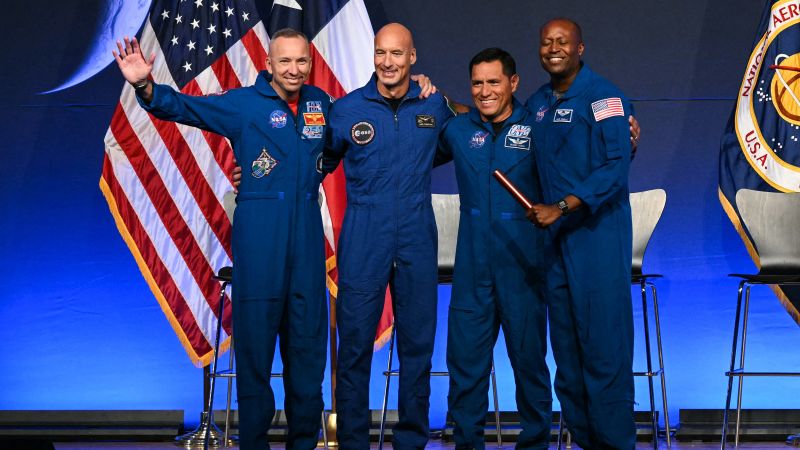
NASA Reveals Artemis III Crew for Lunar Mission
Qwenews.com – NASA has officially announced the Artemis III crew, marking a crucial milestone in its mission to return humans to the Moon. The team, comprising four astronauts, is set to embark on a two-week test flight in late 2027, focusing on critical systems that will support future lunar landings. This crew includes three NASA astronauts and one European Space Agency (ESA) representative, highlighting the growing international collaboration in space exploration. The announcement underscores NASA’s commitment to its Artemis program, which aims to establish a sustainable presence on the Moon and serve as a gateway for deeper space missions.
Crew Composition and Mission Objectives
The Artemis III crew features a mix of experienced and first-time astronauts, ensuring a balance of expertise and fresh perspectives. Among them is Andre Douglas, who will make his debut in space, and Frank Rubio, a veteran with a record for the longest single spaceflight by an American. Randy Bresnik, a test pilot with prior experience in NASA’s space missions, joins the team. ESA’s Luca Parmitano, a seasoned astronaut, will serve as the international representative. This mission’s primary goal is to test the Orion spacecraft’s docking capabilities with lunar landers, a vital step toward the program’s ultimate aim of landing humans on the Moon’s surface by 2028.
“Artemis III is not just about getting to the Moon—it’s about proving the technologies and procedures that will enable long-term exploration,” emphasized NASA spokesperson Melissa Moore. “Every detail, from crew training to spacecraft systems, is designed to ensure success.”
Testing in Low-Earth Orbit
Artemis III will conduct its critical tests in low-Earth orbit (LEO), a strategic decision that allows for controlled environments to simulate the complexities of lunar operations. By using LEO, NASA can evaluate the Orion capsule’s ability to dock with different landers, a process essential for future missions. The spacecraft will launch from Florida’s Kennedy Space Center, reusing the Orion capsule that successfully completed the Artemis II flyby in April 2026. This approach not only reduces costs but also enables the crew to refine procedures without the risks associated with lunar conditions.
Logistics and Lunar Lander Options
The mission’s logistics involve at least one lunar lander launching separately from the Orion spacecraft, though the final choice between SpaceX’s Starship and Blue Origin’s Blue Moon remains under review. Once in LEO, the landers will rendezvous with Orion, allowing the crew to transfer between vehicles. NASA’s program manager, Jeremy Parsons, highlighted the importance of this phase: “The Artemis III crew will test how Orion interacts with both landers, which is critical for future missions.” However, the timeline for both landers is uncertain, with Blue Origin recently facing delays after a New Glenn rocket explosion during a ground test.
“We’re working closely with both SpaceX and Blue Origin to ensure their landers meet the required standards for Artemis III,” said Parsons. “This competition is driving innovation and giving us more options for long-term lunar operations.”
Training and Timeline Adjustments
The Artemis III crew has about one year for training, a shorter window compared to Artemis II astronauts who spent three years preparing due to earlier schedule shifts. This accelerated timeline reflects NASA’s focus on incremental testing, aiming to reduce risks before the first lunar landing in 2028. A key milestone, the wet dress rehearsal for the Space Launch System (SLS) rocket, is planned for the end of the year, with the goal of finalizing launch readiness by early 2027.
The mission’s revised plan, announced in February 2026, prioritizes testing over direct landing, allowing NASA to gather data on systems like the lunar lander, habitats, and navigation tools. This phased approach ensures that each component is validated before the full-scale landing, which will require the Artemis III crew to demonstrate the integration of all systems under realistic conditions.
Significance for Future Exploration
Artemis III represents a pivotal step in NASA’s broader vision of deep space exploration. By focusing on lunar lander compatibility and low-Earth orbit testing, the mission lays the groundwork for sustainable lunar operations and eventual missions to Mars. The crew’s experience will be vital in refining the protocols needed for long-duration stays on the Moon, including habitat maintenance, scientific research, and emergency procedures. Additionally, the mission will provide valuable data on how humans can live and work in space for extended periods, which is essential for future interplanetary travel.
As the Artemis program progresses, the focus keyword “NASA reveals Artemis III crew” is naturally integrated into the narrative, emphasizing the team’s role in advancing the mission’s goals. The crew’s selection highlights NASA’s strategic investment in human spaceflight, ensuring that the Artemis III mission will be a cornerstone in the agency’s efforts to establish a lunar presence and prepare for deeper space exploration. With the upcoming wet dress rehearsal and the crew’s training underway, the Artemis III team is poised to take a significant step toward achieving these ambitious objectives.