
DNA Evidence From Thomas Jefferson Clarifies Hemings History
Qwenews.com – DNA evidence from Thomas Jefferson has added substantial genetic support to the historical record concerning Sally Hemings and her children. Researchers reconstructed DNA from hair attributed to the third US president, then compared it with samples from living descendants across several family branches.
The analysis found a 99.96% probability that Jefferson fathered at least one of Hemings’ children. It adds new scientific findings to an issue that has been debated for generations through historical documents, family accounts and earlier genetic research.
Hemings was enslaved in Jefferson’s household. Four of her children survived into adulthood, and two of them—Madison Hemings and Eston Hemings—said Jefferson was their father. The study examined descendants of those two lines alongside descendants connected to Jefferson, his wife Martha and his brother Randolph.
How the researchers obtained the genetic material
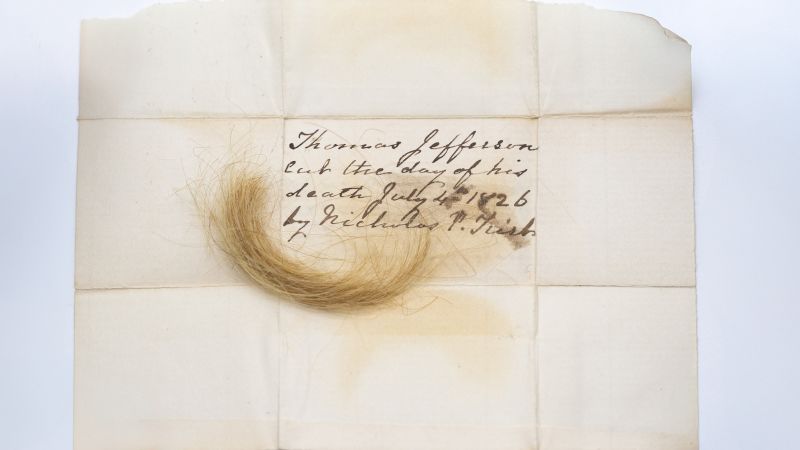
The project began in 2011, when staff at the Smithsonian National Museum of American History found a reddish-blond hair pressed inside a Bible once owned by Jefferson. Researchers initially considered whether it could provide a direct genetic link to him.
Testing showed otherwise. Scientists compared the hair’s mitochondrial DNA with DNA from a living descendant through Jefferson’s maternal line. Because mitochondrial DNA passes through mothers, the samples would have been expected to match if the hair were Jefferson’s. They did not.
Researchers continued their work with other historical hair samples documented as belonging to Jefferson, including a lock reportedly cut at his deathbed. The samples were held in a packet supplied by the Thomas Jefferson Foundation at Monticello and had not previously been available for this kind of analysis.
Using those materials, the team reconstructed historic genome sequences and compared them with samples from 16 living people. That broader comparison is what distinguishes the new DNA evidence from Thomas Jefferson from the earlier study focused on a paternal marker.
What changed from the 1998 study
A 1998 study led by the late Eugene Foster found a rare Y-chromosome haplotype in male descendants of Thomas Jefferson’s uncle and in descendants of Hemings. It linked the Hemings descendants to a man in the Jefferson family, but it could not determine whether Thomas Jefferson himself or another male relative was the father.
“He didn’t have Thomas Jefferson’s DNA,” Richard Kurin said of the earlier research. “He didn’t have something to directly compare living descendants of the Jefferson family to Madison Hemings and Eston Hemings and others that might have been the descendants of Thomas Jefferson.”
Kurin, a distinguished scholar and ambassador-at-large at the Smithsonian, is the senior author of a paper describing the new methods. The paper was posted September 21 on the preprint platform bioRxiv and has not yet undergone peer review. His book, History by a Hair: Thomas Jefferson, Sally Hemings & Solving a 200-Year-Old Mystery, was published September 22.
By examining multiple descendants and branches of the family tree, researchers could assess how closely inherited genetic material matched an expected relationship. DNA evidence from Thomas Jefferson therefore offers a more direct comparison than the Y-chromosome finding alone.
FAQ: Understanding the Jefferson-Hemings DNA Findings
Does the study prove that Thomas Jefferson fathered every child of Sally Hemings?
The analysis reported a 99.96% probability that Jefferson fathered at least one of Hemings’ children. The findings strengthen the case for Jefferson’s paternity, while the study’s stated conclusion concerns at least one child.
Why does peer review matter?
The research paper was posted on bioRxiv, a preprint platform, and had not yet been peer reviewed. Peer review allows independent specialists to evaluate the methods, data and conclusions before formal publication.
Why were living descendants included?
Living descendants provided comparison samples that helped researchers evaluate reconstructed DNA from the historical hair. Looking across several family lines can reveal more about a possible relationship than relying on one inherited marker alone.