
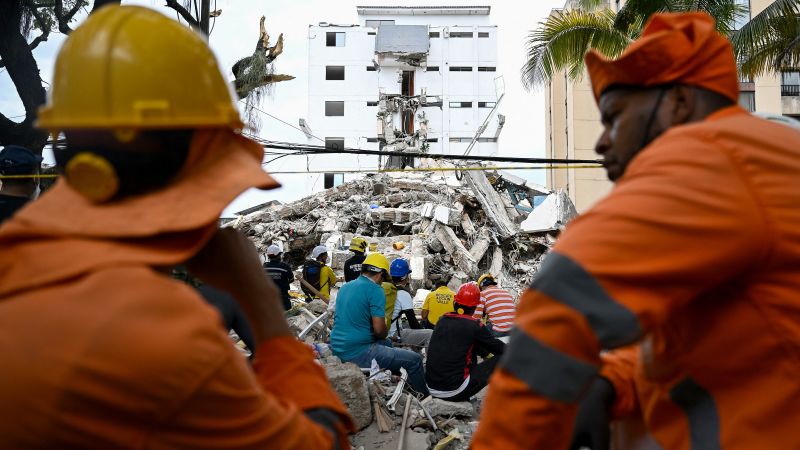
Qwenews.com – Lee este artículo en español Colombia has begun receiving international aid and rescuers after initially refusing some offers in the crucial hours following Monday’s devastating earthquake. The delay is considered the first controversy of the country’s new government, led by conservative President Abelardo de la Espriella, who took office on Friday. News of the holdup comes as the clock nears the end of the critical 72-hour window for rescuing survivors under the rubble of collapsed buildings, after which rescuers warn that the possibility of finding anyone alive drops dramatically.
Leaders across the Americas had offered support right after the 7.4 magnitude quake struck this week – just as they had done with Venezuela when it was hit by two powerful tremors in June. The difference is that Venezuela immediately received dozens of international rescue groups without question, while Colombia either turned some of them down or limited how they would help. Political scientist Sandra Borda argued that the difficulties in aid management are related to the tense political transition between the current and previous administrations, which lacked a formal handover.
Notably, it was only on Wednesday that David Tamayo Roldán was appointed director of the National Unit for Disaster Risk Management, the agency responsible for Colombia’s disaster preparedness and response. “Without a transition and with that kind of personnel change, it was perfectly normal for these short circuits to occur,” said Borda, a professor at Universidad de los Andes. The outlook on Tuesday was uncertain as multiple countries and organizations, including the UN, said they had not received a request for aid from Colombian authorities.
“If that happens, the United Nations system and humanitarian actors are prepared to provide all the support we can,” said Jens Laerke, spokesperson for the UN Office for the Coordination of Humanitarian Affairs. Mexico, which had prepared tons of supplies and a contingent of 255 military personnel, also it had not received a request from Colombia and that the deployment depended on it. Meanwhile, Chinese ambassador to Colombia Zhu Jingyang “urgently” asked Colombia to establish an official channel to coordinate international assistance, saying, “We hope the Colombian Government will immediately announce the name of the official and their contact to coordinate international assistance for the earthquake victims.” As the hours passed, coordination finally began.
Salvadoran President Nayib Bukele announced Tuesday afternoon that he was sending humanitarian aid to Colombia but noted that de la Espriella’s government requested aid “only in the form of supplies” for those affected. “We have been informed that their rescue teams, medical personnel, and other emergency bodies are deployed and attending to the situation, so at this time, they do not require personnel support,” he said. However, Peru confirmed Wednesday that it will dispatch volunteers to support search and rescue efforts.
The Colombian Foreign Ministry later said it was preparing a list of “specific needs” to request international aid and that it had asked the United Nations Development Programme to provide support. The new head of disaster management also said Wednesday that the government has requested rescue teams from only four countries – the US, El Salvador, Ecuador and Israel – because, in Colombia’s view, their rescue teams have the international and national certifications required for the job. Foreign Minister Omar Bula insisted that the country has “not excluded absolutely any country in terms of the offers that have been made to us,” adding, “We work with countries without any ideological or political consideration.” The US confirmed Wednesday that had mobilized search and rescue teams from Virginia and California to Colombia after receiving a request from its government.
Borda commented that the new government showed “a deep distrust of some parts of the international community,” which she considered “difficult to understand.” She added that there was “no clarity about the procedure that was to be followed” regarding the arrival of rescuers, saying, “I think this happened to us at a very difficult time. It is truly a regrettable situation.” She also said that the subsequent acceptance of the arrival of experts undermined the argument that they were not needed. “There was a perception from the beginning that the rescue teams would be sufficient, although a technical assessment was never made public to confirm that they would indeed be enough to deal with all the damage and destruction caused by the earthquake,” she said.
In any case, it is also unclear where international personnel are needed. The emergency chief of the fire department in Cali, one of the most affected cities, indicated that volunteers should not approach collapsed sites “because there are already enough specialized personnel to carry out the rescue work without complications.” The Topos Tlatelolco Rescue Brigade, a Mexican group with extensive experience responding to natural disasters, said Wednesday that Colombian authorities “will not allow the entry of external rescue groups” because the work is being handled by national rescuers. Meanwhile, in Pereira, another severely affected city, the foreign ministry celebrated the arrival of 19.5 tons of aid from Mexico.
“Additional flights are expected in the coming days. Colombia is not alone! The international community is with us,” the ministry said on X.
Mexican President Claudia Sheinbaum confirmed that her government had finally coordinated with its Colombian counterparts, who “requested specific items” and that the flight also included “members of the Mexican Army to assist in the efforts.” Michael Rios contributed to this report.
Related Reading
Frequently Asked Questions
What is Colombia limits foreign rescue teams as earthquake?
Colombia limits foreign rescue teams as earthquake is the main topic of this guide. The article explains the context, practical details, and next steps readers should understand.
Why does Colombia limits foreign rescue teams as earthquake matter?
Colombia limits foreign rescue teams as earthquake matters because readers are looking for a useful answer, not just a short summary. Good content should match search intent and help them decide what to do next.