
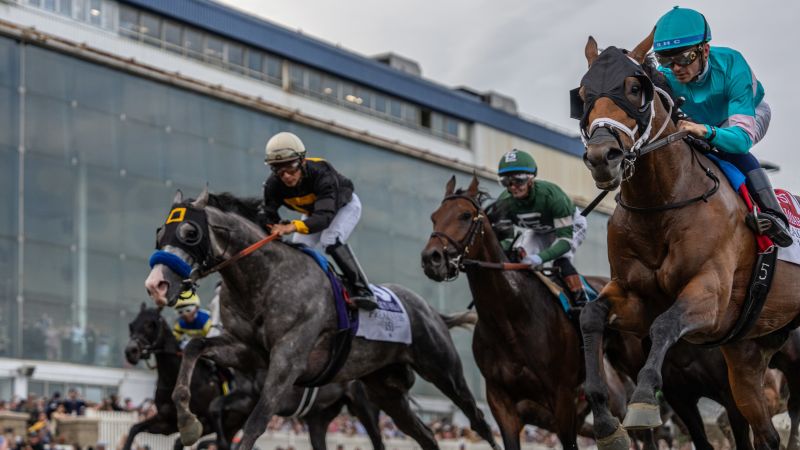
A Sport in Crisis: How Greed Is Undermining Horse Racing’s Golden Era
Qwenews.com – At first glance, college football and horse racing appear to occupy opposite ends of the athletic landscape. One represents a multi-billion-dollar juggernaut that dominates headlines from late summer through winter. The other occupies a modest five-week window on the annual calendar. Yet both face nearly identical challenges: corporate greed, competing interests, and a remarkable failure to collaborate effectively.
The Preakness Makes a Move
Maryland’s governor, Wes Moore, revealed on Wednesday that the Preakness Stakes will shift from its customary third Saturday in May to the fourth Sunday of that month. On the surface, this adjustment appears sensible. For years, trainers and owners have maintained that the traditional two-week gap between the Kentucky Derby and the Preakness no longer accommodates modern thoroughbreds.
If you want to win the Triple Crown, we’ll see you in Baltimore.
Moore’s statement, delivered during a press conference emphasizing Maryland’s importance, overlooked one detail: victory in the Triple Crown requires competing in three separate locations, not just Baltimore. Three of the past five Derby champions have skipped the Baltimore race entirely, effectively ending their Triple Crown ambitions before they truly began.
Partnerships Without Coordination
The timing of this calendar change reveals deeper problems. Just two days before Moore’s announcement, Churchill Downs, Incorporated and the New York Racing Association unveiled a collaboration to create a six-race thoroughbred circuit. This new series incorporates the Belmont Stakes, the Triple Crown’s final leg.
According to the announcement, the Belmont will maintain its traditional first Saturday in June slot. Consequently, horses seeking the Triple Crown must now compete thirteen days following the Preakness, rather than the previous two-week window after the Derby. This creates an unfortunate scenario: equine athletes will face the longest race in the series—the Belmont at one-and-a-half miles—after the shortest recovery period available.
This isn’t merely a schedule adjustment; it represents a bait-and-switch that threatens the Triple Crown’s viability.
History and Heartbreak
The Triple Crown stands as horse racing’s most recognizable achievement, as familiar to casual observers as a mint julep or a wide-brimmed hat. Beyond the Derby, Preakness, and Belmont, only the Breeders’ Cup generates over $100 million in annual wagers.
Since Sir Barton’s historic victory in 1919 through Justify’s triumph in 2018, the Triple Crown has been celebrated for both its difficulty and its rarity. During my years covering sporting events, I’ve frequently been asked which moment stands above all others. I witnessed Christian Laettner’s buzzer-beater against Kentucky and watched the American Olympic hockey team capture gold in Milan. Yet nothing compares to the roar that erupted when American Pharoah crossed the finish line in 2015, ending a 37-year drought.
We cannot control our own future if we don’t own it.
That euphoric celebration has somehow become another commodity in corporate negotiations. The greater good has been sacrificed to infighting among the three organizations as they competed for valuable broadcast agreements.
College Sports Parallel
The situation mirrors college athletics, where backdoor meetings serve self-preservation above all else. Operating without a central commissioner to maintain balance, horse racing’s governing bodies have prioritized individual interests.
Had NYRA, Churchill Downs, and the Maryland Jockey Club collaborated properly, they could have modified the calendar while preserving both their races and the Triple Crown’s integrity. Instead, Churchill (analogous to the SEC) maintains tradition while securing additional revenue through the Derby and the new series. NYRA (the Big Ten equivalent) receives four series races on its tracks plus a revenue share. Maryland (the ACC counterpart) retains its regional market position.
Lost amid this self-serving maneuvering is the one thing that makes horse racing special. The Triple Crown can still happen. But only if the sport remembers what truly matters.
Related Reading
Frequently Asked Questions
What is What college football and horse racing?
What college football and horse racing is the main topic of this guide. The article explains the context, practical details, and next steps readers should understand.
Why does What college football and horse racing matter?
What college football and horse racing matters because readers are looking for a useful answer, not just a short summary. Good content should match search intent and help them decide what to do next.