
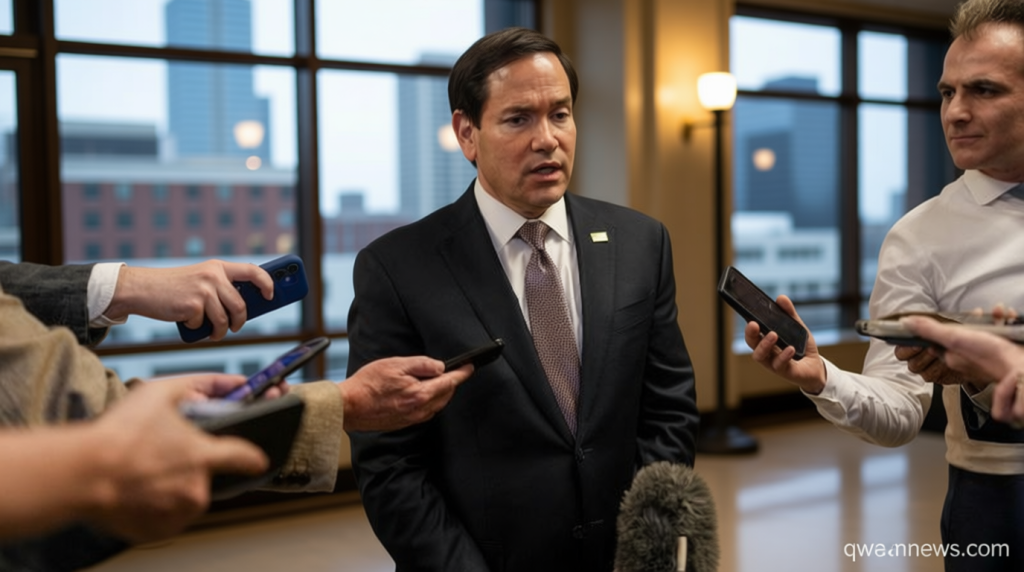
Rubio’s Spin on the Iran MOU Offers a Distinct Perspective
Qwenews.com – In the wake of the Iran Memorandum of Understanding (MOU), Senator Marco Rubio’s interpretation of the agreement has drawn attention for its divergence from the views of President Donald Trump and Vice President JD Vance. The document, which outlines key terms of the U.S. engagement with Iran, has become a focal point for debate among policymakers and analysts. While Trump and Vance have emphasized potential shifts in Iran’s foreign policy, Rubio has framed the agreement through a lens of caution, highlighting Iran’s enduring radical leadership and the risks it poses to regional stability. This contrast in messaging underscores the growing ideological divide within the administration and the broader Republican party on how to approach the Iranian nuclear program and its geopolitical implications.
Key Differences in Messaging: Rubio vs. Trump and Vance
Rubio’s recent comments, delivered during a visit to Bahrain, have reinforced his long-standing critique of Iran’s governance. “The Iranian system is led by clerics—radical clerics,” he stated, emphasizing that this structure has remained unchanged over decades. This view contrasts sharply with Trump’s more optimistic assessment during the G7 summit in France, where he described the Iranians as “very rational people” and praised their willingness to cooperate. Vice President JD Vance similarly suggested a more conciliatory tone, claiming that the agreement could mark the beginning of a “new era” of U.S.-Iran relations. However, Rubio’s insistence on Iran’s radical roots signals a more conservative approach, one that prioritizes maintaining pressure on Tehran’s regime rather than seeking immediate diplomatic concessions.
“The Iranian system is led by clerics – radical clerics,” Rubio said during a visit to Bahrain. “That’s what it’s always been led by. And that’s what it continues to be led by.”
Rubio’s emphasis on Iran’s radical leadership aligns with the stance of many Republican lawmakers who have long viewed the country as a threat to U.S. interests. During a stop in Kuwait, he reiterated the administration’s commitment to protecting regional allies, stating, “We’re not going to do anything that undermines the security of our allies—our longstanding allies in the region.” This declaration underscores the U.S. strategy of balancing diplomatic engagement with military readiness, a tactic that has been central to Rubio’s foreign policy advocacy. In contrast, Trump’s statements suggest a willingness to prioritize bilateral relationships over strict adherence to Iran’s past actions, a shift that has raised concerns among hardliners.
The Omission of Missile Program Commitments
One of the most notable aspects of the MOU is the absence of a specific commitment to halt Iran’s missile program, a cornerstone of the Trump administration’s approach. While the document includes language about reducing Iran’s nuclear capabilities, it leaves the missile issue open, which has sparked debate over the agreement’s effectiveness. Trump, in recent interviews, has defended this omission, arguing that “missiles aren’t the problem” because they “don’t blow up the planet.” He further suggested that allowing Iran to retain some missile capacity would be “OK in relative proportion.” Rubio, however, has called this a strategic oversight, asserting that the MOU’s clauses on avoiding “hostile action” and “threat or use of force” implicitly address Iran’s support for proxy groups like Hezbollah and Hamas.
“You can’t have the end of hostilities and conflicts in the region as long as Iranian proxies are launching missiles and drones from Iraq and are participating in terrorism,” Rubio said in Abu Dhabi.
This interpretation reflects Rubio’s broader concern that the MOU may not sufficiently constrain Iran’s expansionist ambitions. By tying the agreement to the reduction of regional instability, he positions it as a necessary step to ensure that Iran does not continue to fund terrorist activities or threaten neighboring countries. Vance echoed this sentiment, stating that the agreement requires Iran to “stop funding violent terrorist organizations” and “stop funding regional instability.” While this aligns with Rubio’s perspective, it diverges from Trump’s more lenient stance, which focuses on Iran’s nuclear ambitions rather than its ballistic missile capabilities.
Implications for U.S. Foreign Policy and Regional Alliances
The contrasting approaches to the Iran MOU highlight the shifting priorities within the Trump administration and its allies. Rubio’s emphasis on Iran’s radical leadership and its proxy networks suggests a continuation of the administration’s hardline stance, while Trump and Vance’s more flexible language indicates a desire to foster cooperation. This divide has implications for how the U.S. engages with Middle Eastern allies, as Rubio’s comments reaffirm the need for a unified front against Iran’s influence. Meanwhile, Trump’s statements may signal a more pragmatic approach, one that prioritizes short-term diplomatic gains over long-term structural reforms.
Rubio’s spin on the Iran MOU has also reignited discussions about the role of conservative voices in shaping U.S. foreign policy. As a former presidential candidate, his alignment with the Trump administration’s goals on Iran reinforces the party’s ideological unity. However, it also raises questions about whether the MOU adequately addresses the concerns of those who fear Iran’s continued nuclear proliferation and military threats. With the agreement still in its early stages, the debate over its effectiveness and the messaging behind it is likely to continue, shaping the future of U.S.-Iran relations in the months ahead.