
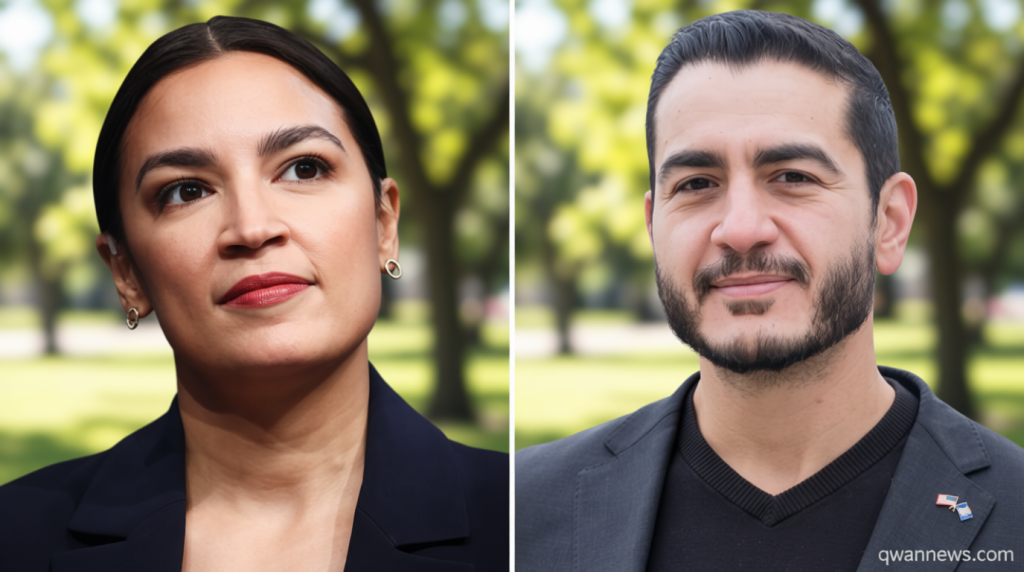
Ocasio-Cortez Backs Abdul El-Sayed in Michigan Senate Race
Qwenews.com – Democrat Alexandria Ocasio-Cortez, the New York congresswoman and prominent progressive voice, has made a significant move by endorsing Abdul El-Sayed in the Michigan Senate race. This decision marks a pivotal moment for El-Sayed, who is running as an independent candidate, and highlights the growing influence of progressive figures within the Democratic Party. The primary election is scheduled for August 4, and Ocasio-Cortez’s support comes at a critical juncture as the race intensifies. Her endorsement is notable not only because of its impact on El-Sayed’s campaign but also because it signals a shift in how progressive candidates are being positioned to challenge established Democrats in key battleground states.
A Progressive Alliance in the Midst of Party Tensions
Ocasio-Cortez’s endorsement of El-Sayed is part of a broader strategy to consolidate progressive power in the Democratic Party. This move contrasts with her previous hesitancy to back certain candidates, such as Saikat Chakrabarti in California or Zohran Mamdani’s allies in New York. Despite this, her support for El-Sayed is aligned with her long-standing advocacy for bold, transformative policies. “Abdul El-Sayed has demonstrated a commitment to fighting for the people, just as I have,” Ocasio-Cortez said in a recent statement. “His platform resonates with the values that progressives hold dear.”
El-Sayed, a former Michigan gubernatorial candidate, has gained traction by emphasizing economic justice, healthcare reform, and climate action. His campaign has drawn comparisons to Ocasio-Cortez’s own progressive agenda, particularly in their shared focus on challenging corporate interests and expanding social programs. The endorsement by a high-profile figure like Ocasio-Cortez is expected to bolster El-Sayed’s visibility among younger voters and progressive base, potentially shifting the race’s momentum in his favor. However, the challenge remains in balancing this support with the need to appeal to broader demographics in a state where the Democratic Party has struggled to maintain a strong majority.
Israel and the Divide in Democratic Priorities
As the Michigan Senate race heats up, the issue of Israel has emerged as a key point of contention between candidates. El-Sayed’s criticism of Israeli Prime Minister Benjamin Netanyahu and his stance on the Gaza conflict have drawn sharp reactions from some Democratic leaders. He has described the ongoing military campaign as “genocide,” a label that has sparked debate within the party. This position aligns with state senator Mallory McMorrow, who previously called the conflict “genocide” but argued for a more nuanced approach to defining the term.
Meanwhile, centrist Rep. Haley Stevens, a strong contender for the Democratic nomination, has received backing from the American Israel Public Affairs Committee (AIPAC). Stevens has defended the use of the word “genocide” and emphasized the importance of maintaining a strong alliance with Israel, framing it as a strategic necessity for the party’s broader goals. This ideological divide has added another layer of complexity to the race, with voters in Michigan’s diverse electorate weighing the importance of national security against progressive social policies. The endorsement of Ocasio-Cortez by El-Sayed could further amplify this split, as his focus on Palestinian rights and economic equity appeals to a different segment of the Democratic base.
El-Sayed’s Campaign and the Democratic Strategy
Abdul El-Sayed’s campaign has been characterized by a clear focus on uniting working-class voters and challenging the status quo. His decision to run as an independent candidate has both advantages and risks, as it allows him to bypass traditional Democratic primary structures and appeal directly to a wider audience. However, this choice also means he must navigate the complexities of coalition-building, ensuring that his message resonates with both progressive activists and centrist voters.
With the Democratic Party aiming to flip nine Senate seats in 2026, the outcome in Michigan is a critical test case. Ocasio-Cortez’s endorsement is seen as a signal that the party’s left wing is increasingly willing to support candidates who prioritize bold policy changes over electoral pragmatism. While some establishment Democrats, including Senate Minority Leader Chuck Schumer, argue that Stevens has a better chance of securing the seat, El-Sayed’s growing support suggests a more dynamic and polarizing race. The campaign has also drawn attention to issues like healthcare affordability and tax reform, which are central to El-Sayed’s platform and resonate with voters across the state.
House Minority Leader Hakeem Jeffries recently acknowledged that progressive victories in New York, such as those in the 2022 elections, do not guarantee success in other states. He emphasized the need for “common sense Democrats authentically committed to making life better for the American people.” Despite this caution, Ocasio-Cortez’s backing of El-Sayed appears to be a calculated risk, aiming to galvanize a new wave of progressive energy in the Democratic Party. This strategy could influence the broader national conversation, particularly as the 2026 midterms approach.