
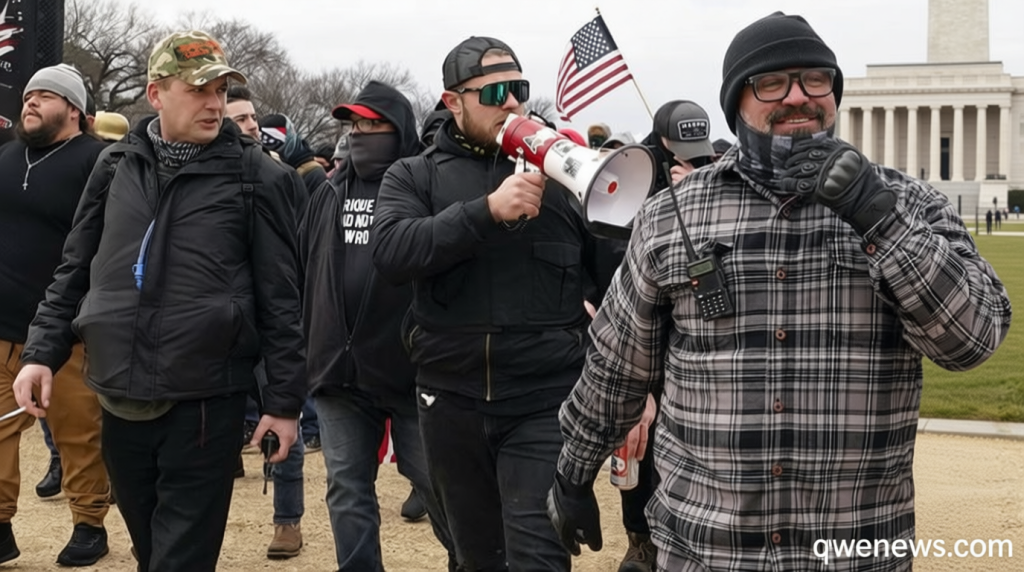
Judge Dismisses January 6 Case Against Proud Boys on Trump Admin Request
Qwenews.com – The U.S. federal court in Washington, D.C., has granted the Trump administration’s request to dismiss the seditious conspiracy charges against four members of the Proud Boys, a move that has sparked significant debate about the role of executive power in shaping legal outcomes. This decision marks a pivotal shift in the aftermath of the January 6, 2021, Capitol riot, which was initially seen as a major victory for the Biden-era Justice Department. The court’s ruling aligns with the administration’s push to halt the prosecution, signaling a potential influence of the executive branch on the legal process.
Judge’s Legal Justification
US District Judge Timothy Kelly, who was appointed by former President Donald Trump, justified the dismissal by stating that the executive branch holds the authority to decide whether to pursue or abandon a case. “I lack the power to enforce the Executive’s decision,” he noted, emphasizing that the administration’s choice to commute sentences via an executive order signed on January 7, 2021, was deliberate. The judge also highlighted the importance of the Executive’s role in shaping the course of justice, particularly in cases tied to the Capitol attack.
“The President’s views on the January 6th investigation—whether grounded in fact or opinion—have been well documented, and his intent to extend clemency to those involved is clear,” Kelly explained in his ruling. This sentiment underscores the broader tension between judicial independence and executive influence, raising questions about the balance of power within the U.S. government.
Convictions and the Path to Dismissal
The four defendants—Ethan Nordean, Joseph Biggs, Zachary Rehl, and Dominic Pezzola—were initially convicted in 2023 for their roles in the Capitol riot. These convictions were part of a larger effort by the Justice Department to hold individuals accountable for inciting violence on that day. However, the Trump administration’s executive order pardoned over 1,000 individuals convicted in connection with the attack, leaving these four with their convictions intact. The Justice Department’s subsequent move to vacate the charges has now been finalized by the court, marking a key development in the legal aftermath of the event.
Context and Implications
While the dismissal removes some of the most severe charges from the Proud Boys’ case, the judge acknowledged the gravity of the January 6 incident. “The Executive’s decision to abandon this prosecution—despite the Government’s prior convictions—reflects a broader strategy to redefine accountability,” he observed. The ruling highlights how political shifts can influence the trajectory of legal proceedings, with implications for the future of similar cases. The judge also emphasized that the event was an attack on both the government and the Constitution’s framework for peaceful transitions of power.
With the dismissal, the Trump administration’s influence on the legal process has been reinforced. Critics argue that this decision undermines the pursuit of justice, while supporters see it as a necessary correction to a politically motivated prosecution. The case has become a symbol of the ongoing debate over how executive authority interacts with judicial independence, particularly in high-profile political trials.
The Proud Boys, a far-right organization known for their involvement in the Capitol riot, have welcomed the decision. Dominic Pezzola, one of the dismissed defendants, expressed relief on social media, calling the outcome a “victory” for the group. Meanwhile, the Justice Department faces scrutiny as it navigates the challenges of maintaining its role in the face of executive intervention. This development could set a precedent for future cases involving political actors and their legal consequences.