
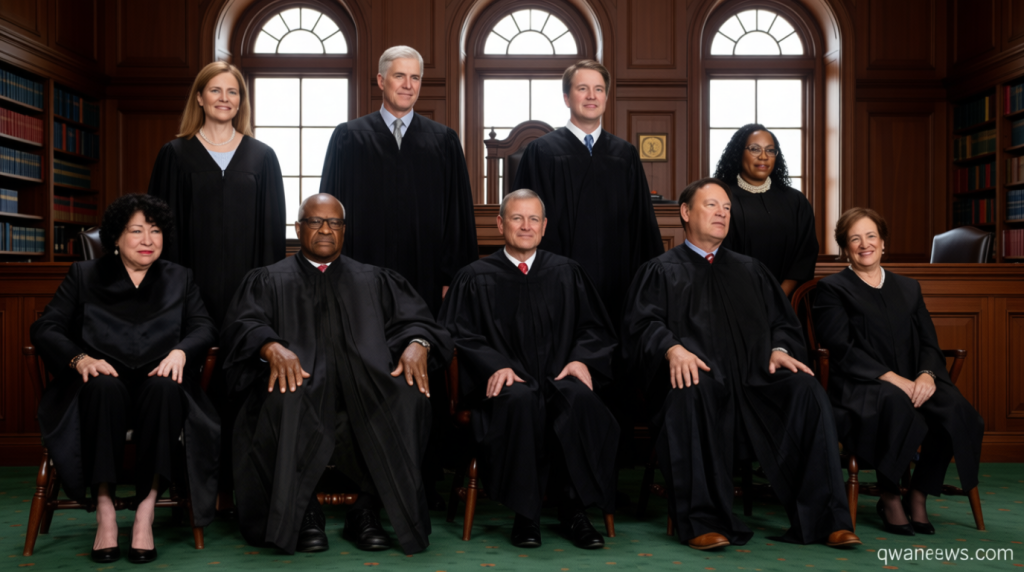
6-3 Split Dominates Supreme Court: Ideological Divide Intensifies
Qwenews.com – As the Supreme Court races to finalize its most pivotal cases by the end of the term, the 6-3 ideological split has become a defining feature of its decision-making process. This pattern, which has already seen more rulings divided along partisan lines than in the entirety of the previous term, highlights a deepening divide between the Court’s conservative and liberal blocs. With key cases on presidential authority and transgender rights pending, the 6-3 majority appears to be shaping the Court’s legacy in a way that reflects the political polarization gripping the nation. The trend raises questions about judicial independence and the role of partisanship in shaping landmark rulings.
Record-Setting Partisan Decisions
This term has witnessed an unprecedented number of 6-3 rulings, with four of the five decisions released recently following that exact split. These rulings span a variety of issues, from religious freedom disputes to historic property claims. For example, a 6-3 decision recently blocked a Rastafarian inmate’s challenge to prison rules regarding dreadlock trimming, while another allowed Exxon to pursue legal action against the Cuban government for seizing property in 1960. The most consequential 6-3 ruling to date came in April, when the Court struck down a key provision of the Voting Rights Act, enabling Republicans to redraw district maps in Southern states like Louisiana and Alabama. This decision has been widely cited as a turning point in the Court’s approach to electoral reform.
“The 6-3 pattern isn’t just a statistical trend—it’s a clear reflection of the Court’s growing partisan alignment,” remarked legal analyst Sarah Mitchell. “It’s hard to ignore how these rulings often align with the political agendas of the justices’ appointers.”
Despite this trend, some rulings have managed to bridge the ideological gap. Notably, the Court’s February decision to invalidate Trump’s global tariffs received broad support, with three conservatives and three liberals joining the majority. Similarly, a recent unanimous ruling affirmed that the Second Amendment protects a Texas man’s right to carry firearms even after frequent marijuana use. These cases suggest that the Court’s divisions are not absolute, but the frequency of 6-3 splits has created a consistent narrative of polarization.
Historical Context and Public Perception
The 6-3 split is not a new phenomenon, but its prevalence this term has drawn sharper scrutiny. From 2020 to 2024, nearly 14% of the Court’s merits decisions were split along ideological lines, according to SCOTUSblog data. However, as the term progresses, this number is expected to rise, with many analysts predicting that the final rulings could tip the balance further toward partisan outcomes. The Court’s 6-3 pattern has become a focal point in debates about its legitimacy, with critics arguing that it undermines the judiciary’s role as an impartial arbiter of law.
“When the Court consistently votes 6-3 on major issues, it sends a signal that the decision is more about political alignment than legal reasoning,” said Justice Elena Kagan during a recent lecture at the University of Chicago. “This can erode public trust in the institution.”
On the other hand, supporters of the current majority maintain that the 6-3 split reflects the Court’s commitment to upholding the Constitution as interpreted by the current conservative bloc. They argue that the 6-3 trend is a natural consequence of the justices’ ideological backgrounds and the shifting landscape of American jurisprudence. For instance, the Court’s recent decisions on executive power and civil rights have been framed as a response to evolving societal and political challenges.
With a dozen major cases still pending, the Court’s 6-3 pattern is likely to persist, particularly as the final decisions approach. This divide has already influenced the outcomes of significant cases, such as those involving the Affordable Care Act and environmental regulations. As the justices prepare to address these issues, the 6-3 split continues to serve as a barometer of the nation’s political and legal landscape. The Court’s upcoming rulings will be closely watched to determine whether this trend will solidify or shift in the coming weeks.