
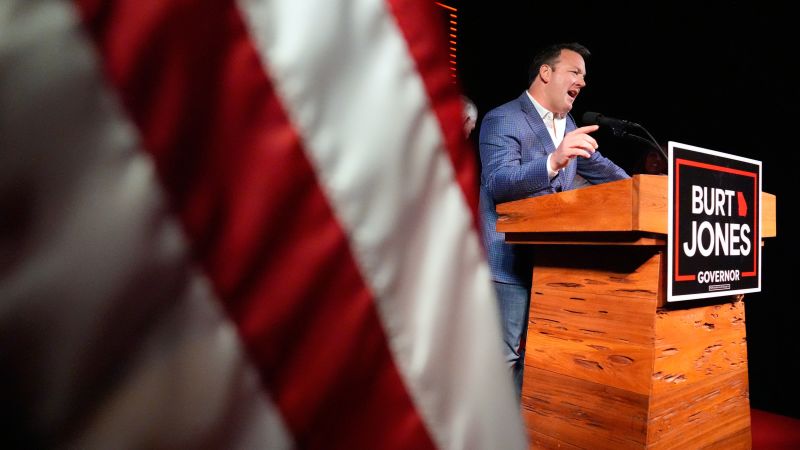
Burt Jones Criticizes Rick Jackson’s Spending in Georgia Governor’s Runoff
Qwenews.com – As the Georgia Republican gubernatorial runoff nears, Lieutenant Governor Burt Jones is leveraging Rick Jackson’s aggressive spending as a pivotal argument in his campaign. Jones’ latest ad challenges Jackson’s financial strategy, asserting that the billionaire candidate is overextending his resources to secure victory. The ad bluntly states, “Rick Jackson is everywhere – spending over $100 million to buy votes,” while positioning Jones as a more fiscally responsible alternative. This strategy aims to frame the race as a choice between a candidate who is “selling the state” and one who is “fighting for Georgia.”
Rick Jackson’s Financial Strategy
Rick Jackson, a former healthcare executive and self-made billionaire, has dominated the race with his massive campaign expenditures. His campaign’s reliance on high-dollar advertising and mailers has allowed him to maintain a strong presence in key districts, even as he faces scrutiny over his spending habits. According to recent polls, Jackson’s support remains steady, but Jones’ focus on financial transparency could shift voter sentiment. Jackson’s team has defended their approach, arguing that the state’s voters are willing to invest in a candidate who can deliver tangible results, not just media exposure.
Jackson’s financial strategy began with a bold move in February when he launched his campaign, initially overshadowed by more established figures. However, his ability to raise and spend large sums quickly propelled him into the runoff. By the time of the May primary, he had secured a third of the vote, forcing a contest with Jones. His campaign has emphasized a “winner-takes-all” mentality, with slogans like “Georgia is ready for a change” and “Invest in the future.”
Comparative Spending in the Race
AdImpact data reveals that Jackson’s campaign has outspent Jones by nearly $55 million, making him the most financially robust contender in the race. Jones, however, has strategically allocated funds to targeted messaging, focusing on key issues like infrastructure and healthcare. While Jackson’s ads are often seen in prime-time slots and high-traffic areas, Jones’ team is emphasizing a more grassroots approach, with volunteers canvassing neighborhoods and hosting community events.
Political analysts note that Jackson’s spending is not just a tactic but a reflection of his broader campaign strategy. His team has invested heavily in digital outreach and data analytics, tailoring messages to specific demographics. Despite this, critics argue that the focus on money may alienate voters who prioritize fiscal conservatism. “The challenge for Jones is to show that he can compete without relying on the same tactics,” said political commentator Emily Cross, adding that the race will ultimately be decided by voter trust in the candidates’ economic plans.
Historical Context and Voter Sentiment
Georgia’s electorate has historically shown a wary attitude toward candidates with immense personal wealth. This sentiment was evident in the 2021 Senate runoff, where former Senator Kelly Loeffler lost to Raphael Warnock despite a $40 million campaign. Guy Millner, a Republican who ran for governor in the 1990s, also faced similar challenges, with his campaign criticized for appearing too corporate. Political science professor Charles Bullock highlighted that Jackson’s approach “echoes past failures,” suggesting that voters may grow tired of candidates who prioritize spending over substance.
Jackson’s campaign, meanwhile, is framing its expenditures as a necessary investment in the state’s future. They argue that the current economic climate requires bold action, and that Jackson’s financial muscle ensures his ability to implement policies quickly. “Rick Jackson is not just a candidate—he’s a leader who can bring about real change,” said a spokesperson for Jackson’s team. However, as the runoff approaches, the question remains: will voters reward this approach, or will they penalize it?
Both candidates are pushing their limits in the final stretch, with Jones’ team accusing Jackson of “buying the election” and Jackson’s campaign countering that Jones is “hiding his lack of vision.” The race has become a battle not just of ideas, but of influence and messaging. As Tuesday’s election draws closer, the focus on financial strategy is expected to intensify, with both sides seeking to sway undecided voters with their respective narratives.