
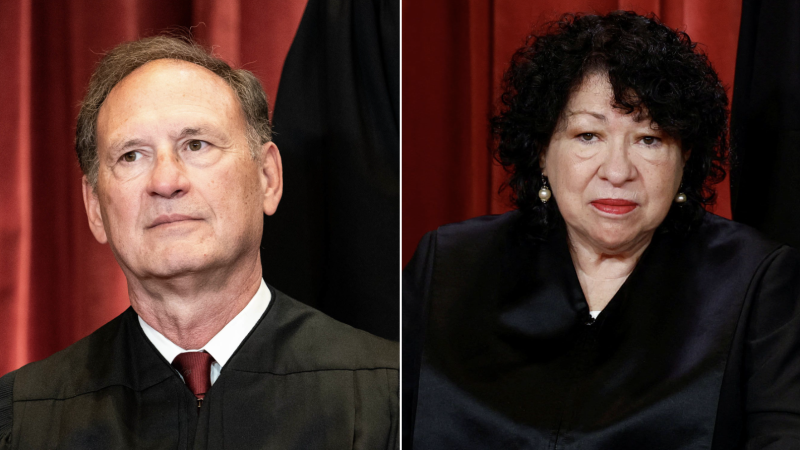
Alito’s Testy Reaction to Sotomayor Underlines Supreme Court Strains
Supreme Court Tensions Emerge as Alito Reacts to Sotomayor’s Dissent
Qwenews.com – On a day marked by high-stakes legal deliberations, Justice Samuel Alito’s visible frustration during a recent dissenting opinion from Justice Sonia Sotomayor sparked renewed interest in the dynamics within the U.S. Supreme Court. The moment, which unfolded during a hearing on immigration policy, highlighted the growing ideological divide among the justices. While the Court typically projects unity and decorum, Alito’s reaction—characterized by sharp intonations and a brief, but telling, interruption—revealed the tensions simmering beneath the surface of their decisions.
“There’s much that I would have added to my bench statement had I known there would be a dissent read,” Alito remarked, barely concealing his frustration after Sotomayor completed her remarks. His comment, directed at the procedural timing of the dissent, underscored a pattern of assertiveness that has become a hallmark of his judicial style. The exchange, though brief, drew immediate attention from legal analysts and media outlets, who saw it as a reflection of the Court’s internal struggles over key rulings.
Immigration Rulings and Asylum Eligibility
The case at the center of the debate concerned the Trump administration’s approach to asylum eligibility, specifically whether individuals seeking refuge must physically enter the United States to qualify for protection. Alito’s 6-3 majority opinion, which aligned with the administration’s position, argued that the process begins only after arrival, a stance that contrasted sharply with Sotomayor’s dissent. Her argument drew from historical parallels, such as the M.S. St. Louis, a 1939 vessel carrying 900 Jews fleeing Nazi Germany, to illustrate how the decision could hinder vulnerable asylum seekers.
“The M.S. St. Louis, a vessel carrying 900 Jews fleeing Nazi Germany, was denied entry to the U.S., Cuba, and Canada in 1939,” Sotomayor recounted during her dissent. “When it returned to Europe, over 250 of those passengers perished in the Holocaust.” Her poignant comparison emphasized the human cost of restrictive immigration policies, framing the case as more than a legal technicality. The justices’ discussion of the ruling, and the subsequent fallout, has reignited debates about the balance between national security and humanitarian concerns.
Alito’s Judicial Style and Dissent Dynamics
Justice Alito’s testy reaction to Sotomayor’s dissent reflects a broader trend in his judicial approach. Known for his pragmatic yet often combative style, Alito has consistently pushed back against dissenting opinions, particularly those from more liberal justices. His frustration during Thursday’s session was not an isolated incident but part of a pattern that has drawn scrutiny over his role in shaping recent decisions. The Court’s procedural choices, such as the timing of dissent readings, have become points of contention, with some justices believing they should be given more space to articulate their views.
While the administration’s refugee policy has faced criticism for its strict criteria, the Court’s interpretation of “arriving in the United States” has significant real-world implications. For example, asylum seekers arriving by land may now face greater scrutiny, while those arriving by sea might be given more leeway. This distinction has sparked debates about how the Court’s rulings might affect the lives of individuals fleeing conflict, persecution, or violence. Sotomayor’s dissent, in particular, emphasized the need for a more flexible framework that accounts for the urgency of asylum applications.
Historical Context and Legal Precedents
The issue of asylum eligibility has roots in longstanding legal interpretations. The M.S. St. Louis case, which Sotomayor referenced, serves as a powerful reminder of the consequences of denying entry to those in need. While the 1939 incident is a well-known historical example, the Court’s recent ruling echoes similar principles, raising questions about whether the current legal standard is as equitable as it claims to be. Critics argue that the decision could leave asylum seekers in limbo, especially those arriving near the border without clear documentation.
Alito’s reaction to Sotomayor’s dissent also highlighted the personal dynamics among justices. The exchange, though professional, revealed a level of camaraderie and rivalry that is often absent in public view. His tone suggested a belief that the dissent was not only incomplete but also unnecessary, a sentiment that may reflect his confidence in the majority’s position. Meanwhile, Sotomayor’s dissent stood as a reminder of the diversity of perspectives within the Court, even as it underscored the growing influence of Alito’s conservative faction.
Broader Implications for the Supreme Court’s Role
As the Court nears the conclusion of its term, the incident involving Alito and Sotomayor has become a symbol of the shifting power dynamics among justices. With the administration’s policies increasingly under judicial review, the Court’s ability to remain impartial is being tested. Alito’s testy reaction to Sotomayor’s dissent added another layer to this complexity, suggesting that even the most seasoned justices are not immune to the emotional weight of contentious rulings.
Legal experts note that such moments of friction are not uncommon in a high-stakes environment. The Court’s recent pace of opinion deliveries, with multiple decisions issued in a single day, has amplified these tensions. As the justices prepare to deliver their final rulings, the interplay of personalities and ideologies will likely continue to shape the narrative around key cases, including the one that sparked Alito’s notable reaction. This case, therefore, serves as a microcosm of the broader ideological battles unfolding within the judiciary.