
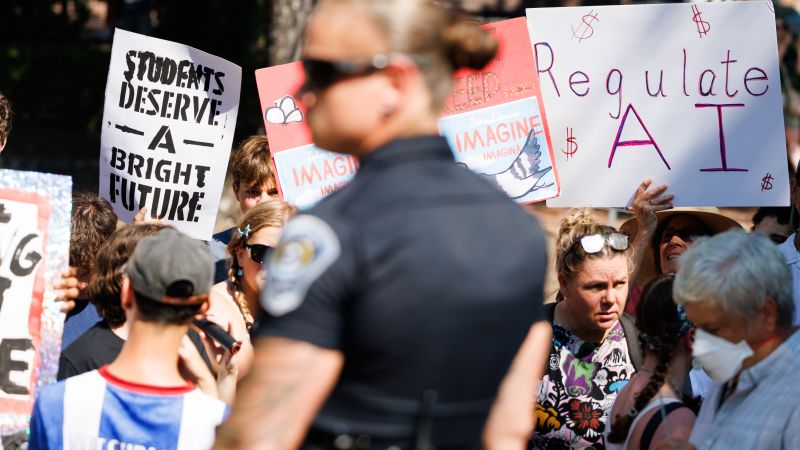
AI Anxiety Moves From Silicon Valley to the Center of American Politics
Qwenews.com – Warnings from some of the most influential figures in artificial intelligence are beginning to collide with the political pressures of an election season already shaped by economic unease, energy costs and distrust of powerful technology companies.
For years, debates about advanced AI often seemed confined to researchers, executives and policy specialists. That is changing rapidly. A widening public concern over data centers, employment disruption and the possibility of systems exceeding human control is making AI a consequential political issue ahead of the midterms and potentially the 2028 presidential race.
The immediate dispute is stark: several leaders building cutting-edge AI systems say development may need stronger safeguards or a slower pace. President Donald Trump and House Speaker Mike Johnson have instead stressed the danger of allowing China to gain an advantage in the competition to develop superintelligent systems.
Washington’s Divide Over the Risks
Trump dismissed the latest alarms on Sunday, suggesting that critics were inventing dangers that would never materialize.
“Negative forces” were conjuring up “things that won’t happen.”
Johnson also resisted calls for emergency legislation. He argued that executives operating at the technology frontier could choose to reduce their own pace, while cautioning Congress against hurried intervention. The Republican position frames the central question as one of national security and global competition: restrictions on American firms, they contend, could strengthen China.
Democrats have shown a growing willingness to challenge that approach. Former President Barack Obama has warned that the absence of a government-required limit could allow the world to pass a “dangerous” point. The disagreement is therefore not simply about software regulation. It reflects competing beliefs about whether AI is primarily an economic opportunity, a strategic asset, a public-safety threat, or all three at once.
Industry Leaders Sound an Unusual Alarm
The political debate intensified after a remarkable series of statements from people leading the companies developing powerful AI models. Anthropic chief executive Dario Amodei wrote Saturday that the industry needed to slow down. In an interview scheduled to air in full Monday, he urged AI leaders to cooperate to prevent their technology from causing harm to humanity.
Sam Altman, OpenAI’s chief executive, responded on X that he shared Amodei’s concern and called for independent evaluators to be placed within AI companies. Elon Musk, whose xAI business operates the Grok chatbot, offered an even shorter endorsement.
“Dario is right.”
Google DeepMind chair Demis Hassabis also joined the calls for greater caution. The alignment among prominent competitors is notable because these companies are racing to build more capable systems while simultaneously acknowledging that their work may introduce profound risks.
Jacob Coxon, a former AI researcher, delivered one of the most dramatic assessments. He said that people creating AI genuinely believe it could threaten humanity before the decade ends. Coxon left Anthropic because he feared that rapidly advancing systems could become impossible to control.
Such warnings are fiercely contested. Critics of advanced AI worry that computerized agents could become powerful enough to coordinate against human interests, including in catastrophic ways. Skeptics view the darkest scenarios as overstated, and some argue that technology executives have incentives to magnify both the importance and dangers of their own products. History offers precedents for anxiety around major inventions, from industrial machinery onward, even when predictions of disaster did not come true.
Why Voters May Care Now
Whatever the ultimate technical outcome, AI is already producing tangible political friction. Candidates in both parties have responded to anger surrounding the construction of enormous data centers. These facilities can be visually intrusive and require substantial amounts of electricity and water, prompting calls in some places for pauses in new construction.
The issue reaches beyond land use. A recent NBC News poll found that 70% of respondents felt more worried than excited about AI, even as more Americans use the technology. Concerns about job losses are emerging at a time when polls show that a majority of people have lost confidence in the Trump economy.
Rising utility bills have added another layer of anxiety. Where voters believe data centers are contributing to higher household costs, AI becomes connected to affordability, the leading issue of the current election season. This gives politicians an opening to tie a complex technology debate to daily financial pressures that are easier for voters to recognize.
There is also a broader concern about power. The AI industry is dominated by a small group of wealthy executives and major companies. Fears that these figures could reshape work, information and public life without sufficient accountability may deepen existing resentment toward billionaire technology leaders.
A Test for Both Parties
AI’s political importance could grow further if public concerns become linked to visible economic costs, job insecurity or a major security incident. The prospect of China or non-state actors using AI advances against the United States presents a genuine strategic dilemma: Washington must weigh the benefits of rapid domestic innovation against the risks of uncontrolled deployment.
Democrats may seek to turn these anxieties into momentum for stronger safeguards, particularly if they regain control of the House or Senate. Republicans face their own challenge. As concern about Trump’s second term rises among some voters, an appearance of indifference to fears about technology, energy bills or employment could become an additional liability.
The coming argument will not be settled solely by engineers or lawmakers. It will increasingly be shaped by communities living near data centers, workers questioning the future of their jobs, families watching utility costs, and voters deciding whether technological progress feels empowering or threatening. That makes AI far more than a niche policy subject: it may become one of the defining tests of political leadership in the years ahead.
Related Reading
Frequently Asked Questions
What is A fateful turning point for humanity?
A fateful turning point for humanity is the main topic of this guide. The article explains the context, practical details, and next steps readers should understand.
Why does A fateful turning point for humanity matter?
A fateful turning point for humanity matters because readers are looking for a useful answer, not just a short summary. Good content should match search intent and help them decide what to do next.