
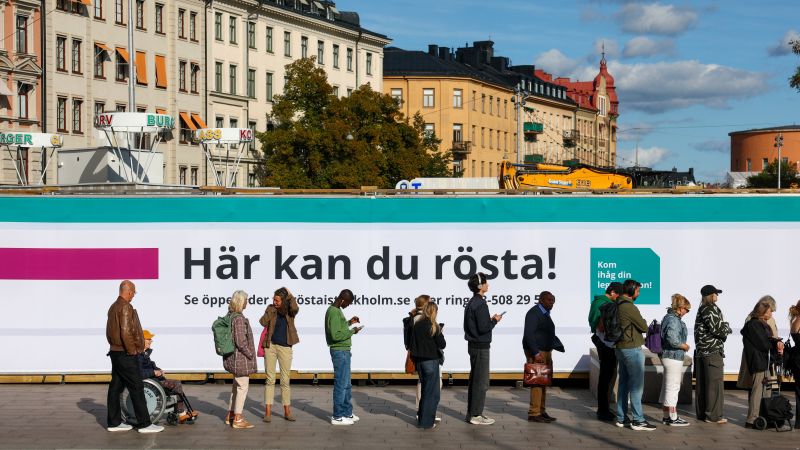
Sweden Faces a Tense Wait as Parliamentary Election Remains on a Knife Edge
Qwenews.com – Sweden’s parliamentary election was still too close to call on Sunday, leaving the country’s political future dependent on ballots yet to be counted, including votes cast abroad. A partial tally pointed to a razor-thin advantage for the center-left opposition, raising the possibility that Sweden could shift away from the tougher migration agenda pursued during the past four years.
With results in from 4,853 of the country’s 6,312 electoral districts, the center-left alliance led by Social Democrats leader Magdalena Andersson was projected to take 175 seats in the 349-member Riksdag. Prime Minister Ulf Kristersson’s right-wing governing camp stood at 174 seats. In a parliament of this size, a single seat can decide which bloc has the opportunity to govern.
The narrow margin meant there was no expectation of an immediate final verdict. Overseas ballots could take days to arrive and be included in the count, with a definitive result potentially delayed until Wednesday.
“I think it will be a long night,” said Foreign Minister Maria Malmer Stenergard of Kristersson’s Moderate Party. “Maybe we won’t even have the results until Wednesday when the votes that have been cast abroad arrive.”
A Vote With Broad Domestic Consequences
The election is not expected to overturn Sweden’s support for Ukraine or its broader pro-Western orientation. Instead, the campaign has largely focused on the direction of domestic policy: whether the country continues with tighter immigration rules and a greater role for the hard right, or moves back toward the more liberal traditions for which Sweden has long been known.
Sweden, home to about 10.6 million people, was for many years among Europe’s more welcoming destinations for immigrants and refugees. That approach changed sharply after Kristersson took office four years ago. His government ended permanent residency for refugees, made welfare requirements stricter and expanded efforts to remove people who did not have legal permission to remain in the country.
Supporters of the governing bloc argue that its program has brought more control to immigration policy and helped restrain gang-related violence. Opponents contend that the government has pressed immigrants to adapt to Swedish cultural norms under the threat of penalties or departure, while weakening civil-liberty protections in the process.
The outcome therefore carries significance beyond the makeup of the next cabinet. It will be read as a public judgment on whether voters want the country’s recent political shift to continue.
The Sweden Democrats at the Center of the Contest
Kristersson made a consequential promise before the election by saying he would include the Sweden Democrats in government if the right won enough support. The pledge crossed a longstanding boundary in Swedish politics, bringing a party with roots in the Nazi fringe closer to formal power.
The Sweden Democrats were founded in the 1980s with involvement from neo-Nazis and white supremacists. Party leaders acknowledge that history, say extremists have been pushed out of the organization and have apologized for its past. Yet its expanded influence remains deeply divisive, particularly because immigration has become central to its identity and electoral appeal.
At a polling place in Rinkeby, outside Stockholm, party leader Jimmie Akesson pointed to the area’s large Swedish-Somali community and said it “doesn’t look like Sweden.” The remark underscored the cultural and demographic arguments that have shaped the campaign.
For some voters, Kristersson’s willingness to work with the Sweden Democrats represents a practical route to sustaining a conservative majority. For others, it has become a warning sign that Sweden may be moving too far from its democratic and inclusive political norms.
Campaign Momentum and a Wider European Trend
Kristersson had spent much of his term behind in opinion polling, but his coalition narrowed the gap during the final phase of the campaign. At the same time, Andersson and the Social Democrats lost some of their earlier advantage, turning what had appeared to be a clearer opposition lead into an exceptionally close finish.
An initial exit poll had put the center-left ahead with 51% of the vote, but a later projection suggested a substantially tighter race. The revised estimate prompted celebrations among Sweden Democrats supporters, who saw the new figures as evidence that the governing side remained in contention.
“You cannot imagine how nervous I am right now. It feels like my life’s work is hanging in the balance,” said Ludvig Aspling, a Sweden Democrats member of parliament and the party’s immigration spokesperson.
“It is going to be super tight. We still have a chance,” he said.
The Swedish result is being watched across Europe, where parties on the far right are seeking to build on recent gains. The anti-immigration Alternative for Germany won a state election in Germany the previous week, giving momentum to like-minded movements. Other contests are approaching across the continent, including the National Rally’s effort to win France’s presidency next year.
A strong showing by the Sweden Democrats would be welcomed by these parties as further proof that hard-line migration policies can attract wider electoral support. A center-left victory, even by one seat, would offer a contrasting message: that voters may be prepared to put limits on the rightward turn.
What Happens Next
The immediate question is whether the preliminary one-seat edge survives the completion of the count. If it does, Andersson’s bloc would be positioned to seek power. If the balance moves by even a single seat, Kristersson’s coalition could retain the initiative.
Whatever the final arithmetic, the result reveals a deeply divided electorate. Sweden’s next government will have to govern with little room for error in parliament and with major disagreements unresolved over immigration, public safety, integration and the country’s political identity.
Related Reading
Frequently Asked Questions
What is Sweden s parliamentary election heads?
Sweden s parliamentary election heads is the main topic of this guide. The article explains the context, practical details, and next steps readers should understand.
Why does Sweden s parliamentary election heads matter?
Sweden s parliamentary election heads matters because readers are looking for a useful answer, not just a short summary. Good content should match search intent and help them decide what to do next.