
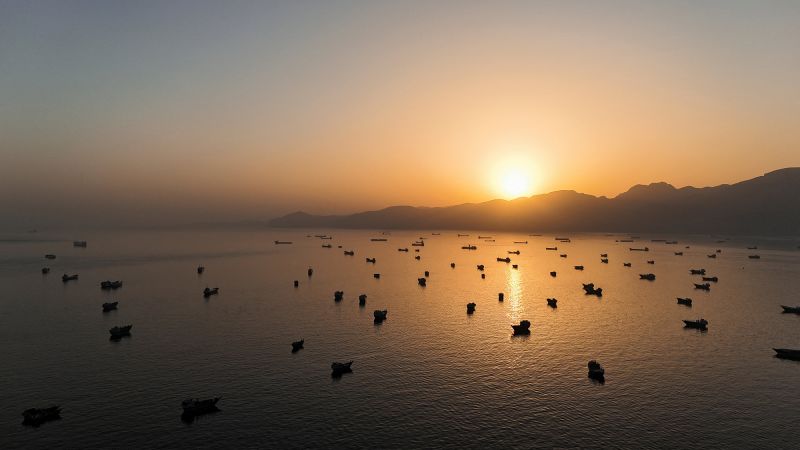
The Strait of Hormuz is ‘leaking’ oil
Qwenews.com – Amidst a prolonged conflict that has crippled the Strait of Hormuz, the global oil market has shown unexpected resilience. Analysts had anticipated a sharp spike in prices, yet crude futures have remained relatively stable. This anomaly has sparked debate about how the energy system is adapting to the crisis.
A Hidden Escape Route
While commercial traffic through the strait has dwindled to just 15% of pre-war levels, JPMorgan reports that approximately 2.1 million barrels per day of oil are slipping past the blockade. These so-called “clandestine flows” may be evading detection by disabling transponders on their vessels, experts told CNN. Such movements suggest the market is absorbing the shock, though not entirely.
“Despite the ongoing naval blockade and steep decline in commercial traffic, surprising volumes of crude and petroleum products still appear to be transiting the Strait,” Natasha Kaneva, JPMorgan’s head of global commodities strategy, wrote in a client note last week.
Bob McNally of Rapidan Energy Group echoed this view, noting that the leakage could have eased the crisis. “We assume Hormuz traffic has been 0% to 10% of prewar flows, but with this leakage it could be a little higher,” McNally said. “It’s not nearly enough to avoid big and bullish inventory draws, but it does take some of the edge off.”
Other Factors at Play
Jan Stuart of Piper Sandler estimated that about 2.9 million barrels per day of crude bypassed the strait in May, with 2.1 million on ships that paid tolls to Iranian entities. The remaining 900,000 barrels were likely “ghost” transits—vessels that slipped through undetected. These covert movements, combined with other adjustments, have helped stabilize prices.
“The ghosts, or clandestine flows, help,” Stuart told CNN. “There has been far better mitigating of the crisis than I would have thought possible.”
Meanwhile, the international benchmark for Brent oil dipped to $93 a barrel on Friday. While this is higher than pre-war levels of $70, it remains below the recent high of $114. However, the market’s calm is not solely due to clandestine flows. Piper Sandler highlights that around 4.5 million barrels per day have left the Persian Gulf via alternative routes, including the East-West Pipeline.
A Shift in Demand
China’s drastic reduction in crude imports has also played a key role. As one of the world’s largest energy consumers, its decreased demand has alleviated some pressure on global supplies. JPMorgan’s Kaneva pointed to additional factors, such as deeper-than-expected demand losses and larger-than-reported stockpiles, as contributors to the price stability.
“Taken together, these adjustments help explain why prices near $100 are not signaling that the disruption is small,” Kaneva wrote. “Rather, they are signaling that the market has found ways — albeit costly ones — to absorb it.”
Despite these measures, some seasoned oil professionals warn that the market may be underestimating the long-term impact. U.S. crude stockpiles, including the Strategic Petroleum Reserve, have fallen sharply since the conflict began, nearing their lowest level since the early 1980s. Stuart forecasts that Brent prices could average $130 a barrel in the coming months, which would drive gas prices above $5 a gallon this summer—up from the current $4.20.
“You’ll need to persuade people. That’s far easier to do when prices are high,” Stuart said, emphasizing the urgency of rising oil costs to incentivize further emergency releases and curb consumption.