
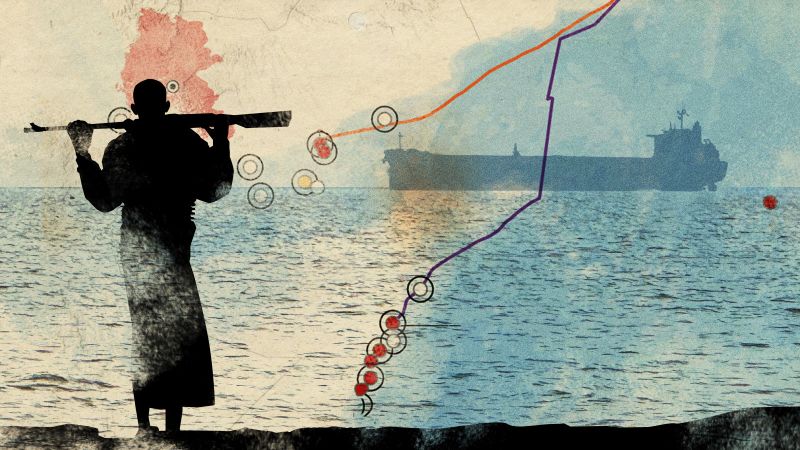
If You Don t Stop: Somali Pirates Target Vulnerable Ships Again
Qwenews.com – If you don t stop, they will kill all of us. That warning captures the fear felt by crew members aboard the diesel tanker Honour 25 after Somali pirates seized the vessel on April 21. The attack highlighted a renewed threat to commercial shipping near Somalia, where conflict, higher fuel prices and changing sea routes have created new opportunities for pirate groups.
Second engineer Syed Hussain Yousuf said the ordeal began with a knock at his cabin door and a blunt alert: “Pirate attack.” Gunfire followed as armed men boarded the tanker and moved the crew toward the bridge.
The Honour 25’s 17 crew members were held for five months, largely confined to an area measuring less than 50 feet. They could leave only with an escort to use the bathroom. The standoff ended violently last month, leaving five crew members dead.
An Exposed Tanker on a Dangerous Route
The tanker had left Shinas Port in Oman carrying 2,700 tons of diesel for Mogadishu, Somalia’s capital. Its Pakistani crew had completed a previous journey to Mogadishu in January without incident, but the second voyage brought far greater danger.
Crew member Yassir Khan said the vessel was badly rusted and had unreliable engines and generators. It also lacked the basic protections that can make pirate boarding attempts more difficult. There were no security guards, no barbed wire and no visible defensive system on board.
“No guards. No barbed wires. No nothing,” Khan said.
As the tanker traveled through the Gulf of Aden, pirates approached in two small boats. Khan said he saw Somali men firing at the vessel’s bulkhead, with some carrying AK-47 rifles. He ran from the engine room and tried to warn fellow crew members to lock their doors.
The attackers quickly took control of the Honour 25 and shut down its engine. In the early days of captivity, the crew faced threats, weapons pointed at them, demands for silence and gunfire into the air. For those aboard, the message was clear: if you don t stop obeying, the consequences could be fatal.
The cargo made the attack especially hazardous. Diesel is highly combustible, and gunfire near a tanker carrying thousands of tons of fuel can create the risk of a catastrophic explosion.
“It has 2,700 tons of diesel,” Khan said. “If you fire a gun, it can make a spark, and it will explode the ship.”
Why Somali Piracy Is Growing Again
Somali piracy had declined sharply after becoming a major international security concern in the late 2000s and early 2010s. At its height, hijackings and ransom demands supported a criminal economy estimated to have generated billions of dollars. Naval patrols, stronger onboard security and armed guards helped reduce the number of successful attacks.
Those safeguards are now under pressure. The war involving Iran has drawn US naval attention toward the Persian Gulf, while Houthi attacks in the Red Sea and Gulf of Aden have disrupted established shipping routes. Ships attempting to avoid one danger can find themselves traveling closer to Somalia, where pirate groups can identify vulnerable targets.
Rising fuel prices have increased the value of petroleum cargoes. Diesel prices have nearly doubled during the war, while insurance costs for ships operating near the Red Sea and Persian Gulf have risen sharply. Shipping companies must weigh the cost of safer routes against the danger of sailing through high-risk waters.
Larger companies can reroute vessels around Africa’s Cape of Good Hope, though doing so can add weeks to a voyage and cost millions of dollars in extra fuel. Smaller operators and companies with weaker safety procedures may be more likely to use risky passages through the Bab-al-Mandeb strait or sail nearer Somalia’s coast while avoiding waters off Yemen.
Tim Walker, maritime project leader at the Institute for Security Studies, Africa, said the lack of armed protection remains a major weakness. If you don t stop piracy before a boarding takes place, crews on poorly protected ships may have few options left.
“The ships being hijacked aren’t carrying guards to deter pirates,” Walker said. “And those ship owners are likelier to disappear before the ransom is paid.”
Walker said no ship protected by armed guards has been successfully attacked since 2008, underscoring the role that security measures can play in deterring pirate groups.
Five Months Held Off Somalia’s Coast
After the initial takeover, more pirates came aboard the Honour 25, bringing their total number to about three dozen. Yousuf estimated that the hijackers ranged from their late 20s to their late 40s. They assigned people to positions around the vessel, including the pump room, engine room, forecastle and bridge.
The pirates ordered the crew to steer toward Durdura, a fishing village on Somalia’s coast. The tanker eventually anchored about two nautical miles offshore, where it remained during an extended ransom negotiation.
For the crew, the prolonged detention turned a commercial voyage into a daily struggle for safety. Their experience shows how quickly a ship without adequate protection can become isolated once armed attackers gain control. The Honour 25 case also illustrates why the warning “If you don t stop” carries such weight for crews navigating the Gulf of Aden.
FAQ: Shipping Safety Near Somalia
Why are ships near Somalia at greater risk?
Changing shipping routes, conflict in nearby waters and the increased value of fuel cargoes can place more vessels within reach of pirate groups. Ships that lack guards or physical barriers may be especially vulnerable.
What protections can deter pirate attacks?
Measures cited in the Honour 25 case include armed guards, barbed wire and other onboard protections designed to make boarding more difficult. Strong security planning can reduce the chance that pirates gain control of a vessel.
Why does a diesel tanker face added danger during an attack?
Diesel cargo is highly combustible. Gunfire or sparks near a tanker carrying large quantities of fuel can create a severe risk to the crew, the vessel and surrounding waters.