
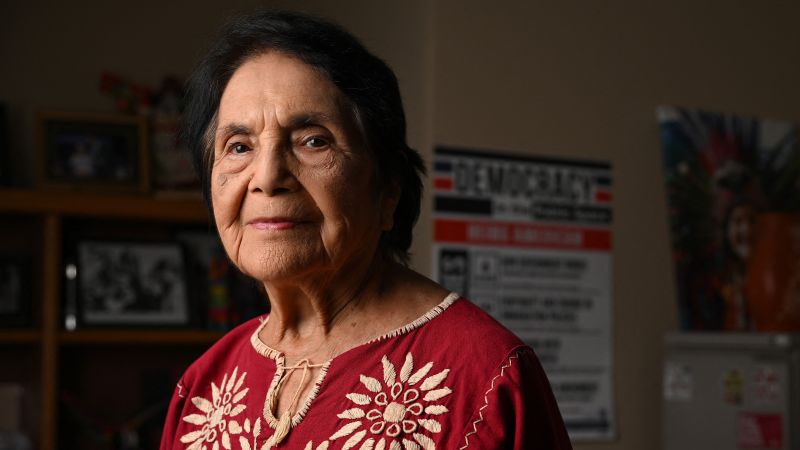
Dolores Huerta Dies at 96, Leaving a Lasting Legacy in Labor and Civil Rights
Qwenews.com – Dolores Huerta, whose organizing helped reshape the American labor movement and gave farm workers a powerful national voice, has died at age 96. Her family announced her death Wednesday and said plans for memorial events would be shared later.
“We are deeply saddened to announce that our beloved mother, Dolores Huerta, has passed away today.”
For decades, Huerta stood among the country’s most influential advocates for agricultural workers, civil rights and gender equity. She cofounded the United Farm Workers with Cesar Chavez during the 1960s, helping turn the struggles of low-paid laborers in California’s fields into a national cause.
Her family asked for privacy while mourning, while recognizing that people around the world would feel the loss of a leader whose work reached far beyond her own community.
“As you can imagine, this is an incredibly difficult time for us, and we ask for privacy as we grieve this incredible loss to our family. We know that many of you around the world share in our mourning, and we will be following up on plans to recognize and celebrate her incredible life and legacy.”
A movement built around farm workers
Huerta’s work with the United Farm Workers centered on the rights and dignity of people who harvested the nation’s food while often facing dangerous conditions, low pay and little power at work. Through boycotts, marches and organizing drives, the union pressed growers and public officials to recognize farm workers’ demands.
The United Farm Workers described continuing that mission as the strongest way to honor Huerta. The organization said her commitment to organizing never faded, even in the final years of her life.
“Our greatest monument to her memory is for the union she helped found to continue to grow. Dolores fought for farm workers to the very end of her life. The union she helped found will always continue that work.”
Huerta became especially associated with “Sí se puede,” the Spanish phrase meaning “Yes, we can.” The call became a defining expression of perseverance for labor activists and later reached a much wider political audience.
Tributes from across the country
In downtown Los Angeles, mourners gathered Wednesday beneath a mural of Huerta for a vigil marked by candles, roses and music. The mural, painted earlier this year by Robert Vargas, had been unveiled in Huerta’s presence near her 96th birthday.
Vargas recalled that Huerta was pleased with the portrait and said the meaning of her public life would endure.
“Legacy will always be hope.”
Political leaders, activists and entertainers also remembered Huerta as a person whose work changed public understanding of workers’ rights. Former President Barack Obama called her “a hero of mine” and highlighted her role in helping migrant laborers speak out against harsh working conditions. Obama awarded Huerta the Presidential Medal of Freedom in 2012.
He also noted that the widely recognized slogan associated with his own political career belonged first to Huerta.
“She also came up with a pretty good slogan, ‘Si, se puede’ — Yes, we can — that I too often get credit for. But as usual, Dolores got there first.”
California Gov. Gavin Newsom said he had intended to visit Huerta on the day she died. He described her as someone who represented the state at its best and whose work opened doors for future generations.
“California — and the United States — would not be what we are today without her resolute spirit, her passion for justice and fairness, and her commitment to those overlooked and forgotten.”
Illinois Gov. JB Pritzker called Huerta a fearless champion for working people. Rep. Joaquin Castro said she transformed the U.S. labor movement and improved the lives of countless people. Actor Danny Trejo wrote that her influence would not be forgotten and that her work would continue.
Speaking openly about abuse
Earlier in 2026, Huerta publicly described allegations of sexual abuse by Chavez. She said he raped her in 1966 in a secluded grape field in Delano, California, during the height of a United Farm Workers boycott. She also described an earlier 1960 incident during a work trip, saying Chavez pressured her into sex.
Huerta said she did not report the alleged assaults because she feared police hostility toward the movement and believed others in the union might not accept her account. She said she had carried the experience privately for many years.
“I have kept this secret long enough. My silence ends here.”
Her decision to speak publicly added another dimension to a life already defined by advocacy. It underscored the sexism and abuse women could face even while helping lead movements dedicated to justice and equality.
Huerta’s partnership with Chavez remains central to the history of the farm worker movement, but her own role was distinct and substantial. She organized communities, negotiated, mobilized voters and helped make labor rights a civil-rights issue with lasting national significance.
Her death closes a remarkable chapter in American activism. Yet the message she carried through strikes, boycotts and public campaigns remains closely tied to the people she spent her life defending: collective action can make change possible. Sí se puede.
Related Reading
Frequently Asked Questions
What is Dolores Huerta pioneering labor leader and civil?
Dolores Huerta pioneering labor leader and civil is the main topic of this guide. The article explains the context, practical details, and next steps readers should understand.
Why does Dolores Huerta pioneering labor leader and civil matter?
Dolores Huerta pioneering labor leader and civil matters because readers are looking for a useful answer, not just a short summary. Good content should match search intent and help them decide what to do next.