
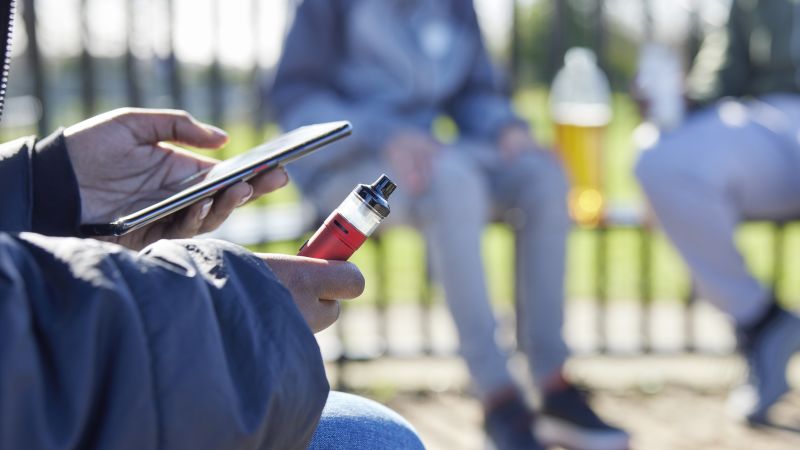
Early Social Media Exposure Tied to Increased Substance Experimentation in Teens
Qwenews.com – A new study published in The American Journal of Psychiatry suggests that adolescents who begin using social media at a younger age are more prone to experimenting with drugs and alcohol earlier than their peers. While most platforms set a minimum age of 13, nearly 40% of children aged 8 to 12 already engage with these platforms, raising concerns about their influence on substance use behaviors.
Patterns of Social Media Adoption and Substance Use
Researchers analyzed data from the Adolescent Brain Cognitive Development Study over four years, categorizing teens into four distinct groups based on their social media usage. These groups included: minimal or low use, gradual moderate increases, rapid mid-onset growth, and early-onset, rapid escalation. The early-onset group encompassed children who started using social media as early as age 9, while the mid-onset group began around age 11.
According to the study, adolescents in the increasing usage categories faced higher risks of substance experimentation. Those in the highest category, who spent three or more hours daily on social media, had nearly 17 times the chance of trying cannabis and 14 times the likelihood of experimenting with tobacco compared to peers with little to no use.
“Once you’re on social media platforms getting exposed to targeted marketing related to substances or just seeing social media posts that portray substance use in a positive light,” said Dr. Jason M. Nagata, lead author and associate professor at the University of California, San Francisco. “They’re all reasons why adolescents may be more likely to experiment with substances.”
Nagata emphasized how content on social media shapes perceptions. Over 50% of adolescents reported encountering alcohol marketing online, with nearly 61% of their peers sharing alcohol-related posts. The study also found that more than 77% of substance-focused content was framed positively, often showcasing young adults having fun or ads highlighting the appeal of products like liquor.
Dr. Courtney Blackwell, a medical social sciences professor at Northwestern University’s Feinberg School of Medicine, highlighted the study’s strength in using longitudinal data to track changes in usage patterns. “Instead of just using an average time use for social media,” she explained, “what they were able to do is look across four years and ask, ‘How did this child change in their social media use?’ and map that to create different groups of kids.”
Blackwell noted that such data is rare in the broader research on social media’s impact. “People are less likely to post the adverse consequences that have happened,” Nagata added, “so I think they may be getting a bias in what they’re seeing.” This skewed exposure could foster favorable views of substances, with positive content correlating to higher experimentation rates among teens.
Additional findings revealed that substance-related content on platforms like Facebook and Instagram in Australia saw nearly 40,000 alcohol ads annually, many featuring interactive elements such as “Buy Now” buttons. These ads, along with the overall tone of social media, may contribute to the normalization of substance use among young audiences.