
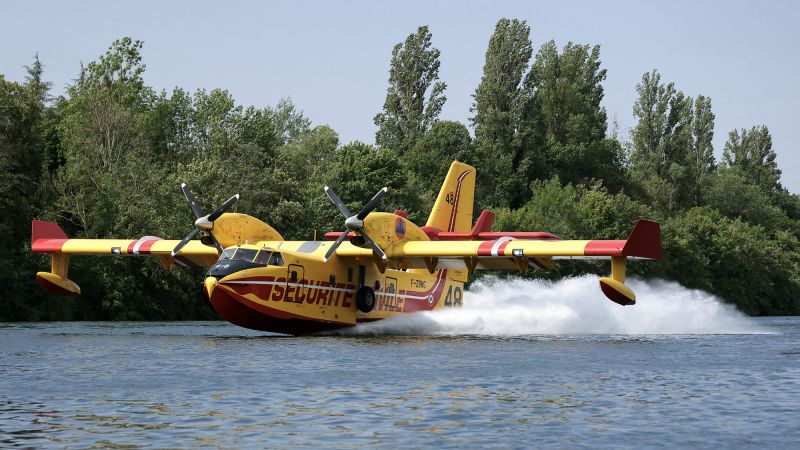
Aerial Water Extraction Combats Wildfire Near Paris Amid Europe’s Heatwave Crisis
Qwenews.com – French firefighters are working to contain a massive wildfire in the Fontainebleau forest, situated just south of Paris, as a relentless heatwave spreads across Europe. To combat the blaze, fire-fighting aircraft are drawing water from the River Seine, according to BFMTV, which reported that over 3 square miles of the forest have been scorched. The situation has prompted concerns about the fire’s origin, with French Interior Minister Laurent Nuñez stating that police are investigating whether it was deliberately set.
Wildfires Intensify Due to Climate Crisis
While wildfires are common in Europe, the climate crisis is amplifying their frequency and severity. Hotter, drier weather conditions, exacerbated by three consecutive heatwaves, have turned vegetation into highly flammable material, leading to a sharp rise in large-scale fires. Data from the European Forest Fire Information System highlights this trend, noting a surge in fires fueled by temperatures reaching the high-30s Celsius.
Laurent Nuñez also mentioned that other wildfires have erupted across France, underscoring the broader challenge posed by the heatwave. “Diseases like malaria and dengue, traditionally confined to tropical zones, are now emerging in temperate and urban areas,” the authors said,
as cited in a recent Italian study
. The study found that the risk of dengue fever outbreaks in Europe increased by 56% between 2013 and 2022 compared to the 1951–1960 period.
Heatwave Toll on Health and Infrastructure
France’s health authorities reported over 2,000 heat-related deaths during the final week of June, a 29% rise from the previous week. This followed the nation’s record-breaking hottest day ever, recorded on June 24, with Stéphanie Rist, the Health Minister, noting a “clear increase” in fatalities among those aged over 45. The EU’s Copernicus Climate Change Service emphasizes that Europe is warming more than twice as fast as the global average, suggesting such trends will persist.
Spain’s southern region saw a tragic fire that claimed 13 lives last week, leaving 10 people missing. Over 460 emergency workers were deployed to tackle the blaze near Los Gallardos on the Costa de Almería, Spanish Interior Minister Fernando Grande-Marlaska stated on Friday. This incident has surpassed the 2005 fire in Guadalajara, which killed 11 firefighters, making it Spain’s deadliest wildfire since 2005. Spain’s national weather service, AEMET, noted that last month’s temperatures reached 12.8 degrees Fahrenheit (7.1 Celsius) above average in some areas.
In England and Wales, the national meteorological office reported that more than 2,700 people died from heat-related causes during May and June heatwaves. Germany also faced a spike in drownings, with at least 99 fatalities in June—the highest monthly toll since 2003. Beyond immediate dangers, the heatwave is disrupting critical systems, such as France’s nuclear plants, which rely on river water for cooling. EDF announced reduced output at the Nogent nuclear plant on the Seine, and another reactor on the Garonne river suspended operations as water temperatures hit 28 degrees Celsius (82 degrees Fahrenheit).
Climate Shifts Reshape Agricultural and Economic Prospects
The extreme heat has significantly impacted crop forecasts, especially for corn (maize). European grain trade association Coceral revised its EU and UK corn output projection to 52.7 million tons, down from 57.2 million last month. France’s corn harvest, expected to fall below 10 million tons, marks the lowest yield in two decades. Similar reductions have been seen in barley and wheat production across Europe.
As the climate continues to shift, the implications extend far beyond wildfires. The heatwave’s effects are reshaping Europe’s agricultural landscape and intensifying health and environmental risks, with consequences likely to deepen in the coming years. CNN’s Lisa Courbebaisse, Elina Baudier Kim, and Tim Lister contributed to this report.