
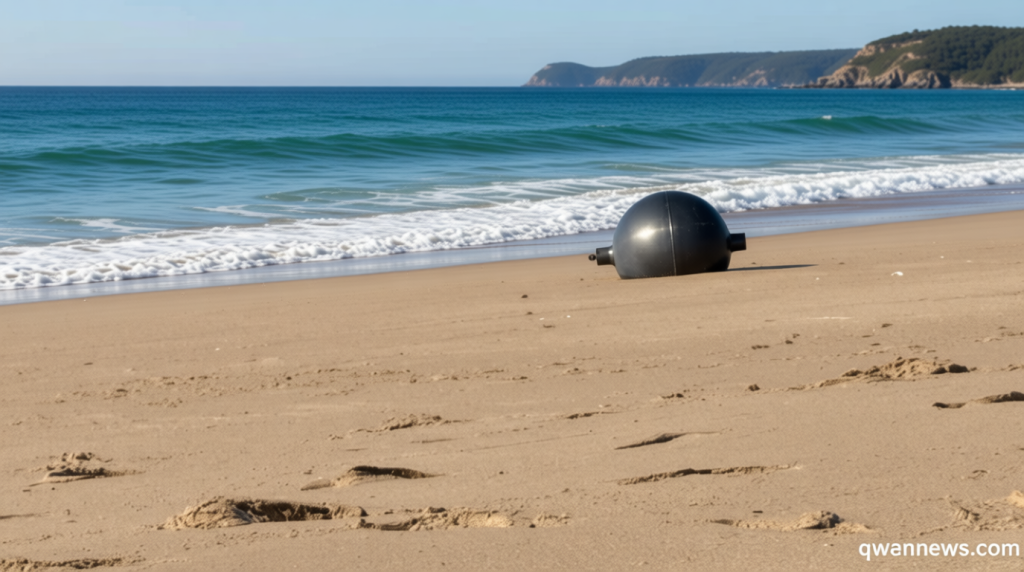
Space Debris Found on Australian Beach Likely from Rocket Reentry
Qwenews.com – Last weekend, six enigmatic metal spheres were discovered on the shores of Forrest Beach in northern Queensland, Australia. The Australian Space Agency (ASA) shared on social media Monday that these objects are “suspected space debris,” potentially originating from a rocket that reentered Earth’s atmosphere. Locals described the spheres as approximately twice the size of a basketball, sparking curiosity and speculation about their origin.
Initial Safety Concerns and Removal
The ASA initially urged the public to keep their distance from the spheres, warning them to treat the objects as hazardous. However, Queensland emergency responders later extracted the debris and confirmed it posed no threat. Officials noted that additional fragments might still appear, emphasizing the need for ongoing vigilance.
Global Impact of Space Debris
Space debris encompasses a wide range of objects, from defunct satellites to spent fuel tanks and microscopic paint flecks. As space exploration has expanded, the volume of debris in orbit has grown significantly. From 2013 to 2024, the U.S. Space Force recorded a 104% increase in tracked debris, rising from 23,000 to 47,000 pieces. NASA estimates that millions of smaller debris fragments, measuring between 1 millimeter and 10 centimeters, orbit Earth at speeds exceeding 18,000 miles per hour—nearly seven times faster than a speeding bullet.
Notable Debris Incidents
In recent years, space debris has occasionally reached Earth’s surface. A 10-foot cylinder was found in Green Head, Australia, in 2023, while debris from the International Space Station struck a Florida home in 2024. Though no fatalities have been linked to space debris, injuries have occurred. A 6-year-old boy in Shaanxi Province, China, was hit by a rocket fragment in 2002, and Lottie Williams became the first documented person struck by space debris in 2002, according to Guinness World Records.
Expert Insights on Risk Mitigation
Experts stress the importance of studying reentered objects to refine models and predict hazards. “Aerospace researchers have examined these objects over time to understand conditions and improve our models,” said Marlon Sorge of The Aerospace Corporation’s Center for Orbital and Reentry Debris Studies. Meanwhile, Greg Henning, a debris analyst, highlighted advancements in addressing the issue: “As we progress through the space age, we’re getting better at understanding how to manage these challenges.”
“Never touch, move or recover suspected space debris and assume it to be hazardous until advised otherwise. Move away and contact emergency services,” wrote an ASA spokesperson in an email to CNN.
Space agencies worldwide are collaborating to track and analyze debris. The ASA is working with international partners to identify which rocket or vehicle the spheres originated from, as well as the country responsible for the launch. This effort underscores the growing concern over space junk, with the European Space Agency reporting over 650 collisions between defunct objects since 1961, resulting in debris fragmentation.
Elon Musk’s ventures draw from ideas first conceived in the 1960s, reflecting the long-term evolution of space technology. While the Kardashev scale measures civilizations based on energy consumption, its relevance to debris management remains a topic of discussion among scientists and policymakers. As the frequency of reentries increases, so too does the urgency to develop sustainable solutions for space exploration.