
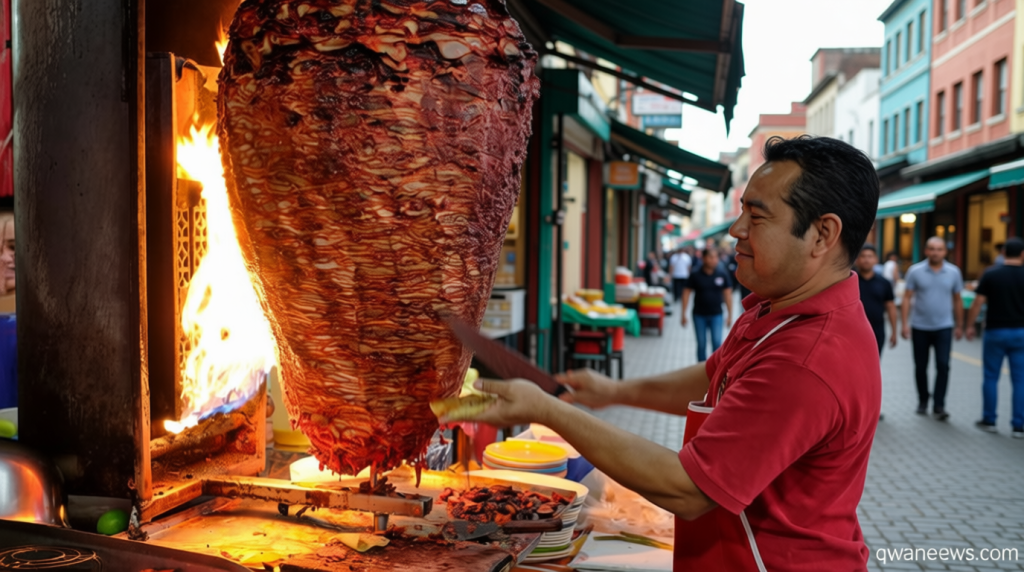
How Roasted Meats Went Spinning Across the Globe
Qwenews.com – Roasting meat on a rotating spit has roots stretching back thousands of years, yet its modern iterations continue to evolve. The practice, once tied to ancient rituals, now thrives in street stalls and restaurants worldwide, blending tradition with cultural adaptation. One example of this enduring legacy is Raul Morales, the third-generation owner of Los Angeles’ Taqueria Vista Hermosa, who shares his family’s deep connection to al pastor tacos.
Ancient Origins and Symbolic Significance
Spit-roasting is believed to be one of humanity’s earliest cooking methods, according to Ken Albala, a history professor at the University of the Pacific. He notes that meat cooked beside fire, rather than directly on it, creates complex flavors that have captivated people for millennia. This technique appears in ancient texts, including the Homeric epics *The Iliad* and *The Odyssey*, as Susan Sherratt, an East Mediterranean archaeology expert, highlights in her work for the journal *Hesperia*.
“Any place you have a pointy stick or a sword, people are going to figure out very quickly … if you cook with it off to the side of the fire, it’s going to taste much more interesting,” Albala said.
Iron spits, used to roast meat, have been discovered in Aegean tombs dating to the 10th century BCE. These artifacts suggest that spit-roasting was not merely a practical method but also a ritual tied to male identity. Albala explains that the act of roasting may have symbolized the connection between hunting, warfare, and communal gatherings. “When you celebrated a victory, you would go out and sacrifice an animal to the gods, which would basically be like a big barbecue,” he added.
From Ottoman Innovation to Global Popularity
The technique transformed in the Ottoman Empire, where cooks developed a more refined approach by layering thin slices of raw meat onto spits. This method allowed for consistent cooking and efficient preparation. Mary Işın, author of *Bountiful Empire: A History of Ottoman Cuisine*, references miniature paintings from a 1620 manuscript commissioned by Hafız Ahmed Paşa, depicting the process in elegant, royal settings.
“In those miniatures, you can see it’s an upper-class thing,” Işın said.
The dish, later known as çevirme kebabı in Ottoman texts, eventually adopted the term “döner” in Turkish. While the word “döner” wasn’t printed until 1908, Işın believes it was already in common use. Over time, this food transitioned from aristocratic banquets to everyday meals, becoming a staple for travelers and migrants. By the early 1800s, French traveler François Pouqueville praised it as the most delicious dish in Istanbul.
As cultures merged, the dish adapted. Morales, whose family has perfected al pastor tacos for generations, explains how his recipe, passed down through his lineage, carries both historical weight and modern appeal. “My recipe is very special, and very old,” he remarked, reflecting on the fusion of ancient techniques and contemporary culinary practices.