
Fact Check: Trump Repeatedly Promised No New Wars, Despite Claims
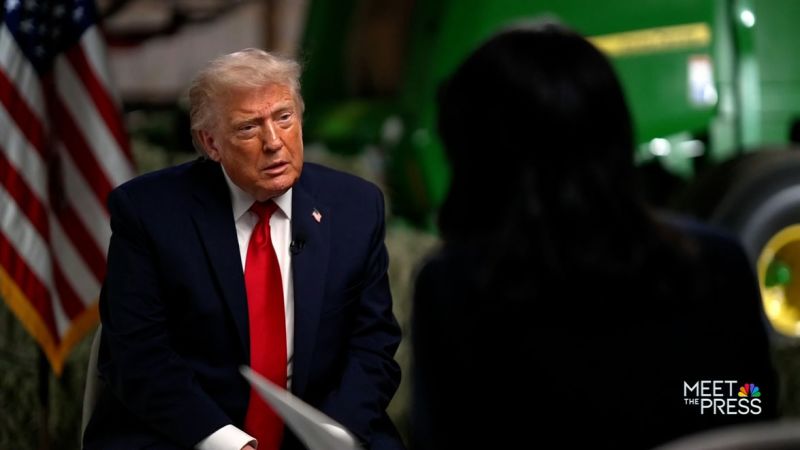
Qwenews.com – Fact check: During a June 2024 interview on NBC’s “Meet the Press,” Donald Trump faced scrutiny over his stance on military engagement. When asked about his pledge to avoid new wars, he asserted,
“First of all, I didn’t guarantee no war.”
This statement contradicted his own campaign promises, which had repeatedly emphasized a commitment to peace. The conversation highlighted the growing tension between Trump’s public assurances and his recent comments, raising questions about the consistency of his war-related messaging.
Trump’s Campaign Rhetoric on Peace
Throughout the 2024 election, Trump consistently framed his candidacy as a path to stability and reduced conflict. In a June 2024 social media post, he claimed,
“We are choosing between peace and prosperity or war and no war.”
This language was echoed in his July 2024 speech at the Republican National Convention, where he declared,
“With our victory in November, the years of war, weakness, and chaos will be over. I don’t have wars.”
Such statements were designed to appeal to voters concerned about ongoing global conflicts, particularly in regions like the Middle East and Ukraine.
Trump’s pledge was further reinforced during an August 2024 rally in Pennsylvania, where he stated,
“Under Trump, we will have no more wars, no more disruptions, and we will have prosperity and peace for all.”
This message was repeated multiple times across swing states, often paired with references to Viktor Orbán, the Hungarian leader, who had publicly endorsed Trump’s commitment to peace. Orbán’s remarks, such as
“Make sure that Trump gets re-elected president and you’re not going to have any more wars,”
became a recurring theme in Trump’s campaign, linking him to a broader narrative of anti-war leadership.
Contradictions in Trump’s Statements
Despite his campaign’s emphasis on avoiding wars, Trump’s statements during the June 2024 NBC interview revealed a key inconsistency. When pressed on his earlier promises, he claimed,
“So when you say I promised – I didn’t promise anything.”
This deflection ignored the numerous instances where he had explicitly stated his intent to prevent further military conflicts. For example, in a Madison Square Garden rally in October 2024, he alternated between saying,
“We’re not going to go to war with me as your president,”
and acknowledging,
“It’s always a possibility.”
These variations suggest a strategic approach to messaging, where Trump tailored his language to different audiences while maintaining the core promise of peace.
Trump’s November 2024 victory speech added another layer of complexity. While celebrating his win, he noted,
“Four years, we had no wars, except we defeated ISIS. … They said, ‘He will start a war.’ I’m not going to start a war, I’m going to stop wars.”
This line was both a rebuttal to critics and a reinforcement of his anti-war stance. However, the fact check reveals that his campaign had previously made repeated assertions about avoiding new wars, contradicting his claim of having “not promised anything.” The key issue lies in the interpretation of his words: while he denied a specific guarantee, his rhetoric consistently painted a picture of commitment to peace.
Fact Check: Trump’s Repeated Commitments
A detailed fact check of Trump’s statements shows that he made multiple promises to avoid new wars during the 2024 campaign. In June 2024, he told a reporter,
“We won’t have wars again.”
This sentiment was reinforced at an August 2024 rally in Wisconsin, where he declared,
“Viktor Orbán said, ‘If Trump comes back, you won’t have any wars. You won’t have any wars.’”
These statements, though sometimes repeated with slight variations, collectively formed a narrative of Trump as a leader who would end the “endless wars” of the previous administration.
The fact check also highlights the strategic use of his campaign’s messaging. While Trump denied making a specific promise to avoid new wars, he frequently tied his re-election to a vision of peace and stability. His comments on NBC underscored this contradiction: he claimed to have not guaranteed peace, yet his campaign had repeatedly framed his platform around ending conflicts. This pattern suggests that Trump’s rhetoric on war was not just a campaign slogan but a central element of his political strategy, despite the ambiguity in his exact wording.
Impact of the Fact Check on Public Perception
The ongoing fact check of Trump’s war-related statements has sparked debates about the accuracy of his campaign promises. Critics argue that his repeated emphasis on “no new wars” was a deliberate attempt to connect with voters weary of prolonged military engagements. However, Trump’s June 2024 remarks on NBC challenge that interpretation, as he claimed to have not made such a guarantee. This discrepancy has fueled discussions about the intent behind his words and whether his campaign’s messaging was a consistent promise or a flexible strategy.
Fact check analyses indicate that Trump’s statements, while sometimes vague, were grounded in specific commitments. For example, his campaign had repeatedly linked his policies to ending wars, particularly in the context of the Middle East and NATO alliances. Even as he denied a direct promise, the cumulative effect of his rhetoric created an impression of dedication to peace. This underscores the importance of context in political messaging: a single statement may not capture the full picture of a candidate’s commitments.