
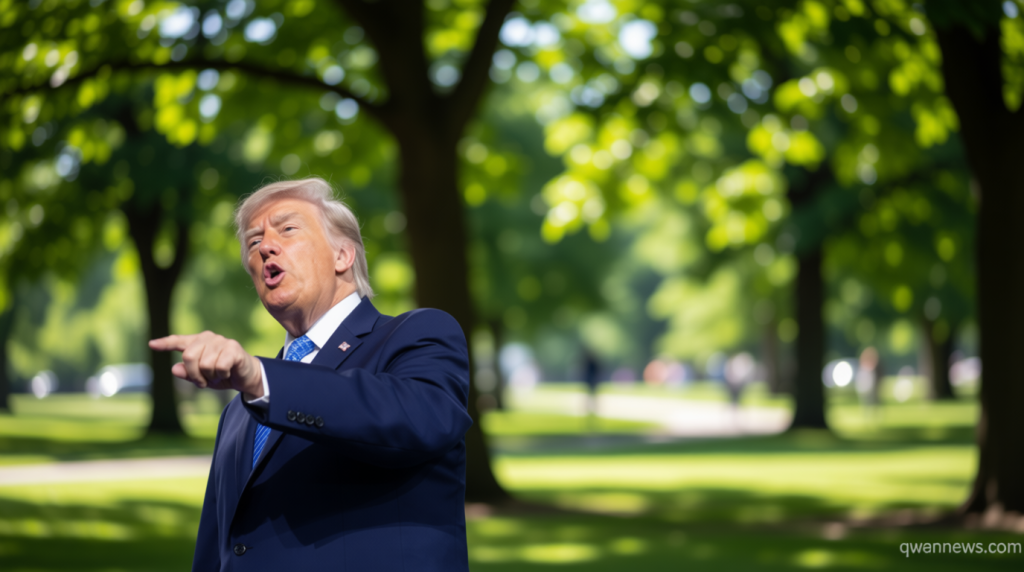
Trump Intensifies Attacks on Democrats as ‘Godless Communists’ Ahead of Midterms
Qwenews.com – President Donald Trump has intensified his campaign of criticism against the Democratic Party, labeling its members as “godless Communists” in an effort to sway voters ahead of the November midterm elections. This strategy comes as progressive candidates gain traction in key races, prompting Trump to frame the Democratic platform as a threat to American values and institutions. His recent remarks emphasize a shift toward ideological polarization, positioning the party as a radical force that challenges traditional beliefs and the country’s economic system.
Democrats Move Left, Sparking Trump’s Rhetorical Campaign
The Democratic Party’s embrace of progressive policies has become a focal point for Trump’s rhetoric. During a recent speech to conservative allies, he declared that Democrats are “taking over” with “godless Communists,” a term he has repeatedly used to describe their growing influence. This narrative is supported by the election of democratic socialist candidates in historically safe districts, such as in New York, where voters recently endorsed a socialist mayor. These developments signal a significant realignment within the party, as more members advocate for transformative social and economic reforms.
“The Democratic Party is now a far-left movement that’s abandoning America’s founding principles,” Trump wrote in a Truth Social post, further amplifying his message during a rally for social conservatives. “They’re not just liberals—they’re communists who want to destroy our freedoms!”
Trump’s attacks on Democrats are not limited to the political arena. He has also targeted the party’s social policies, arguing that they promote secularism and weaken religious institutions. This includes his claims that Democrats seek to “erase” Christianity by closing churches and supporting abortion rights. Such arguments resonate with his base, who view these policies as a direct challenge to traditional values. However, critics argue that Trump’s rhetoric is designed to mislead rather than inform, using hyperbolic language to paint Democrats as ideological extremists.
Democratic Socialism vs. Communism: A Growing Divide
While Trump equates democratic socialism with communism, the two ideologies differ significantly. Democratic socialism seeks to reform capitalism through progressive taxation and public services, such as universal healthcare and free education, without dismantling private enterprise. In contrast, communism envisions a classless society where the government controls all resources. Trump’s confusion between the two has fueled debates about the true nature of the Democratic Party’s platform and its alignment with global communist movements.
“They’re not just socialists—they’re communists in disguise,” Trump asserted during a televised debate, drawing on his base’s fears of economic collapse and cultural change. “If we don’t stop them, our country will become a socialist state ruled by godless ideology.”
Democratic leaders have defended their policies, highlighting the benefits of social welfare programs and climate action. However, Trump’s framing of Democrats as communist threats has overshadowed these discussions, creating a climate of fear among some voters. His approach mirrors that of his 2016 campaign, where he used similar rhetoric to differentiate himself from his opponents. Yet, this time, the focus is on a perceived ideological shift within the party itself.
Midterm Implications and Voter Sentiment
As the midterms approach, Trump’s attacks on Democrats may influence voter behavior in critical battleground states. Polls suggest that his messaging is effective in rallying conservative support, particularly among older and religious voters. However, the effectiveness of his strategy depends on whether the public perceives Democrats as genuine threats or as overreaching in their progressive agenda. This divide is likely to play a central role in shaping the election’s outcome.
“The Democratic Party is leading us toward socialism, and socialism is leading us to communism,” Trump claimed, using his rallies to stress the urgency of his message. “If we let them win, our country will be lost.”
Meanwhile, Democratic strategists are working to counteract Trump’s narrative by emphasizing their commitment to American values and economic growth. They argue that the party’s policies are a response to rising inequality and corporate influence, not a rejection of freedom. The challenge lies in balancing these messages with Trump’s charged rhetoric without appearing to compromise their core principles. This battle for public perception is expected to intensify as both parties mobilize their bases in the final stretch of the campaign.
Trump’s strategy also reflects a broader effort to position himself as the sole defender of traditional American values. By accusing Democrats of being communist sympathizers, he taps into historical anxieties about foreign influence and economic collapse. This tactic aligns with his previous efforts to frame opponents as either unpatriotic or part of a global plot against the United States. Despite the exaggeration, the fear of a communist takeover resonates with many voters, particularly in rural and suburban areas where Democratic gains are seen as a threat to local governance.
“This isn’t just about policy—it’s about the soul of our nation,” Trump declared, drawing on his supporters’ concerns about cultural erosion and economic instability. “If we don’t act now, our children will inherit a communist state.”
With the midterms fast approaching, Trump’s rhetoric is expected to shape the political landscape in the weeks ahead. The impact of his attacks on Democrats will depend on how effectively they can counter the narrative while maintaining their progressive stance. As the election draws near, the battle for ideological dominance is likely to dominate headlines and determine the course of American politics for years to come.