
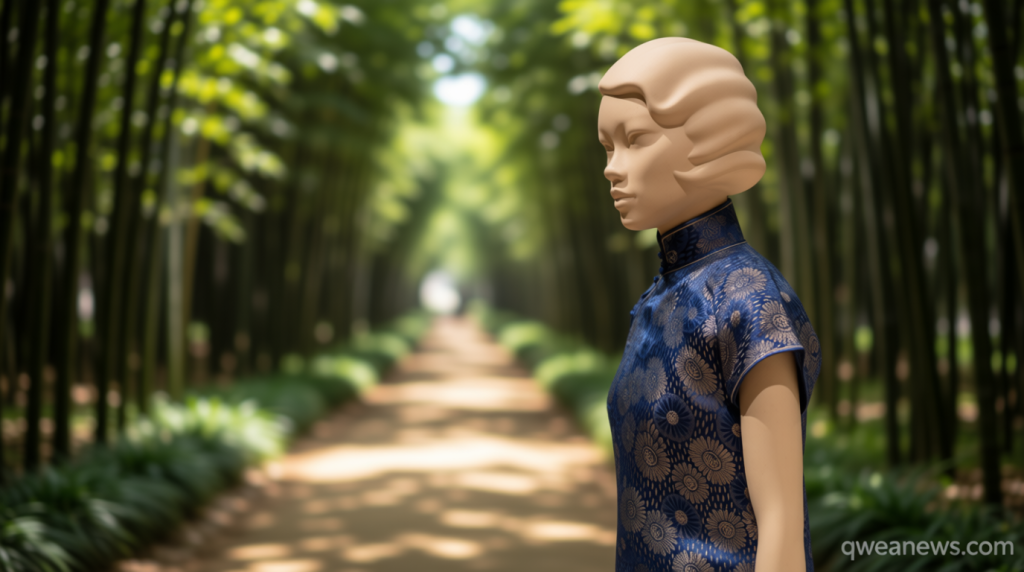
Rare Chinese Cheongsam Collection Explores Cultural Fusion in 20th-Century America
The Evolution of a Hybrid Style
Qwenews.com – A rare collection of Chinese cheongsams offers a compelling narrative of cultural adaptation and personal expression during the 20th century. Susan Mah, a pioneering Chinese American woman from Fresno, California, became a symbol of this blend as she transformed traditional garments into unique pieces that reflected both her heritage and the vibrant influences of her new home. While her early designs were rooted in the classic cheongsam silhouette, her creative experimentation introduced bold American elements, from vivid color palettes to playful patterns, creating a visual dialogue between East and West. This collection of Chinese cheongsams not only highlights her artistry but also serves as a testament to how immigrant communities navigate identity through fashion.
Though Susan initially sourced her cheongsam expertise from Shanghai and Hong Kong tailors, her innovation led her to reinterpret the design with a distinctly American flair. She chose lime green fabric, inspired by Mayan aesthetics, and incorporated whimsical motifs such as clowns and roses—elements that diverged from the traditional Chinese symbols often seen in the garment’s original forms. This creative shift underscores how the collection of Chinese cheongsams became more than just clothing; it evolved into a canvas for cultural storytelling, capturing the spirit of a woman who embraced her roots while redefining them in a new context.
A Legacy Preserved at LACMA
In 2022, Susan’s wardrobe was donated to the Los Angeles County Museum of Art (LACMA), where it now forms the centerpiece of the exhibition “Fashioning Chinese Women: Empire to Modernity.” The collection of Chinese cheongsams, comprising over 70 pieces, includes not only Susan’s own creations but also garments from her mother, Li Zhang Huifang, and other early 20th-century Chinese women in America. These items collectively trace the evolution of Chinese women’s fashion, bridging the gap between traditional attire and the modern styles that emerged in the United States.
“The collection documents a period of immense change for women, both socially and culturally,” said guest curator Michaela Hansen. “It captures the duality of maintaining heritage while embracing new identities in a foreign land.”
Curator Michaela Hansen emphasized that the exhibition’s focus on the collection of Chinese cheongsams fills a critical void in fashion history. While many displays highlight Qing dynasty court attire or Western interpretations of Chinese design, this exhibit centers on the lived experiences of everyday Chinese women. The garments reflect their agency in shaping style, from the modest dresses of the 1930s to the more liberated silhouettes of the 1950s, illustrating how personal and cultural narratives intertwined in the American setting.
Stories Woven in Fabric
The collection of Chinese cheongsams is more than a display of clothing—it’s a repository of personal and cultural stories. Susan’s daughter-in-law, Chere Lai Mah, recalled how her mother-in-law used sewing as a way to connect with her past while asserting her place in a new society. One of the earliest pieces in the collection, a turquoise cheongsam with gold embroidery, was given to Lai Mah in 1971 and later inspired her sculptural work. This connection between Susan’s garments and Lai Mah’s artistry highlights how the collection of Chinese cheongsams transcends time, influencing generations through its aesthetic and symbolic power.
Some of the cheongsams in the collection were worn by Susan in her daily life, while others were created for special occasions. The use of vibrant prints and modern cuts reflects her ability to balance tradition with innovation. Lai Mah noted that these garments, though rooted in Chinese heritage, carried a distinct American character, capturing the spirit of a woman who sought to express herself through fashion. The exhibition’s focus on the collection of Chinese cheongsams invites viewers to appreciate the nuanced ways in which cultural identity is reimagined in new environments.
Visitors to the exhibition have praised the collection of Chinese cheongsams for its ability to spark conversations about cultural exchange and personal agency. The garments, with their mix of traditional elements and Western inspiration, have become a focal point for discussions about the role of fashion in shaping identity. As the display continues to draw attention, it reinforces the idea that the collection of Chinese cheongsams is not just a historical artifact but a living testament to the resilience and creativity of Chinese women in America.
Through the lens of Susan Mah’s collection of Chinese cheongsams, LACMA’s exhibit provides a rare opportunity to explore the intersection of cultural heritage and modernity. The garments, preserved in the Bay Area’s climate, offer a tangible link to the past, while their design elements speak to the present. As the collection of Chinese cheongsams continues to be showcased, it inspires a deeper understanding of how fashion can serve as both a personal statement and a cultural bridge, connecting generations and continents through shared creativity.