
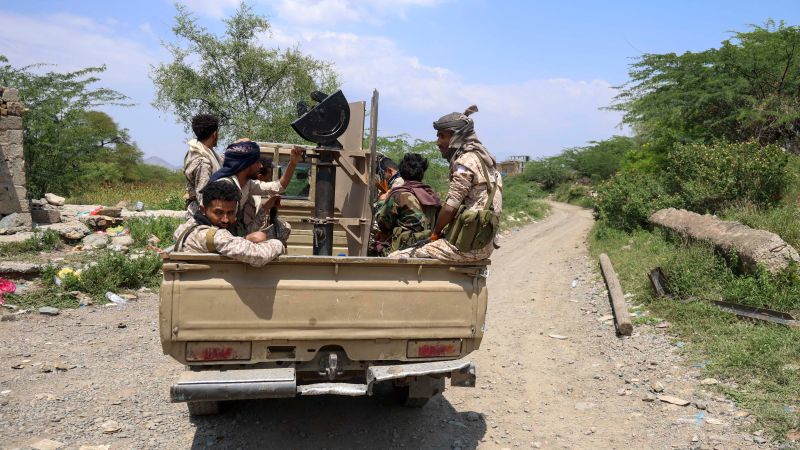
Yemen’s Saudi-Backed Government Begins Offensive Against Houthis
Qwenews.com – Yemen’s Saudi-backed government has announced a major military offensive against the Iran-backed Houthi movement after the group made rapid gains along the country’s Red Sea coast. The campaign could intensify a conflict that has displaced civilians, worsened hunger and threatened a vital international shipping route.
Rashad al-Alimi, head of Yemen’s presidential council, said in a televised address that the operation aims to recover Houthi-held territory and restore state authority across the country. The announcement followed weeks of escalating military activity by both sides.
Government cites Houthi attacks and mobilization
Al-Alimi said the decision was driven by continued Houthi mobilization, attacks and threats against civilians, facilities, neighboring countries and international shipping lanes. Military spokesperson Majid Al-Nuzaili called the operation a “battle for liberation” and said government forces intend to restore state institutions in areas still controlled by the Houthis.
“The Houthi militias’ continued mobilization, escalation and attacks, as well as their threats against civilians, facilities, neighboring countries, and international shipping lanes.”
Yemen’s Saudi-backed government has said it will seek to protect civilians as the offensive proceeds. Al-Nuzaili also urged Houthi-aligned fighters to lay down their weapons and return home, as concerns grow about the impact of renewed fighting on communities near front lines.
Saudi strikes and Houthi claims
The Houthis said Saudi airstrikes struck the capital, Sanaa, on Saturday and again early Sunday. The Saudi-led coalition did not publicly confirm the reported attacks.
After claiming that Sanaa and other locations had been hit more than 50 times, the Houthi movement said it targeted Saudi energy infrastructure. Its military statement said two Aramco sites were struck, one in Riyadh and another in the Khurais area, and alleged that substantial fires followed. Saudi authorities had not commented on the claims.
“The first targeted Aramco company in the Saudi capital, Riyadh, and the second targeted Aramco company in the Khurais area.”
The Houthis have launched ballistic missiles and drones toward locations in Saudi Arabia since late July, including industrial and energy-related targets. Saudi Arabia has supported government forces for more than a decade, while the Houthis have maintained pressure inside Yemen and across the border.
Red Sea coast raises shipping concerns
The latest confrontation comes after a fast Houthi operation last month along Yemen’s Red Sea coast. The group captured a strategically important port and pushed its control southward toward the Bab al Mandeb waterway.
Bab al Mandeb links the Red Sea to the Gulf of Aden and routes leading to the Indian Ocean. The narrow passage is a major maritime chokepoint for commercial goods and energy supplies moving between Asia, Europe and other markets.
In early September, the Houthis seized coastline extending toward Bab al Mandeb and said Saudi vessels trying to pass through the strait would be targeted. Yemen’s Saudi-backed government is seeking to prevent further territorial gains that could affect ports, aid access, coastal roads and shipping security.
Fighting around Taiz and al-Jawf
Recent fighting has centered in part on Taiz in southern Yemen. Houthi forces have sought to isolate government troops in the regional capital, Yemen’s third-largest city, which is home to several hundred thousand people and thousands of government soldiers.
The broader offensive may also affect other contested areas, including al-Jawf. Control of these locations remains significant to both sides as they compete for military influence and access across the country.
FAQ: Yemen’s Saudi-Backed Government Offensive
Why has the government announced an offensive now?
The government says the operation responds to Houthi mobilization, attacks and recent territorial advances, particularly along the Red Sea coast.
Why is Bab al Mandeb important?
The strait is a key passage between the Red Sea and Gulf of Aden. Disruption there can affect commercial shipping, energy transport and maritime security.
What could the offensive mean for civilians?
Expanded fighting could place more civilians at risk and further complicate the delivery of food, aid and other essential supplies in areas affected by conflict.