
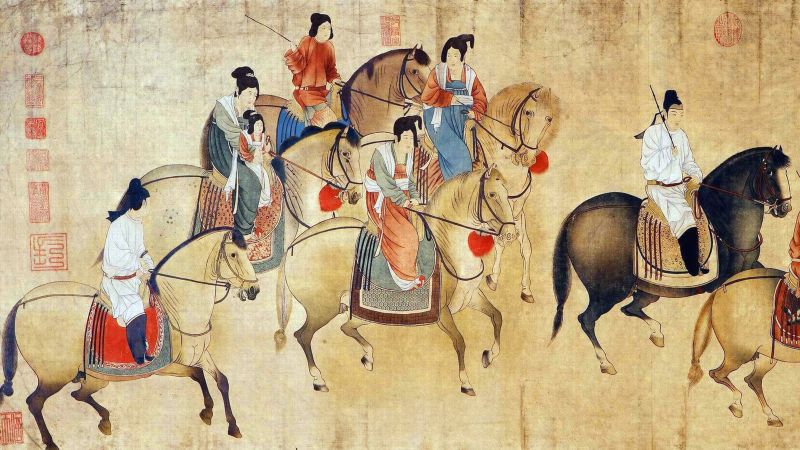
A Viral Denial of China’s Tang Dynasty Sparks National Alarm
Qwenews.com – Across China’s sprawling digital landscape, a peculiar phenomenon has taken hold: a loud minority of netizens is insisting that the Tang dynasty — the empire that governed the country from 618 to 907 AD — simply never existed. For three centuries, that era produced sweeping territorial gains, a surge in cross-border commerce, and a cultural flowering admired well beyond the Middle Kingdom’s borders. Schoolchildren memorize its story from an early age, and state television regularly airs dramas built around its courtly rivalries. To declare that entire span of history a fabrication would be comparable to telling Americans the Civil War was invented, or informing a British reader that the Magna Carta is pure fiction.
How the Claim Took Root
The episode traces back to May, when a history-focused content creator called Qiao Yu released a video deploying what he presented as astrological evidence to “prove” the Tang had never been real. The outlandish assertion quickly escaped its original niche. By later months, callers were reportedly phoning the Xi’an tourism bureau — Xi’an being the seat of the ancient Tang capital — to demand the office shut down because, they argued, the dynasty itself had been exposed as a sham. On Weibo, China’s X-equivalent, the tagline “the Tang dynasty doesn’t exist” has racked up tens of millions of views.
Why the Hoax Gained Traction
Pinpointing the exact fuel behind the spread proves difficult. One thread runs through older nationalist grievances: the Tang’s founding emperor did not belong to the Han ethnic group that constitutes the majority of China’s population. Qiao Yu’s specific argument holds that the successor Song dynasty actually commenced far earlier than conventional chronology allows, thereby erasing the Tang from the record entirely. The Song, by contrast, was of Han ethnic origin.
William Kirby, a professor of China studies at Harvard University, dismissed the thesis bluntly:
“This is basically insane,” he said, adding that there are facts in history and “the Tang dynasty is definitely one of them.” “It was much more than a Chinese dynasty. It was an inner Asian dynasty as well,” he said.
State Media Steps In
As the falsehood proliferated, China’s heavily managed state press corps entered the fray. The Nanjing Daily reported last month that numerous parents complained their children had grown bewildered about basic historical facts because of the online uproar. Three days afterward, The Paper — an outlet linked to the Shanghai municipal government — struck a sharper tone in a commentary:
“Only when rational- inquiry becomes the foundation of public life will historical nihilism truly lose the conditions that allow it to flourish,” it declared.
“Historical nihilism” is a label the ruling Communist Party coined to describe any inquiry or debate that contests its sanctioned narrative of China’s five-millennium arc. The Party itself is a comparatively recent chapter in that story, having seized power in 1949 after a decades-long civil war that shattered the nation.
The Party’s Own Warning
By mid-August, the controversy had drawn the attention of the Party’s flagship newspaper. In an editorial, the People’s Daily branded the claim “absurd” and issued a pointed admonition:
“Once young people begin to doubt our national history, our cultural confidence will become like water without a source or a tree without roots, and Chinese-style modernization will lose its profound historical perspective.”
In recent years, President Xi Jinping has tightened the Party’s command over historical narrative and pushed for stiffer penalties against anyone who challenges the official account. Xi himself has invoked Tang-era splendor on the world stage. In 2023 he received delegations from several Central Asian states in Xi’an — the old Tang capital and the eastern terminus of the Silk Road, along which goods and ideas once traveled between China and Europe. The state banquet featured dancers and performers clad in Tang-style garments, an unmistakable allusion to the era when foreign envoys came to pay homage at the emperor’s court.
History as a Mirror
For roughly a millennium, Chinese writers and thinkers have turned to the past as a creative lens for critiquing or interrogating the present. During the consumer-boom years of the early 2010s, amid mounting criticism of materialism and bourgeois lifestyle aspirations, the suffering endured under Japan’s brutal wartime occupation became a favored subject among intellectuals, according to Rana Mitter, a Harvard Kennedy School historian specializing in modern China. Yet that same tradition of historical reflection also permitted some voices to draw uncomfortable parallels between past and present — a freedom that the current tightening of narrative control now seeks to narrow.
Related Reading
Frequently Asked Questions
What is Why is one corner of China?
Why is one corner of China is the main topic of this guide. The article explains the context, practical details, and next steps readers should understand.
Why does Why is one corner of China matter?
Why is one corner of China matters because readers are looking for a useful answer, not just a short summary. Good content should match search intent and help them decide what to do next.